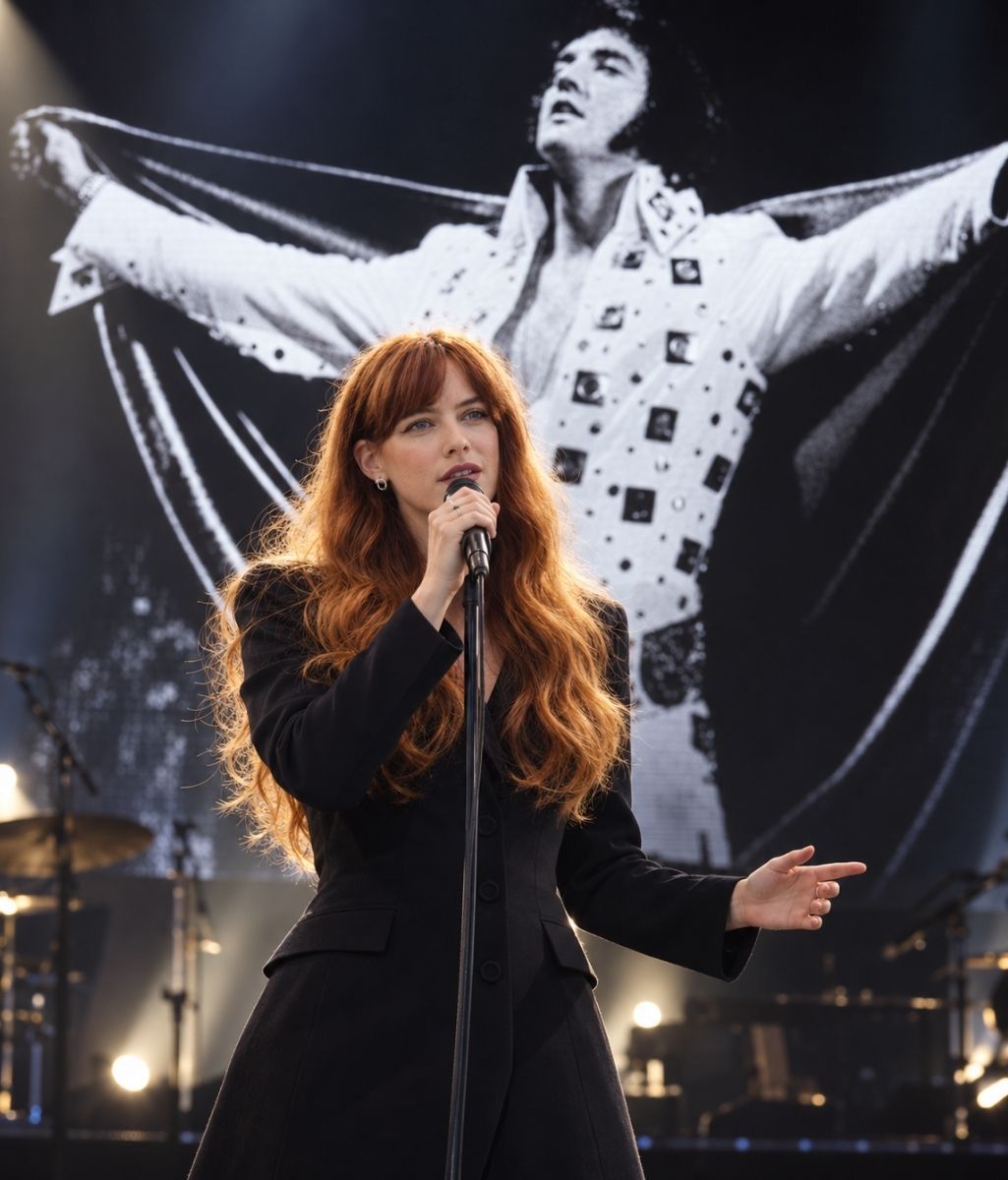
Riley Keough never met her grandfather Elvis Presley, yet his presence has followed her throughout her entire life. She grew up knowing that the man the world called the King was also the father her mother, Lisa Marie Presley, lost when she was only nine years old. For Riley, Elvis was never simply an icon preserved in photographs, records, and concert footage. He was part of a family story filled with extraordinary fame, deep love, and devastating loss.
That is why “Can’t Help Falling in Love” carries such emotional weight whenever Riley is connected to Elvis’s legacy. The song was recorded by Elvis in 1961 for Blue Hawaii and eventually became one of the most recognizable love songs of his career. In later years, it also became closely associated with his live shows, often appearing near the end of performances and helping turn the song into something much larger than a movie soundtrack recording.
In recent months, emotional posts have circulated online claiming that Riley stepped onto a stage and performed the song as a direct tribute to her grandfather. Those stories describe a tearful audience and even a projected or imagined Elvis watching her from the crowd. No reliable entertainment outlet or official Presley source has confirmed that such a performance actually took place, which means the viral version should be treated as a dramatized tribute rather than established history.
The real story surrounding Riley is powerful enough without adding a fictional performance.
Riley has spent much of her life surrounded by the weight of the Presley name while trying to build an identity of her own. She became an actress, filmmaker, and producer rather than attempting to recreate her grandfather’s career. Even so, Graceland, Elvis’s music, and the history of her family remained constant presences in her life.
Growing up, Riley experienced Graceland differently from ordinary visitors. To millions of fans, it was a museum and pilgrimage site. To her family, it remained connected to home, memory, and generations of Presley history. Riley has spoken about spending time there as a child after public visiting hours, when the famous mansion became quiet again and belonged once more to the family rather than the crowds.
The emotional weight of that history grew heavier as Riley got older.
Her younger brother, Benjamin Keough, died in 2020 at only 27. Riley had been extremely close to him, and his death deeply affected the entire family. Then, in January 2023, Lisa Marie Presley died at 54, leaving Riley not only grieving her mother but also carrying responsibilities connected to the Presley estate and Graceland.
Lisa Marie’s relationship with Elvis had always been especially complicated because she lost him so young. Riley later helped complete her mother’s memoir, From Here to the Great Unknown, using recordings Lisa Marie had made before her death. Through that project, Riley helped preserve her mother’s own voice rather than allowing Lisa Marie to be remembered only as Elvis Presley’s daughter.
That distinction matters.
For Riley, carrying Elvis’s legacy does not mean trying to become Elvis again.
It means protecting the stories of the people who lived behind the famous name.
Lisa Marie had often spoken about how deeply losing Elvis affected her childhood. Riley grew up watching that grief continue through another generation. In that sense, songs such as “Can’t Help Falling in Love” are no longer simply Elvis recordings. They have become part of the emotional inheritance passed from Elvis to Lisa Marie and then to Riley.
After Lisa Marie’s death, Riley became the sole trustee of her mother’s estate following a settlement involving her grandmother Priscilla Presley. That role placed her at the center of Graceland’s future and made her one of the most important living guardians of Elvis Presley’s legacy.
It is an unusual responsibility for someone who spent years trying to maintain her own identity outside the Presley mythology.
Yet Riley has never spoken about the legacy as though it were simply a commercial brand.
Her reflections are usually much more personal.
She remembers her mother.
She remembers her brother.
She remembers the family version of Graceland that tourists never saw.
And through those memories, Elvis becomes less like the untouchable King of Rock and Roll and more like the grandfather Riley never had the chance to know.
That is what makes “Can’t Help Falling in Love” such a fitting symbol of the family.
Elvis recorded it more than six decades ago.
Lisa Marie grew up hearing his voice attached to it.
Riley inherited both the song and everything the Presley name came to represent.
The music survived all three generations.
There does not need to be a dramatic stage performance for that connection to feel real.
Every time the opening notes of “Can’t Help Falling in Love” play, listeners are hearing more than one of Elvis Presley’s most beloved recordings. They are hearing part of a family history that continued long after Elvis left the stage for the final time.
Riley Keough may never have stood beside her grandfather.
She may never have shared a microphone with him.
But today, she carries something far more permanent.
She carries the responsibility of deciding how the Presley story will be remembered by the generations that come next.
And in that sense, the King’s legacy is still very much alive.