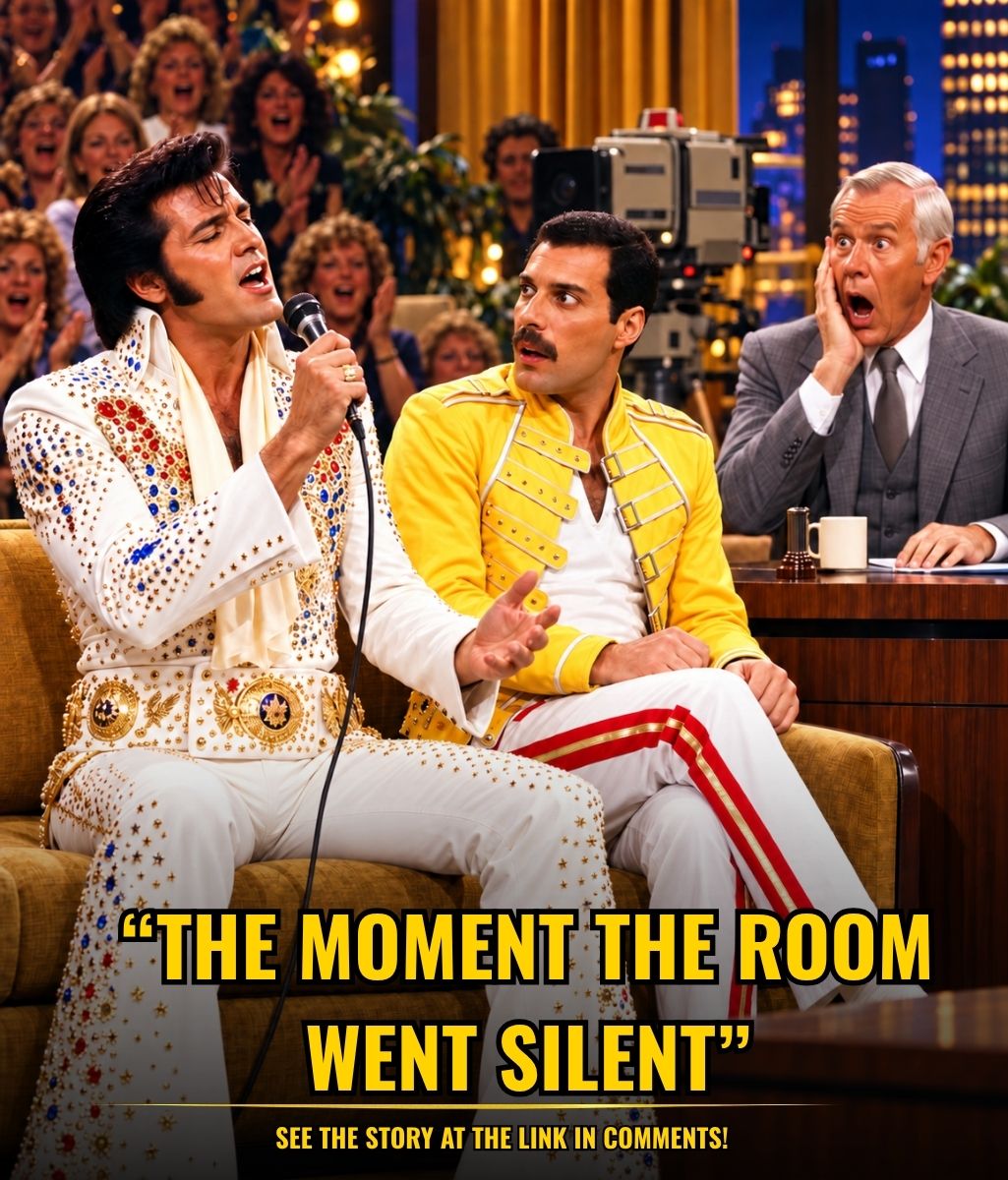
Freddie Mercury never needed much help commanding a stage. By the late 1970s, Queen had already become one of the biggest rock bands in the world, and Freddie had built a reputation around huge vocals, theatrical performances, and songs that seemed designed to break every rule. Yet when inspiration struck for one of Queen’s most unexpected hits, Freddie looked backward rather than forward, toward a singer who had helped define rock ’n’ roll long before Queen existed.
That singer was Elvis Presley.
There is no reliable evidence that Freddie Mercury ever met Elvis, challenged him to sing a difficult Queen song, or stood backstage waiting for “the King” to silence a room. Elvis died in August 1977, while Queen were still climbing toward some of the biggest years of their career. What is documented, however, is that Freddie admired Elvis deeply enough to build one of Queen’s most famous records around the sound and attitude associated with him.
That song was “Crazy Little Thing Called Love.”
Freddie wrote it in Munich in 1979, and the way the song came together was almost as unusual as the finished recording. He later recalled that the idea arrived while he was in the bath. Rather than move to a piano, the instrument most people associated with his songwriting, he asked for an acoustic guitar and began working with only a handful of chords. Freddie freely admitted that guitar was not his strength, but the limitation helped him keep the song simple.
That simplicity was exactly what the song needed.
Instead of the operatic layers of “Bohemian Rhapsody” or the enormous vocal architecture of Queen’s most dramatic recordings, “Crazy Little Thing Called Love” moved with the stripped-down energy of early rock ’n’ roll. Freddie’s vocal delivery carried obvious echoes of Elvis, while the rhythm leaned into rockabilly rather than the heavier arena-rock sound Queen had become famous for.
Brian May later confirmed that connection directly. He described the song as Freddie’s tribute to Elvis and said Freddie had been very fond of him. May also noted that the recording intentionally pursued an authentic early-rock sound, right down to the choice of guitar used for the solo. Instead of relying entirely on his famous Red Special, May used a different instrument to get closer to the crisp tone associated with 1950s rock ’n’ roll.
The remarkable part is how quickly Freddie created it.
In a 1981 interview, he said “Crazy Little Thing Called Love” took only five or ten minutes to write. Because he knew relatively few guitar chords, he could not complicate the composition even if he wanted to, forcing himself into a small musical framework. For an artist famous for extravagant arrangements, that restriction became an advantage rather than a problem.
Freddie then took the idea into the studio, where Roger Taylor and John Deacon helped turn it into a Queen record. Brian May arrived after much of the basic track had already been completed, which showed just how quickly the session had moved. Producer Reinhold Mack helped give the record its unusually raw, spacious character, making it sound more like something from an earlier rock ’n’ roll era than a typical late-1970s Queen production.
When listeners first heard it, some assumed Queen had simply covered an old Elvis song.
They had not.
Freddie had written the song himself.
That confusion may be one of the greatest compliments the tribute could have received. Freddie had absorbed the spirit of the music he admired without copying a specific Elvis recording. The phrasing, rhythm, attitude, and stripped-down arrangement evoked the King, but the song remained unmistakably Queen.
It also became enormous.
Released in 1979, “Crazy Little Thing Called Love” reached No. 1 in the United States, becoming one of Queen’s biggest international hits. For a band known for pushing rock toward grander and more complicated territory, one of its greatest successes came from doing almost the opposite: three chords, a loose rockabilly pulse, and Freddie Mercury temporarily stepping into a musical world Elvis had helped create decades earlier.
The influence even reached Queen’s live performances.
Freddie, who rarely played guitar onstage compared with Brian May, would strap one on for “Crazy Little Thing Called Love.” The visual itself became memorable because audiences were used to seeing him moving freely across the stage with a microphone rather than standing behind an instrument. Yet that change suited the song perfectly and gave Freddie another way to inhabit the early-rock persona that had inspired it.
There is something especially fitting about Freddie being drawn to Elvis.
The two performers belonged to very different generations, but they shared important qualities. Both possessed instantly recognizable voices, both understood the power of physical performance, and both could make an enormous audience feel as though something unpredictable might happen at any moment. Neither remained safely inside one musical category for long.
Elvis mixed country, blues, gospel, and rhythm and blues into the recordings that launched his career. Freddie and Queen later mixed hard rock, opera, pop, funk, disco, and countless other influences without worrying much about where the boundaries were supposed to be.
That is why the real connection between them is more compelling than an invented backstage challenge.
Freddie Mercury never needed Elvis Presley to stand across from him and prove who could sing the harder song.
Elvis had already given him something far more valuable.
He had shown a generation of singers that rock ’n’ roll could be theatrical, physical, dangerous, romantic, and larger than life.
More than two decades after Elvis first changed popular music, Freddie Mercury took some of that energy into a bathtub in Munich, picked up a guitar he barely knew how to play, and wrote one of Queen’s most enduring hits.
The King never had the chance to hear Freddie perform it live.
But every time “Crazy Little Thing Called Love” begins, a little piece of Elvis Presley’s influence is still there.