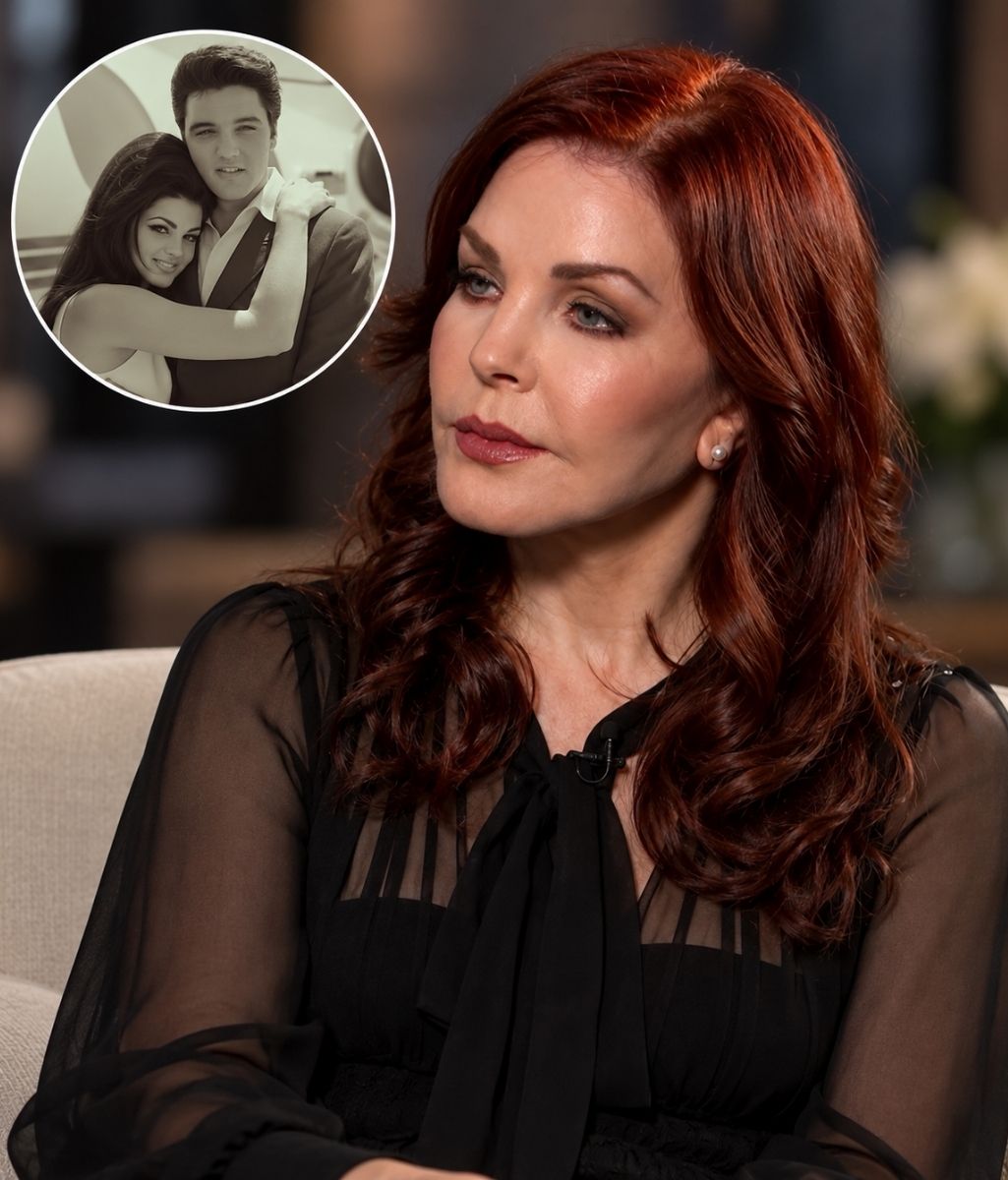
For millions of people around the world, Elvis Presley was larger than life. He was the voice that changed popular music, the young man whose movements caused an uproar, and eventually the superstar whose name became inseparable from American culture. Yet behind the unforgettable performances, the dazzling jumpsuits, and the crowds calling his name was a far more complicated man.
Few people witnessed that private side of Elvis as closely as Priscilla Presley.
Over the decades, Priscilla has spoken carefully about the man she knew away from the stage. Her memories have often revealed a striking contrast between the confident entertainer the public saw and the deeply private person who sometimes struggled when the applause disappeared.
Perhaps one of the most painful truths she has acknowledged is that there were battles inside Elvis that the people around him simply could not fight for him.
That realization becomes especially heartbreaking when considering just how many people cared about him.
Priscilla has explained in interviews that convincing Elvis to change was extraordinarily difficult. In a more recent conversation reflecting on his final years, she was asked whether anyone around him could have persuaded him to stop the destructive patterns that had begun consuming his life.
Her answer was essentially no.
According to Priscilla, Elvis could not easily be convinced of something unless he came to believe it himself. That quality could be one of his strengths when he was pursuing a dream, but during darker periods of his life, it also made reaching him extremely difficult.
Long before Elvis became increasingly isolated in the 1970s, there had already been signs that his extraordinary life carried an enormous emotional cost.
Fame had arrived with astonishing speed.
A young man from modest beginnings suddenly became one of the most recognizable people on Earth. Every haircut, appearance, performance and personal decision attracted attention. He was surrounded by people almost constantly, yet being surrounded by others did not necessarily mean that he felt understood.
Priscilla later suggested that Elvis sometimes struggled to understand what his extraordinary fame actually meant or where his life was supposed to go next.
He had ambitions far beyond simply repeating the same successful formula. He wanted meaningful acting roles. He wanted artistic challenges. He wanted to remain relevant. But as expectations grew and his career repeatedly pushed him toward familiar routines, maintaining his sense of direction apparently became harder.
That conflict matters when looking at the final chapter of Elvis Presley’s life.
By the 1970s, the man who once appeared almost unstoppable was carrying pressures that the audience could not always see.
There were exhausting performance schedules, constant expectations and the strange loneliness that can accompany extraordinary fame. At the same time, his reliance on prescription medication became increasingly serious.
Priscilla has emphasized an important detail when discussing that period: Elvis did not necessarily view prescribed medication in the same way that others might view dangerous substances.
Because much of what he took came through doctors, he could convince himself that it was acceptable or medically justified.
That belief made intervention even more complicated.
The people closest to him could notice changes. They could worry. They could try to speak with him. But recognizing a problem from the outside and persuading someone to recognize it themselves are two very different things.
Priscilla lived with that painful difference.
She remembered a man capable of extraordinary warmth, generosity, humor and ambition. She also witnessed periods when keeping him focused and motivated became increasingly difficult.
And that may be one of the saddest parts of the Elvis Presley story.
His struggles did not erase the man he had been.
They existed alongside him.
The same person who could walk onto a stage and hold thousands of people completely spellbound could return to a private world filled with uncertainty. The same man who inspired millions sometimes struggled to find a clear sense of direction for himself.
For those who loved Elvis, that contradiction must have been extraordinarily painful.
Priscilla eventually made difficult choices about her own life and her responsibility as a mother. Yet even after their marriage ended, the emotional connection between them did not simply disappear.
They remained close.
That makes her reflections on his decline especially powerful. She was not describing a distant celebrity whose story she had observed through newspapers. She was remembering someone whose laughter she knew, whose moods she recognized, and whose vulnerabilities she had witnessed when cameras were nowhere nearby.
When Elvis died at Graceland on August 16, 1977, at only 42 years old, the world lost an entertainer who had already reshaped popular culture.
Priscilla lost something far more personal.
Years later, she would speak about receiving the devastating phone call and realizing that ordinary moments she once took for granted were suddenly gone forever — a laugh, a familiar presence, the comfort of knowing someone was still somewhere in the world.
Those memories help explain why her comments about Elvis remain so compelling decades later.
She does not reduce him to either a legend or a tragedy.
Instead, her recollections reveal something far more human.
Elvis Presley could command a stage, change music history and inspire generations — but fame could not solve every struggle inside him.
Those closest to him could offer concern, loyalty and love. They could encourage him. They could remain beside him.
But ultimately, there were choices and battles that only Elvis himself could face.
And according to the woman who knew him behind the curtain, that may have been the one battle even the King could never fully conquer.