By 1968, there were people in the entertainment business who had begun to wonder whether Elvis Presley’s greatest days were already behind him. It may sound difficult to believe now, because Elvis would eventually become one of the most enduring figures in popular music history, but the landscape of entertainment had changed dramatically during the years he spent away from regular live performance. His voice, his unmistakable style, and his early impact on rock and roll were already legendary, yet the industry around him was moving quickly, and some wondered whether he still belonged at the center of it.
The Beatles had transformed popular music, the Rolling Stones had established themselves as a major force, and new sounds ranging from folk rock to psychedelic music were dominating radio and youth culture. Meanwhile, Elvis had spent much of the 1960s making Hollywood films and recording songs tied to those productions. Some of those films were commercially successful and produced memorable music, but over time the formula became increasingly repetitive, and Elvis reportedly grew frustrated with the direction of his career. The performer who had once seemed rebellious, unpredictable, and completely unlike anyone who came before him was now at risk of being viewed as a star from another era.
That changed with the television program that would later become known as the ’68 Comeback Special. The project began as an NBC production associated with Elvis’ manager, Colonel Tom Parker, along with sponsor Singer, and Parker initially favored a much safer and more conventional presentation, including a strong Christmas theme. Producer Bob Finkel and director Steve Binder, however, saw a very different opportunity. They did not simply want Elvis Presley to appear on television again; they wanted viewers to remember why Elvis Presley had mattered so much in the first place and to see whether that same spark still existed.
By that point, Elvis had not performed regularly before a live audience for more than seven years. He was only 33 years old, but in the rapidly changing world of popular music, seven years could feel like a lifetime. Younger listeners had grown up with entirely different musical heroes, while many longtime fans remembered Elvis as the young revolutionary who had shaken American culture in the 1950s. The central question surrounding the special was simple but enormous: Could Elvis still command a stage the way he once had?
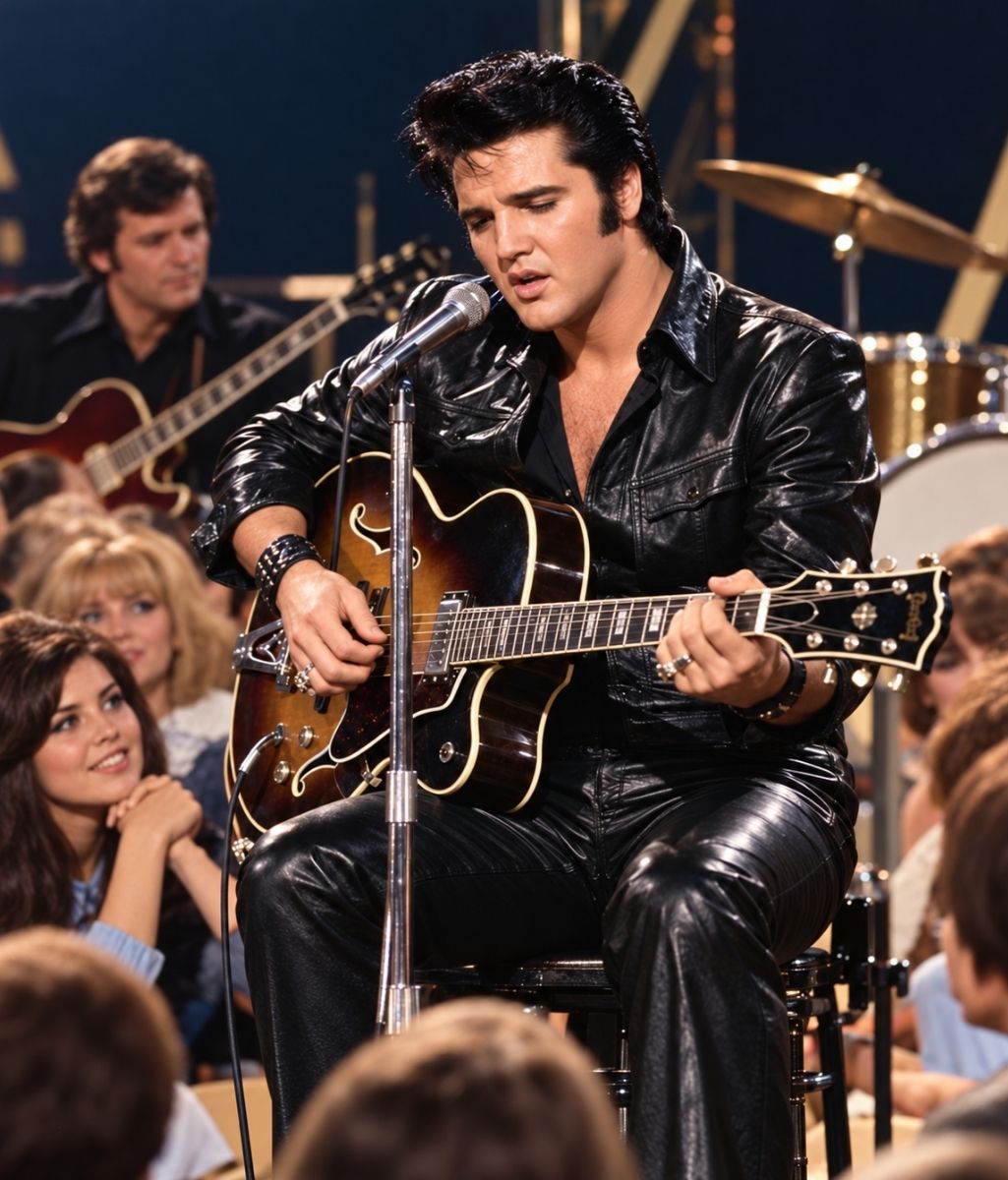
The answer became clear when Elvis appeared onstage wearing black leather. The polished Hollywood image that had defined much of his public life during the 1960s suddenly seemed to fall away, replaced by a performer who looked far closer to the fearless young singer audiences remembered. With a microphone, a guitar, familiar musicians, and a small live audience, Elvis returned to the elements that had always made him compelling. His confidence was visible, his voice sounded powerful, and most importantly, there was a sense that he was genuinely engaged with the music again.
During the informal portions of the program, Elvis sat with musicians including Scotty Moore and D.J. Fontana, both of whom had been part of his early rise. Together, they revisited songs and musical memories from the period when rock and roll was still new and controversial. These scenes became some of the most beloved footage of Elvis ever recorded because they did not feel overly rehearsed or distant. There was humor, spontaneity, occasional imperfection, and the unmistakable feeling of a performer rediscovering the joy that had first brought him to the stage.
For viewers, that sense of freedom mattered. The carefully controlled movie-star image seemed to disappear, and in its place was an artist reconnecting with a part of himself that years of contracts, schedules, and repetitive studio work had gradually pushed into the background. Elvis was not simply asking America to remember who he had been in 1956. He was showing the country who he could still be in 1968, and that distinction gave the program much of its emotional power.
The structure of the special reinforced that message. The opening sequence combined “Trouble” with “Guitar Man,” immediately presenting Elvis as tougher and more commanding than the polished movie image many viewers had become accustomed to. The production then moved between large-scale musical sequences and more intimate performances, allowing him to acknowledge his past without appearing trapped by it. Instead of becoming a nostalgic tribute to an earlier version of Elvis Presley, the program gradually became evidence that he still had something important to say.
The final performance gave the special its most powerful moment. Dressed in white, Elvis performed “If I Can Dream,” a song written by musical director W. Earl Brown during a year of deep national tension and tragedy. The song carried a message of hope, understanding, and the possibility of a better future, and Elvis delivered it with remarkable intensity. Rather than sounding like a lightweight television closing number, the performance felt personal and urgent, as though he understood that the final minutes of the program represented more than the end of a broadcast.
As the song built toward its conclusion, Elvis’ voice became stronger and more emotionally charged. The performance created the impression that he was doing more than singing for an audience; he was reclaiming his place as a serious artist. By the time the final notes faded, the message was unmistakable: Elvis Presley was not finished. Whatever doubts had surrounded his ability to return to television and reconnect with a changing audience suddenly seemed far less important.
When the special aired on NBC on December 3, 1968, it attracted a massive television audience, drawing roughly 42 percent of viewers and becoming one of NBC’s major ratings successes of the season. The impact went far beyond strong numbers, however. The broadcast reminded the public that beneath the years of Hollywood contracts and predictable film roles remained one of the most magnetic performers of his generation.
The success of the program also helped open the door to a renewed creative period. Elvis soon returned to recording important material in Memphis and resumed regular live performance, beginning another major chapter of his career. In the years that followed, he would achieve new recording successes and establish himself as a major live attraction in Las Vegas, proving that the 1968 television special had not been a brief moment of nostalgia but the beginning of a genuine professional revival.
Looking back, what makes the ’68 Comeback Special so remarkable is not simply that Elvis performed well. The real significance lies in how much appeared to be at stake. He was confronting an industry that had changed without him, an audience divided between old memories and new expectations, and a public image that had become increasingly disconnected from the artist he wanted to be. The challenge was not merely to sing familiar songs successfully; it was to prove that Elvis Presley still had something that could not be replaced by changing trends.
That night, he succeeded because he did not try to become the Elvis of 1956 again. Instead, he appeared as someone older, more experienced, and more aware of what he had lost and what he still possessed. The raw energy was still there, but it had been joined by maturity, restraint, and a deeper emotional weight that gave the performances a very different kind of power.
Perhaps that is why the footage remains compelling decades later. Viewers can see Elvis smiling as the musicians settle into familiar rhythms, hear his confidence grow as the performances continue, and watch the entire evening build toward the emotional climax of “If I Can Dream.” It feels less like a carefully manufactured television special and more like the moment a great performer remembered exactly what made him great.
The entertainment business had changed, the audience had changed, and music itself had changed, but Elvis Presley demonstrated on that stage that he had not lost the one quality no industry could manufacture: the ability to make people stop, listen, and feel something. By the time the final note disappeared and the credits began to roll, the question of whether Elvis Presley could still matter had been answered in the most convincing way possible.
The King had returned, and after that night, no one could easily dismiss him as yesterday’s star again.