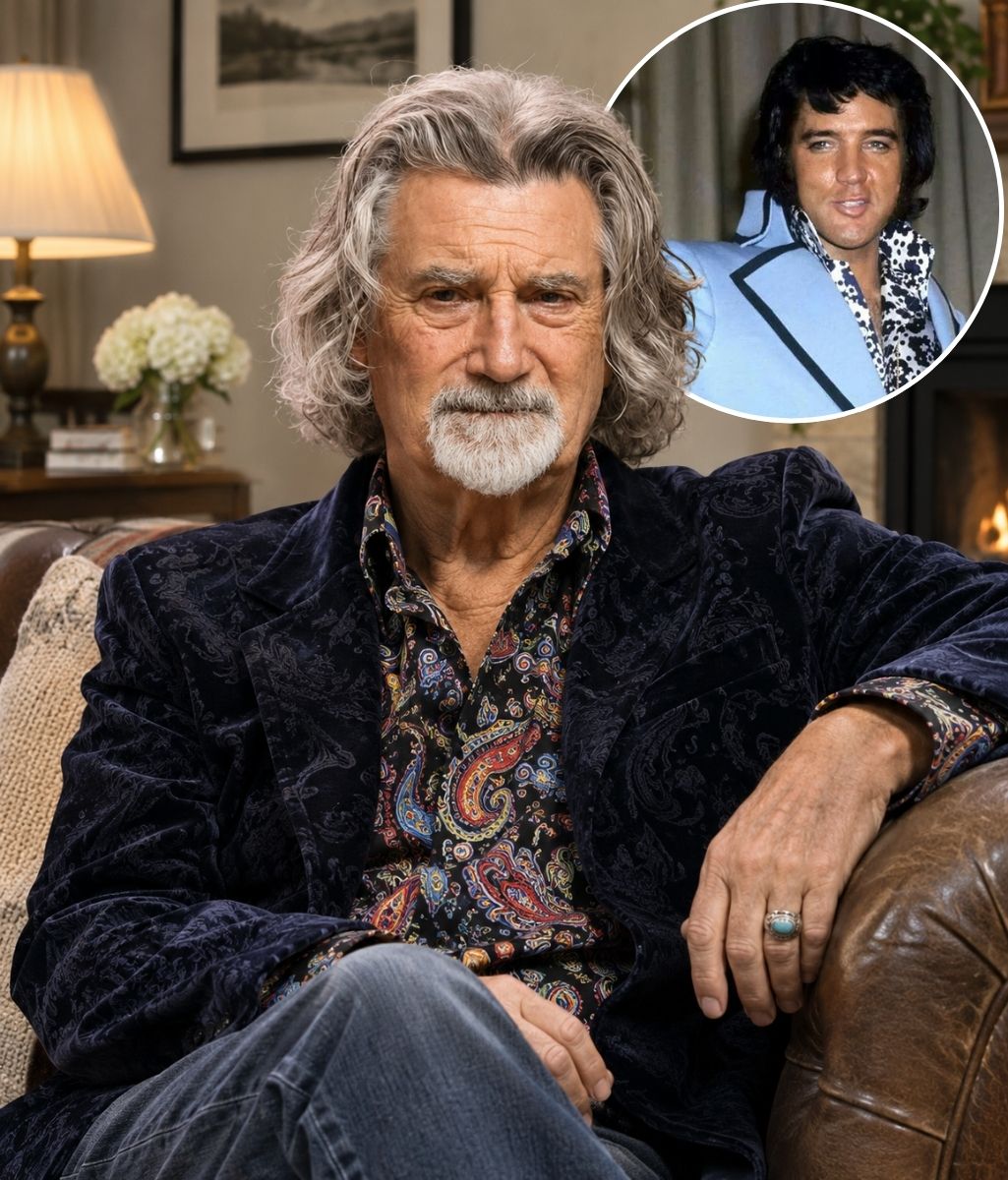
Long before Richard Sterban became famous for the deep bass voice behind The Oak Ridge Boys and the unforgettable “oom-poppa-mow-mow” of “Elvira,” he found himself standing only a few feet away from the biggest entertainer in the world.
That entertainer was Elvis Presley.
In the early 1970s, Sterban was a member of J.D. Sumner and the Stamps Quartet, the gospel group that provided backing vocals for Elvis during one of the most exciting periods of his touring career. For roughly a year and a half, Sterban traveled with Elvis, sang behind him onstage, recorded with him and appeared in the 1972 concert documentary Elvis on Tour. Decades later, after building a legendary career of his own, Sterban still spoke about those months with unmistakable gratitude.
Shortly before the final chapter of his own life, Sterban returned to those memories once again.
During Graceland’s celebration of Elvis Presley’s 90th birthday in January 2025, Sterban recorded a special interview in which he reflected on what it had really been like to work beside the King. He described Elvis as “a special person” and said that recording with him had been almost impossible to comprehend at the time because Elvis was already the biggest star in the world.
Yet the most memorable part of Sterban’s story was not the fame.
It was what happened after he got close enough to see the man behind it.
Sterban remembered the first time Elvis entered a rehearsal room in Minneapolis. The musicians were already there waiting when Elvis finally arrived with his entourage. Sterban later said his jaw dropped because Elvis possessed a kind of magnetism and charisma that immediately filled the room. In that moment, he understood why millions of people reacted to Elvis the way they did.
However, once Sterban began spending time around him, another side slowly emerged.
The intimidating superstar turned out to have a mischievous sense of humor.
Sterban recalled that Elvis loved practical jokes and frequently played them on the Stamps Quartet. It was one of the biggest surprises for the young bass singer because the public image of Elvis was so enormous that it was easy to imagine him as distant or untouchable. The man Sterban encountered backstage could be playful, relaxed and eager to laugh with the people around him.
Sterban later described Elvis as very down-to-earth, a phrase that carried special weight coming from someone who had seen him at the absolute height of his fame.
At the time, Elvis was traveling from one sold-out arena to another. Sterban remembered that the tour was the biggest in the music business and that empty seats were almost impossible to find. For a young singer who had grown up admiring gospel quartets, suddenly becoming part of that world was overwhelming.
Still, Sterban eventually made a decision that many people around him must have considered unbelievable.
In late 1972, he left Elvis.
The Oak Ridge Boys needed a new bass singer, and Sterban had long dreamed of joining what he hoped would become the best vocal group in the world. Walking away from Elvis Presley’s tour meant leaving the most secure and glamorous job he could possibly have imagined, but Sterban chose the uncertain path instead.
That gamble changed his life.
The Oak Ridge Boys went on to become one of country music’s most successful vocal groups, eventually scoring numerous No. 1 hits and entering both the Country Music Hall of Fame and Gospel Music Hall of Fame.
Years later, Sterban looked back and realized that his time with Elvis had helped prepare him for everything that followed.
He had already learned what it felt like to stand in packed arenas, work inside a major touring operation and perform beside an artist capable of commanding enormous crowds. When The Oak Ridge Boys later began filling some of those same venues, Sterban understood the scale of what was happening because he had seen it once before from only a few steps behind Elvis.
There was also a beautiful irony in where both careers eventually led.
Sterban once stood behind Elvis as an unknown backup singer. Decades later, he and Elvis would both belong to the Country Music Hall of Fame and the Gospel Music Hall of Fame, something Sterban said he could never have imagined during those early years on the road.
In August 2026, only months before Sterban’s death, he and other former members of the Stamps were also honored as Graceland Legends for their contribution to Elvis Presley’s musical legacy.
Richard Sterban died on November 14, 2026, after complications from bronchitis and pneumonia following a long battle with cancer. He was 83.
His death gave those final reflections on Elvis an added emotional weight.
Sterban never tried to tear down the mythology surrounding the King. Instead, his memories made Elvis seem more human.
He remembered the extraordinary charisma, the sold-out arenas and the voice that could command an entire room, but he also remembered a man who enjoyed jokes, valued the people around him and could still behave like an ordinary person when the stage lights were gone.
Perhaps that was Richard Sterban’s most meaningful revelation about Elvis Presley. Behind the icon worshipped by millions was a man whose humanity left just as deep an impression on the people who actually stood beside him. More than half a century later, Sterban still sounded grateful that, for a brief and unforgettable period of his life, he had been one of them.