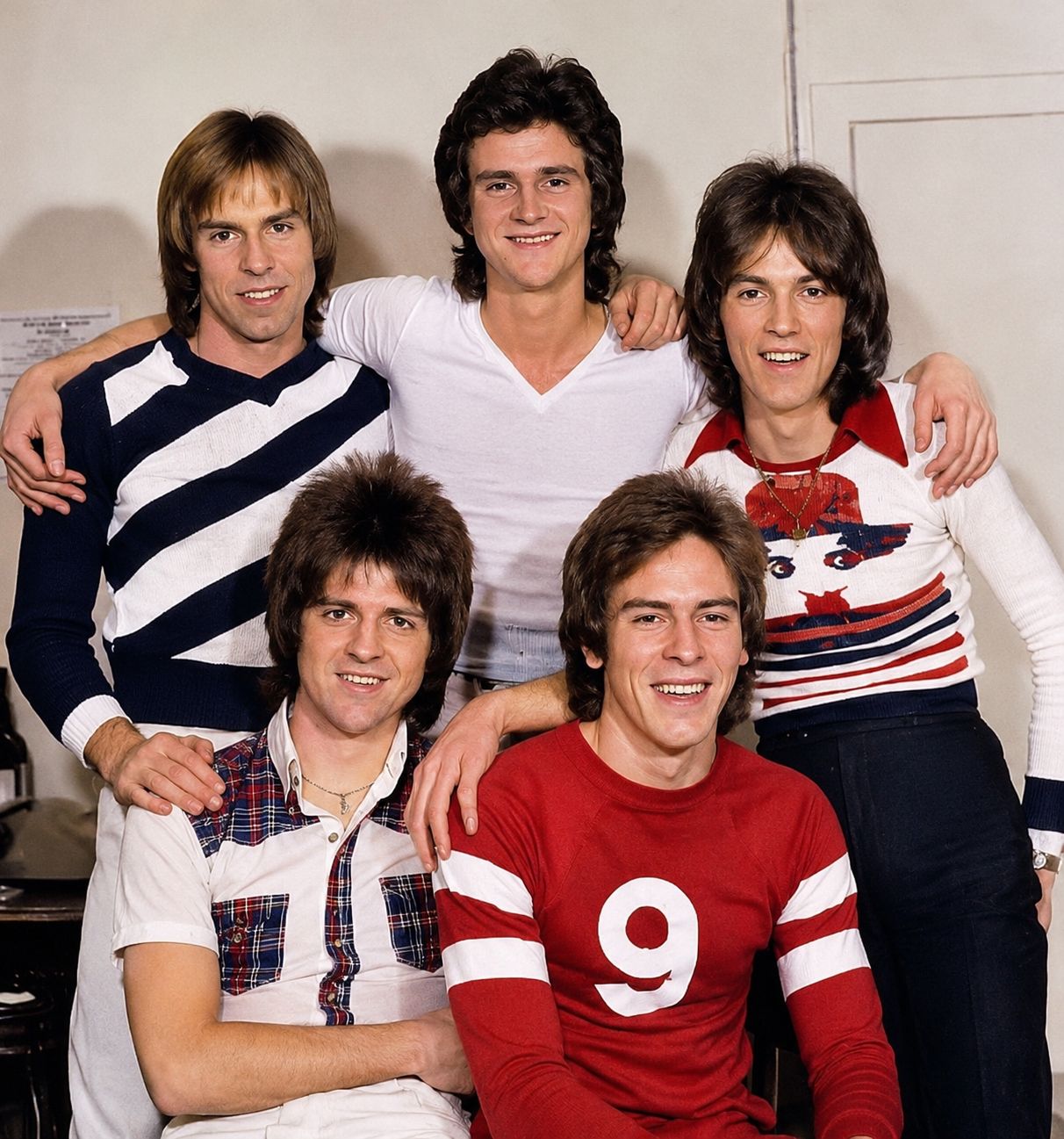
For a brief and extraordinary period in the 1970s, the Bay City Rollers seemed to belong everywhere at once. Their tartan-covered image appeared across magazines, television screens and bedroom walls, while songs such as “Shang-a-Lang,” “Bye Bye Baby,” “Saturday Night” and “Give a Little Love” turned a group of young Scottish musicians into the center of a phenomenon that became known simply as Rollermania.
To the teenagers who screamed outside hotels and crowded concert halls, the Rollers represented fun, youth and a sense of belonging. The smiling photographs suggested that the young men inside the band were enjoying the same carefree adventure as their fans.
Years later, former members would describe a very different reality.
Much of the group’s rise had been shaped by manager Tam Paton, who understood that the Rollers could become more than a band if they were packaged as a complete teenage fantasy. He helped refine the tartan image, oversaw changes in the lineup and exercised enormous influence over the musicians’ professional lives. Paton could be aggressive about who stayed, who left and how the group was presented, and former members later described an atmosphere in which they had far less control over their careers than the public might have imagined.
That control became more troubling as allegations about Paton emerged.
Former guitarist Pat McGlynn, along with other men connected to the Rollers’ world, later accused Paton of sexual abuse and coercive behavior. The 2023 ITV documentary Secrets of the Bay City Rollers revisited those accounts in detail, including testimony from men who said that access to the band, opportunities in music and Paton’s personal demands could become dangerously intertwined. The documentary also explored allegations that Paton used his position of authority to manipulate vulnerable young men while controlling major parts of the Rollers’ lives.
These allegations were not simply stories that appeared long after Paton’s death. His criminal record had already become part of the public record decades earlier. In the early 1980s, he was convicted of sexual offences involving teenage boys and served a prison sentence. By the time he died in 2009, the man once credited with helping create Rollermania had become associated with a far darker legacy than the bright pop image he had helped manufacture.
The emotional damage did not end when the Rollers stepped offstage.
Les McKeown, whose voice became closely identified with the band during its most successful years, later struggled with alcohol and drugs and spoke about the psychological damage connected to the world around the group. In the ITV documentary, his widow and son described him as a man who carried deep wounds for years and never fully found peace. Their testimony added another painful layer to the familiar image of Les smiling into cameras while thousands of fans screamed his name.
Money became another source of bitterness.
The Bay City Rollers sold millions of records, yet former members spent decades arguing that they had never received the royalties they believed they were owed. By the 2000s, several members were involved in a long-running legal battle over unpaid earnings from the band’s catalog. Reports at different times suggested that the amounts being disputed reached into the tens of millions, even though the former stars themselves had not enjoyed anything close to that level of financial security after the group’s peak.
The legal fight eventually ended in an out-of-court settlement in 2016, but by then the dispute had lasted far longer than Rollermania itself.
That contrast says almost everything about the Bay City Rollers’ story.
Their period at the very top was relatively brief, yet the consequences followed some of the members for decades. The fame disappeared quickly, but the arguments over money, broken relationships, personal struggles and memories of what happened behind the scenes remained.
Even the lineup had rarely been as stable as fans might remember.
Before the classic combination of Les McKeown, Eric Faulkner, Stuart “Woody” Wood, Alan Longmuir and Derek Longmuir became familiar to millions, the group had already gone through numerous musicians. More changes followed during the height of their success, with Alan leaving in 1976, Ian Mitchell arriving and departing, Pat McGlynn joining and later being dismissed, and the band gradually losing the unity that had helped create the Rollermania image.
By the late 1970s, the phenomenon was fading.
Musical tastes were changing, internal tensions were growing and the Rollers could no longer maintain the extraordinary level of attention that had once surrounded them. The group eventually splintered, and in later years different former members performed under variations of the Bay City Rollers name, sometimes becoming involved in disputes over who had the right to use it.
For fans who experienced Rollermania firsthand, learning these details can be uncomfortable because the memories attached to the music are often joyful. The records may still bring back school dances, teenage bedrooms, tartan scarves and the excitement of hearing a favorite band on the radio.
Those memories are real.
But so are the stories told by the people who lived behind the posters.
The Bay City Rollers did not simply experience a spectacular rise followed by an ordinary pop decline. Their history became a complicated story about how young performers could generate enormous amounts of money and attention while still having very little power over the system surrounding them.
That does not erase what songs like “Saturday Night” or “Give a Little Love” meant to millions of listeners. It simply changes what can be seen when looking back at the photographs.
The smiles were real, the fans were real and Rollermania was real, but the world behind the tartan was far more complicated than anyone standing in the audience could have known. For some of the men inside the Bay City Rollers, the brightest years of their careers also left shadows that followed them for the rest of their lives.