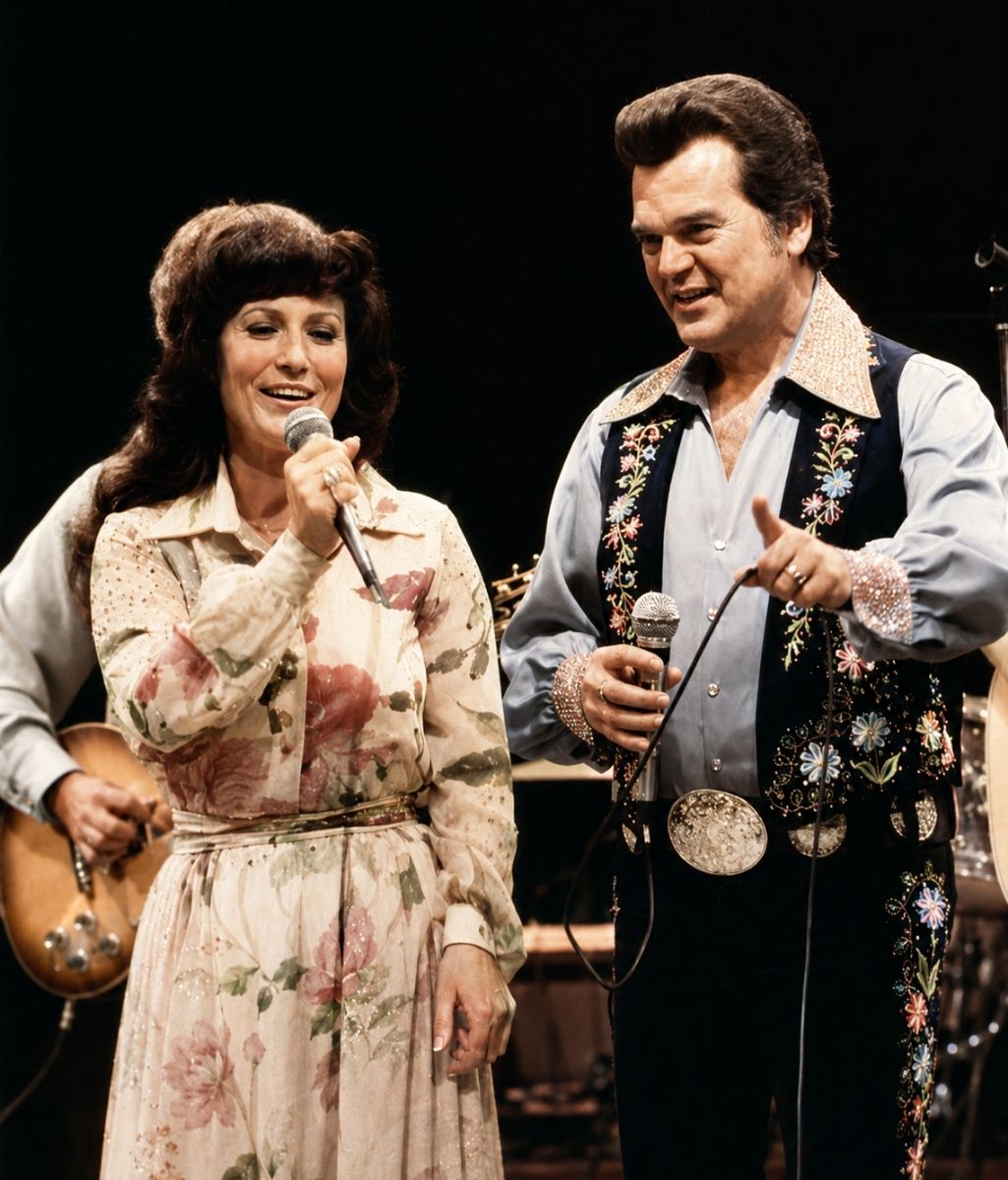
By the time Conway Twitty and Loretta Lynn recorded “Louisiana Woman, Mississippi Man,” country fans already knew there was something special about the way their voices fit together. But this 1973 hit pushed that chemistry into completely different territory. Instead of heartbreak or forbidden love, Conway and Loretta traded lines with a playful urgency that made the song feel less like a studio duet and more like two people desperately trying to get back to each other.
Their partnership had begun a few years earlier and quickly become one of the most successful duet pairings Nashville had ever seen. “After the Fire Is Gone” reached No. 1 in 1971, followed by “Lead Me On,” and audiences became fascinated by the contrast between Conway’s smooth, controlled delivery and Loretta’s unmistakably direct voice. By 1973, they were no longer simply two successful solo stars sharing a microphone. They had developed the timing, trust, and musical instinct of a genuine duo.
Then came “Louisiana Woman, Mississippi Man.”
Written by Becki Bluefield and Jim Owen, the song takes a wonderfully simple idea and turns it into a miniature country love story. A woman in Louisiana and a man in Mississippi are separated by the Mississippi River, but neither distance nor danger seems capable of keeping them apart. The song moves quickly, with Conway and Loretta answering each other almost constantly, giving the entire performance a sense of momentum.
What makes the recording memorable is not merely the story. It is the way Conway and Loretta sell it.
Loretta sounds determined and mischievous, while Conway answers with the relaxed confidence that had already made him one of country music’s most convincing romantic singers. Neither voice overwhelms the other. Instead, they push the song forward together, each line sounding like a response to the person standing on the opposite side of the river.
That back-and-forth created exactly the kind of chemistry fans loved about them.
Unlike some of their more emotionally complicated recordings, “Louisiana Woman, Mississippi Man” is joyful, flirtatious, and almost cinematic. You can practically picture the muddy river, the distance between the two lovers, and the determination to cross whatever stands between them. Even the song’s exaggerated dangers add to its charm. Nothing is going to stop these two characters from reaching each other.
And when Conway and Loretta sang it, fans had little trouble believing them.
The song became another No. 1 country hit for the pair, extending an extraordinary run that eventually included five consecutive chart-topping duets between 1971 and 1975: “After the Fire Is Gone,” “Lead Me On,” “Louisiana Woman, Mississippi Man,” “As Soon as I Hang Up the Phone,” and “Feelins’.” During roughly the same period, Conway and Loretta won the CMA Vocal Duo of the Year award four consecutive times, from 1972 through 1975.
The song also became the title track of their 1973 album Louisiana Woman, Mississippi Man, released during a period when both singers were already major stars on their own. That detail matters because neither Conway nor Loretta needed the partnership to rescue a struggling career. They kept returning to each other because together they could create something neither quite produced in the same way alone.
Their voices created characters almost instantly.
Conway could turn a few words into flirtation simply by lowering his voice or delaying a phrase. Loretta could answer with enough personality to make it feel as if she were challenging him rather than merely singing the next written line. That dynamic became especially effective on a song like “Louisiana Woman, Mississippi Man,” where the entire story depends upon two people being unable to stay away from each other.
It also helps explain why old footage of Conway and Loretta continues to fascinate fans decades later. People do not only listen to these performances. They watch the expressions, the smiles, the pauses, and the way the two singers react to one another. Their stage chemistry was so convincing that generations of listeners have wondered whether something deeper existed behind it, although no credible evidence has established a secret romantic relationship between them.
Perhaps that speculation misses the most remarkable part of the story.
Conway Twitty and Loretta Lynn did not need to be secretly in love to make audiences believe a love song. They had something just as valuable for performers: complete musical trust. After recording together repeatedly, they understood how to leave space for one another and how to make an exchange sound spontaneous even when every lyric had already been written.
“Louisiana Woman, Mississippi Man” captures that relationship at perhaps its most playful.
There is heartbreak elsewhere in the Conway-and-Loretta catalog. There is adultery, temptation, separation, longing, and regret. But here, there is simply irresistible attraction. The river may divide Louisiana from Mississippi, but from the first moments of the record, there is never much doubt that these two characters intend to find their way across it.
That sense of certainty is part of what made the song endure.
More than half a century later, “Louisiana Woman, Mississippi Man” remains one of the defining recordings of the Conway Twitty–Loretta Lynn partnership. The arrangement belongs unmistakably to its era, but the playful conversation between the two voices still works because chemistry cannot really become outdated.
Country music has produced many famous duets since then, but very few pairs could make a song sound as natural as Conway and Loretta did. Their success was not simply about having two recognizable names on the same record. It was about making listeners forget, for two or three minutes, that they were listening to a performance at all.
And perhaps that is the real magic of “Louisiana Woman, Mississippi Man.”
You hear Conway on one side. You hear Loretta on the other. Between them sits a river, a song, and one of the most unforgettable musical connections country music ever produced