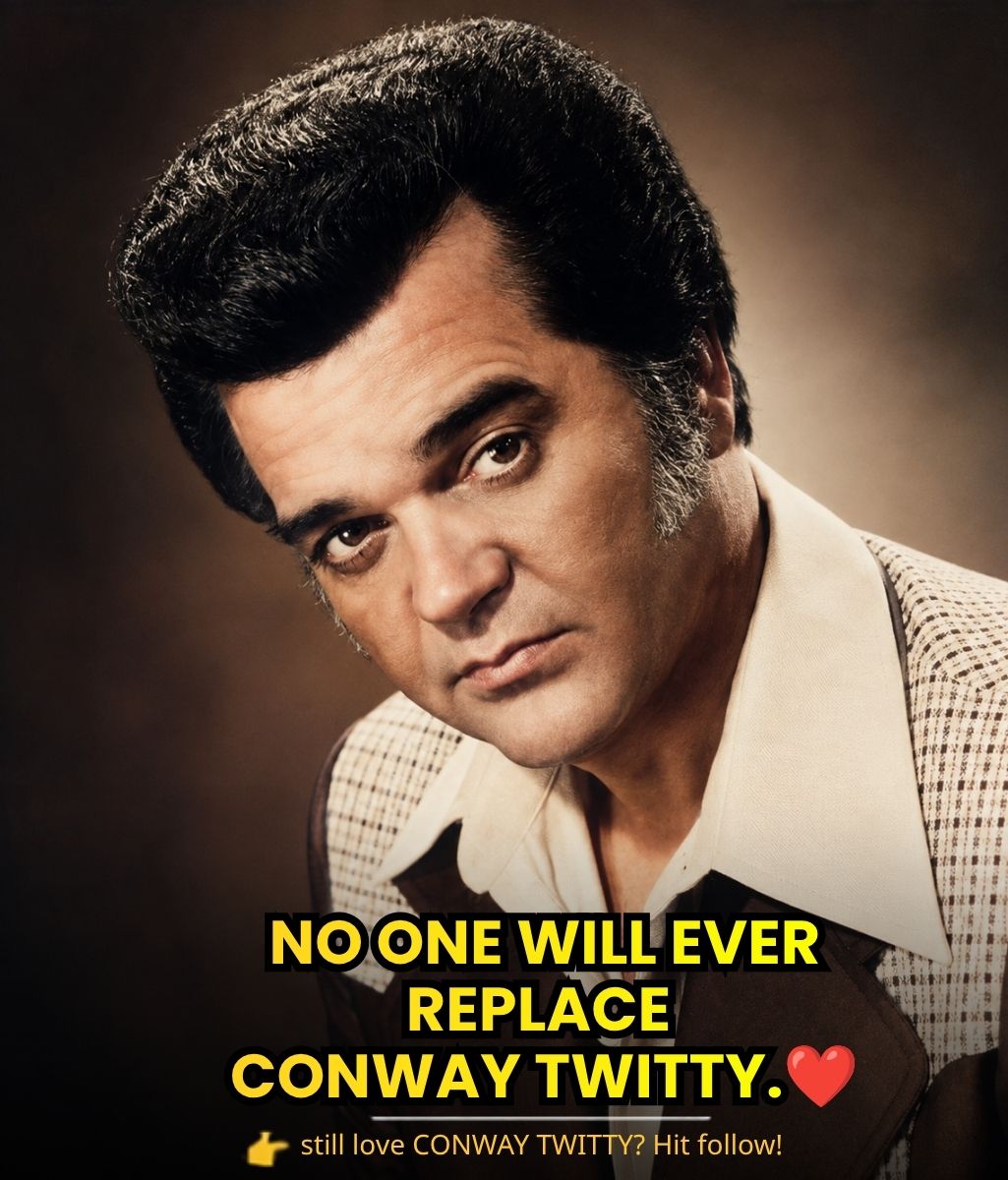
By the late 1980s, Conway Twitty had already spent decades proving that few country singers could make heartbreak sound as personal as he could. He had sung about love slipping away, marriages in trouble, and people realizing too late what they were about to lose. But when he recorded “Goodbye Time” in 1988, Conway found a song that required almost none of the romantic swagger associated with some of his biggest hits. This time, the man at the center of the story was not trying to win someone over. He was standing at the moment when he realized love might no longer be enough to make her stay.
The song was written by Roger Murrah and James Dean Hicks, and its origin was rooted in a real relationship falling apart. Hicks later explained that his brother was going through a divorce and was desperately holding on to a relationship that was already gone. That situation became the emotional seed for “Goodbye Time.” Murrah and Hicks began playing and working through the idea until they arrived at a song built around one devastating realization: sometimes you can still love someone deeply and still understand that you cannot force them to remain.
That is what makes the song different from a typical country breakup record. The narrator begins by questioning the woman who wants to leave, trying to understand how the dreams they once shared could suddenly mean so little. There is hurt in his voice, but there is also disbelief. He can see her looking toward the door, and with every line the listener senses that he already knows the answer to the question he does not want to ask.
This isn’t really a song about saying goodbye. It is a song about realizing the goodbye has already happened in someone else’s heart.
The writers originally had another major country voice in mind. According to the story behind the song, Reba McEntire was initially considered for “Goodbye Time,” but the material hit too close to her own life at the time because she had also experienced divorce. The song eventually reached Conway Twitty, and in his hands the perspective changed completely. Instead of sounding like anger or accusation, Conway delivered it with the exhausted resignation of a man slowly accepting that there may be nothing left to say.
That restraint was one of Conway’s greatest strengths. He rarely needed to shout through an entire song to make listeners believe him. He could begin quietly, almost conversationally, and then allow the emotion to build as the situation became impossible to avoid. “Goodbye Time” follows that pattern beautifully. The early lines sound like a man still searching for an explanation, but by the time the chorus arrives, he is no longer trying to negotiate. He has reached the terrible point where letting someone go may be the only choice left.
There was another remarkable voice quietly helping shape the recording. Vince Gill provided background vocals, years before he would become one of country music’s most celebrated singers in his own right. Gill’s harmony does not compete with Conway; it sits behind him and adds another layer of loneliness to a performance already built around emotional surrender.
Released in February 1988 as the first single from Conway’s album Still in Your Dreams, “Goodbye Time” reached No. 7 on Billboard’s country chart. It arrived during a significant late-career period for Conway. After returning to MCA, he was still producing major country records such as “That’s My Job,” “Goodbye Time,” “She’s Got a Single Thing in Mind,” and others, proving that his ability to find and interpret great songs had not disappeared as country music moved toward a new generation.
Yet chart position alone does not explain why the song endured. “Goodbye Time” works because almost anyone who has watched a relationship slowly die can recognize the conversation inside it. There is a particular kind of heartbreak that comes before an actual separation—the moment when one person is still emotionally reaching while the other has already begun leaving. Conway does not portray the narrator as heroic or bitter. He simply allows him to understand what is happening.
That approach fit perfectly with Conway’s philosophy as a performer. His official biography recalls his belief that he communicated with audiences primarily through the music rather than through long speeches onstage. In “Goodbye Time,” that philosophy becomes obvious. There is no unnecessary theatricality. The pauses, the controlled phrasing, and the gradual increase in vocal power do almost all of the emotional work.
Years later, the song found another life when Blake Shelton recorded “Goodbye Time” for his 2004 album Blake Shelton’s Barn & Grill. Shelton had reportedly been inspired to record it after hearing Conway’s version during a television program about Twitty. His rendition was released as a single in 2005 and reached the country Top 10, introducing the song to listeners who may never have encountered the original recording.
But for many longtime Conway fans, there remains something uniquely painful about the original. Perhaps it is the maturity in his voice. By 1988, Conway was no young singer imagining what heartbreak might someday feel like. His delivery carried decades of experience interpreting complicated adult relationships, and he understood that the saddest endings are not always explosive. Sometimes two people simply reach the place where one still wants to hold on and the other no longer can.
That is the quiet tragedy at the center of “Goodbye Time.”
The narrator does not discover a secret affair. There is no dramatic confrontation and no villain. He simply realizes that if the feeling has disappeared, words cannot bring it back. The relationship may have contained real love, real memories, and years of shared dreams, but none of those things guarantee that another person will stay forever.
Conway Twitty built much of his career around making listeners feel as though he understood the most private moments of their lives. “Goodbye Time” may be one of the clearest examples of that gift. It takes a painful real-life inspiration, strips away unnecessary drama, and leaves only the moment almost everyone fears—the moment when you finally understand that loving someone and keeping them are not always the same thing.
More than three decades after Conway’s death, the song still lands with the same quiet force because its message has not aged.
Sometimes goodbye is not the moment someone walks out the door. Sometimes it begins the moment you realize nothing you say can make them turn around.