Some songs become hits.
Others become part of people’s lives.
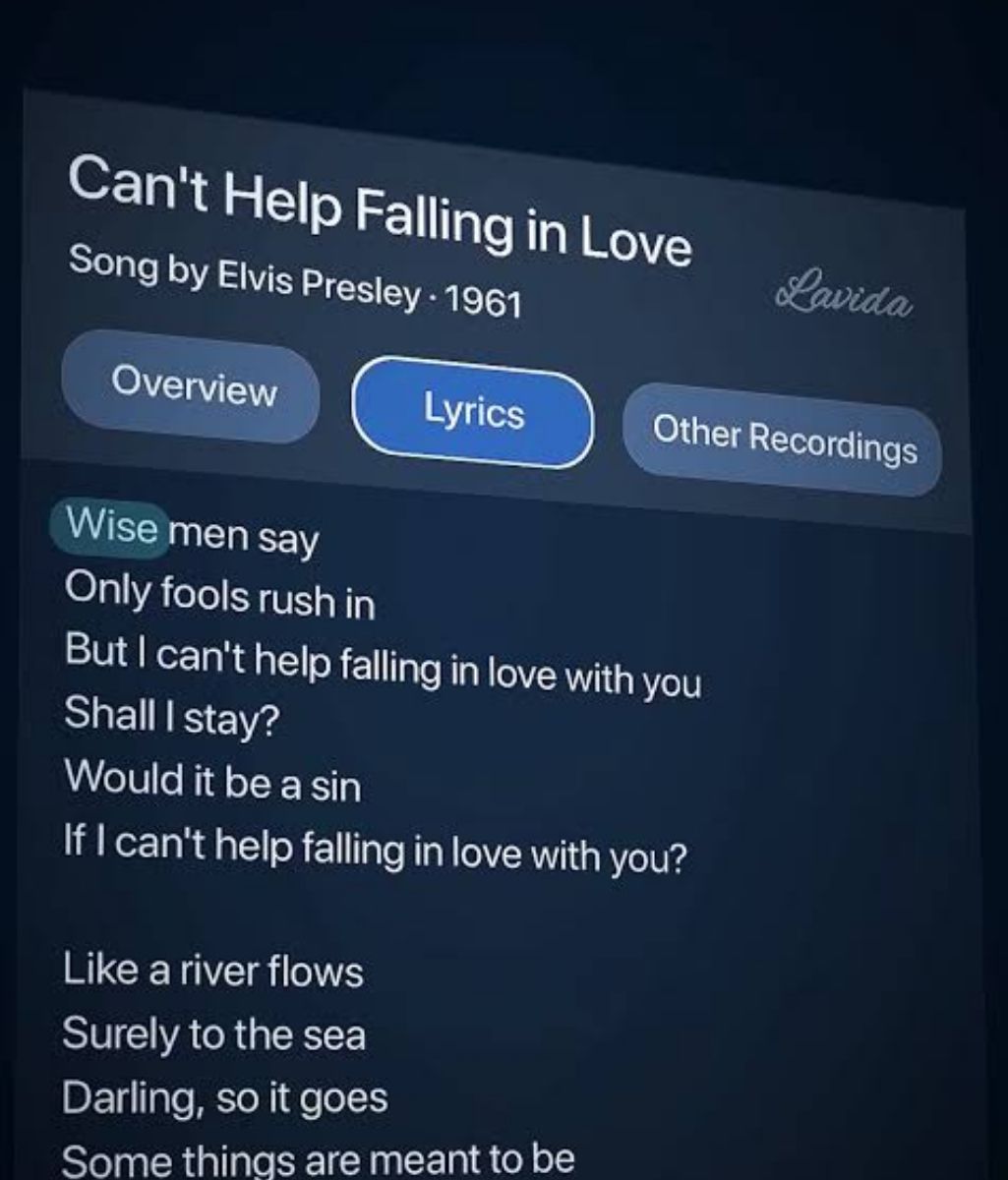
For Elvis Presley, “Can’t Help Falling in Love” became something much bigger than another successful single. More than six decades after he recorded it, the song is still played at weddings, anniversaries, memorials, first dances, and quiet moments when people are trying to say something they cannot quite put into ordinary words. Its melody is gentle, its message is simple, and Elvis sings it with a restraint that feels almost completely different from the explosive rock-and-roll image that first made him famous.
The song was recorded on March 23, 1961, at Radio Recorders in Hollywood for the movie Blue Hawaii. It was written by Hugo Peretti, Luigi Creatore, and George David Weiss, and Elvis’s official music archive lists an impressive group of musicians on the session, including Scotty Moore, Hank Garland, D.J. Fontana, Floyd Cramer, and The Jordanaires.
What makes the recording so striking is how little Elvis tries to overpower it.
There is no dramatic vocal acrobatics and no aggressive rhythm pushing him forward. Instead, he lets the melody breathe. His voice sounds warm, careful, and almost vulnerable, as though he understands that the emotion works best when it is not forced.
That restraint became one of the song’s greatest strengths.
By 1961, Elvis was already famous for changing popular music with records like “Heartbreak Hotel,” “Hound Dog,” and “Jailhouse Rock.” Those performances had energy, danger, and swagger. “Can’t Help Falling in Love” revealed another side of him. It showed that the same singer who could dominate a stage could also make a love song feel private.
The track appeared on the Blue Hawaii soundtrack, released in October 1961, and was issued as a single later that year. Elvis’s official discography credits the song to the film and confirms the November 1961 single release.
Its commercial success quickly matched its emotional appeal.
In the United Kingdom, “Can’t Help Falling in Love” / “Rock-A-Hula Baby” reached No. 1 and remained on the chart for 20 weeks. The Official Charts Company records four weeks at the top and 13 weeks inside the Top 10.
But chart numbers alone do not explain why the song lasted.
Part of its appeal comes from the idea at the center of it: love as something that happens before reason has time to intervene. The song does not describe a complicated romance or tell a detailed story. Instead, it focuses on surrendering to a feeling that seems unavoidable.
That simplicity made it unusually universal.
Listeners did not need to know anything about Elvis’s own personal life to understand it. They could place their own memories inside the song. A couple beginning a marriage could hear hope in it. Someone looking back on a lifetime together could hear gratitude. Someone grieving could even hear the same words as a reminder of love that had outlasted separation.
Over time, Elvis himself helped give the song another meaning.
As his live career developed, “Can’t Help Falling in Love” became closely associated with the closing moments of his concerts. Live recordings from his Las Vegas years and his famous Aloha from Hawaii concert show the song occupying a special place near the end of the performance, allowing Elvis to leave audiences with something tender rather than simply another explosive showstopper. His official catalog documents live versions from both Las Vegas in 1969 and the Aloha from Hawaii concert in January 1973.
That association changed the song permanently.
For many fans, hearing its opening notes became connected not only with romance but with the feeling of Elvis saying goodbye at the end of a show.
That emotional layer became even stronger after his death in 1977.
Songs can change meaning when the singer is gone, and “Can’t Help Falling in Love” is a perfect example. A lyric originally performed as a declaration of romantic surrender began to sound, for many listeners, like a farewell from Elvis himself.
Perhaps that is why the song has never really disappeared.
New generations continue discovering it even when they have little connection to the world in which Elvis originally recorded it. Artists have covered it in countless styles, but the Presley version remains the reference point because of how little it seems to demand from the listener.
It does not shout.
It does not chase attention.
It simply waits.
Then Elvis begins singing.
That quality makes the recording feel surprisingly modern even though it was created in 1961. The production is elegant enough to avoid sounding trapped in one era, and the performance depends more on emotion than fashion.
There is also something almost symbolic about the song’s place in Elvis’s career.
He became famous partly because he seemed dangerous to older audiences. His movements, voice, and combination of musical influences challenged the boundaries of mainstream entertainment in the 1950s.
Yet one of the songs that endured most powerfully was not rebellious at all.
It was gentle.
Elvis Presley spent his career proving he could excite a crowd.
“Can’t Help Falling in Love” proved he could quiet one.
More than sixty years later, couples still choose it for weddings, singers still return to it, and Elvis fans still recognize the opening melody almost instantly.
That kind of longevity cannot be created by promotion alone.
It happens when a song attaches itself to real memories.
For millions of people, “Can’t Help Falling in Love” became the sound of falling in love, staying in love, and remembering someone they once loved.
Elvis recorded it for a movie.
But generations of listeners turned it into something far more personal.
And that may be why, after all these years, it still sounds less like an old hit and more like a promise.
Video