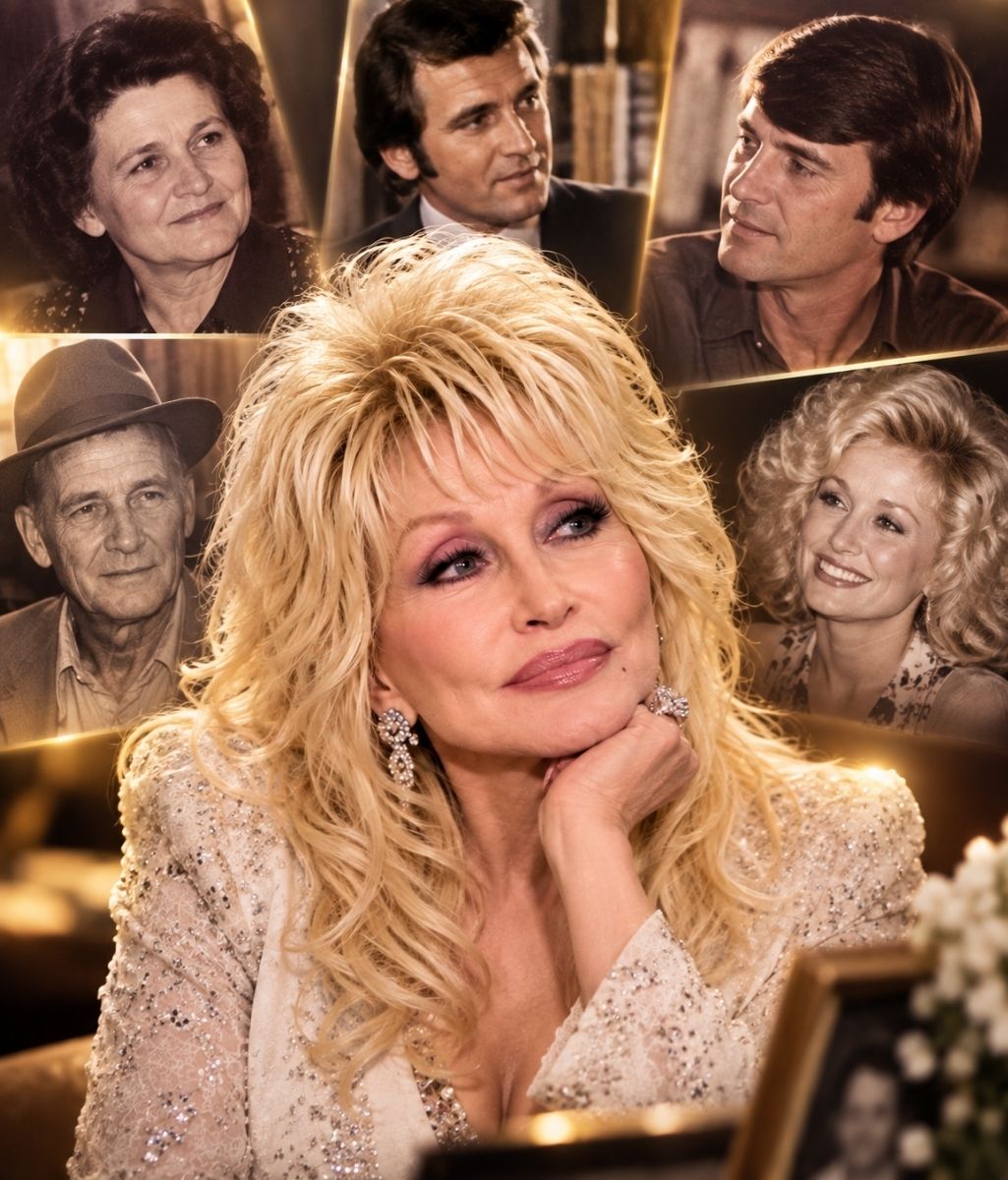
Dolly Parton spent more than six decades telling the world about love, but the people who mattered most to her were not all connected to the same kind of love. Some shaped her childhood. One helped launch her career. Another knew her long before the fame, rhinestones, and international recognition. And one man remained beside her for nearly 59 years while deliberately staying almost completely outside the spotlight.
Dolly never publicly released an official ranking of the five people she loved most, so this should not be treated as a literal list she personally numbered. But looking across the stories she told throughout her life, five relationships repeatedly emerge as essential chapters in understanding the woman behind the music.
The first is Judy Ogle, Dolly’s childhood friend and one of the longest relationships of her life.
Judy knew Dolly before Nashville knew her name. Their friendship began in East Tennessee, long before record deals, television appearances, Dollywood, or Grammy Awards entered the picture. Over the decades, Judy remained part of Dolly’s private world, and that closeness inevitably sparked speculation from outsiders who struggled to understand how two women could remain so close for so long.
Dolly repeatedly rejected attempts to turn that friendship into something it was not. What mattered to her was much simpler: Judy had been there from the beginning.
That kind of relationship becomes increasingly rare when fame arrives. Most people who entered Dolly’s life later knew exactly who Dolly Parton was. Judy had known the girl before the persona existed.
Next came Porter Wagoner, one of the most complicated and important professional relationships of Dolly’s career.
Porter invited the young Dolly onto The Porter Wagoner Show in 1967, giving her national television exposure at a crucial moment. Together they became one of country music’s most recognizable duos, recording hit records and performing for audiences across America.
But success eventually created tension.
Dolly wanted to establish herself fully as a solo artist, while Porter resisted losing the partnership they had built. Their arguments became intense enough that ordinary conversation no longer seemed capable of resolving the situation.
So Dolly did what she always did when words failed her.
She wrote a song.
That song was “I Will Always Love You.”
Dolly later explained that she wrote it out of grief because Porter could not understand why she needed to leave. The song was not romantic. It was a deeply emotional farewell to a man she appreciated, fought with, learned from, and loved in a complicated professional and personal sense. Dolly remembered singing it to Porter in his office and watching him cry before he finally agreed to let her move forward.
Their relationship had difficult chapters afterward, but Dolly never erased what Porter had meant to her.
Then came the man who shaped Dolly’s understanding of work, determination, and dignity: her father, Robert Lee Parton Sr.
Dolly grew up as one of twelve children in rural East Tennessee, and her father worked relentlessly to support the family. He did not have the opportunity to learn to read or write, but Dolly consistently described him as one of the smartest people she had ever known.
His struggle with literacy stayed with her for the rest of her life.
In 1995, Dolly launched the Imagination Library in Sevier County, sending free books to children from birth to age five. She later said the program was created in honor of her father because his inability to read had affected his confidence despite his intelligence and work ethic. What began locally eventually expanded into an enormous international literacy effort.
For Dolly, the project turned one of her father’s greatest hardships into something that could help millions of children.
If her father represented discipline and resilience, her mother, Avie Lee Parton, represented imagination, music, and emotional storytelling.
Avie Lee raised twelve children under extremely difficult circumstances, yet music was constantly present in the Parton home. She sang Appalachian songs, told stories, and helped create the emotional world Dolly would later transform into songwriting.
One of Dolly’s most famous songs grew directly from something her mother did.
When Dolly was a child, Avie Lee stitched together scraps of fabric to make her a coat and told her a biblical story about Joseph’s coat of many colors. Other children mocked Dolly for wearing it, but she remembered her mother’s love more strongly than the embarrassment.
Years later, that memory became “Coat of Many Colors,” one of the defining songs of Dolly’s career.
That is why Avie Lee’s influence can be heard throughout Dolly’s music. Dolly did not simply inherit a love of singing from her mother. She inherited the idea that ordinary family experiences could become stories worth preserving.
But there was one relationship that stretched across nearly Dolly’s entire adult life.
Carl Dean.
Dolly met Carl in Nashville in 1964, shortly after arriving in the city to pursue her dreams. They married in 1966 and remained together until Carl’s death in March 2025, sharing nearly 59 years of marriage.
Their relationship confused outsiders for decades because Carl wanted almost nothing to do with show business.
He avoided interviews.
He rarely attended industry events.
He stayed away from red carpets.
Dolly became one of the most recognizable women in the world while Carl remained so private that generations of fans barely knew what he looked like.
Yet Dolly repeatedly suggested that this was not a weakness in their marriage.
It was one of its strengths.
Carl gave her a life away from Dolly Parton.
He knew the woman who came home after the stage lights went out. He did not need to become part of the brand, and Dolly did not force him into a world he never wanted.
After Carl died, Dolly spoke about him with a vulnerability that made decades of old interviews sound different. She called theirs a “great old love story” and said something that revealed just how central he had been to her life:
“Without Carl, I wouldn’t be here.”
That single sentence may explain why Carl belongs at the end of this story.
Judy knew Dolly before fame.
Porter helped her reach a national audience.
Her father shaped her determination and inspired one of her greatest philanthropic achievements.
Her mother gave her music, stories, and a way of turning hardship into beauty.
But Carl became home.
He was there before the biggest records, movies, businesses, awards, and worldwide fame.
And he remained there when the rest of the world only knew the woman in rhinestones.
Dolly never officially announced a list naming these five people as the ones she loved most.
But if her life is told through the relationships that shaped it, their importance is difficult to miss.
And Carl Dean’s place at the end feels especially fitting.
The world got Dolly Parton.
Carl Dean got Dolly.