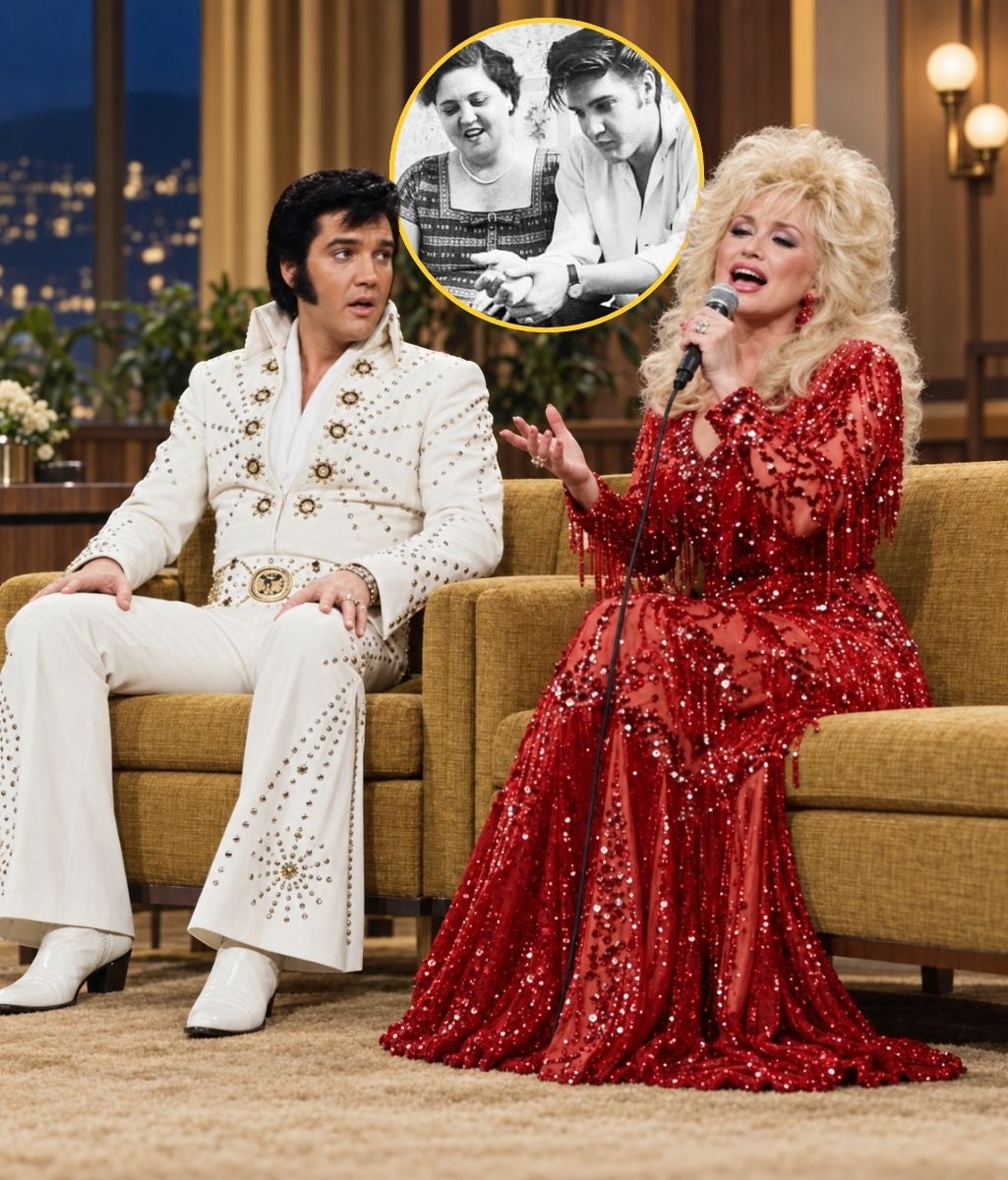
A dramatic story has been circulating online claiming that Dolly Parton once appeared on live television and delivered a final message from Gladys Presley to her son, Elvis. According to the story, Dolly began singing a private lullaby Gladys had once used with Elvis, and within moments the King of Rock ’n’ Roll was overwhelmed with tears. It is an unforgettable image, but there is one important problem: there is no verified historical evidence that this television moment ever happened.
The viral version appears to come from a recently published dramatized video that openly identifies itself as fictional storytelling rather than a documented historical event. The video describes Dolly revealing a forgotten message supposedly hidden inside a Presley family Bible, but no reputable biography, archive, television transcript, or Presley family source confirms such an encounter. The video itself includes a disclaimer stating that the scene is fictional.
The timeline makes the claim even more difficult to support. Gladys Presley died on August 14, 1958, while Elvis was serving in the U.S. Army. Biography reports that Elvis received emergency leave to return to Memphis and spend time with his mother shortly before she died. Her death devastated him, and he later described her as the most important woman in his life.
Dolly Parton, meanwhile, was only 12 years old in 1958. Her major national career was still years away, making the idea that she possessed a secret final message from Gladys and later delivered it to Elvis on live television unsupported by the known historical record. There is also no authenticated clip of Dolly and Elvis sharing such an exchange.
But the absence of that story does not mean Dolly and Elvis had no remarkable connection.
The real story between them is already extraordinary.
Years later, Elvis wanted to record Dolly’s “I Will Always Love You.” Dolly had written the song as a farewell to Porter Wagoner when she decided to leave their professional partnership. By the time Elvis expressed interest, the song had already become deeply important to her personally and financially.
Dolly was thrilled.
She admired Elvis enormously, and the thought of hearing him sing something she had written felt almost unbelievable. In later interviews, she repeatedly described how excited she became when she learned that Elvis wanted the song.
Then Colonel Tom Parker stepped in.
According to Dolly, Elvis’s longtime manager told her that Presley generally did not record a song unless his team received a substantial share of the publishing rights. In the case of “I Will Always Love You,” Dolly said Parker wanted roughly half of the publishing. She refused because the song had become one of the most important copyrights in her entire publishing company.
The decision devastated her.
Dolly later recalled going home and crying because she desperately wanted Elvis to record the song. Turning him down was not an act of disrespect or ego. She simply understood that giving away such a large percentage of ownership would affect the song for the rest of her life.
Elvis never released a completed commercial recording of “I Will Always Love You.”
For years, Dolly could only wonder what his version might have sounded like.
Then history took an unexpected turn.
In 1992, Whitney Houston recorded the song for The Bodyguard. Her version became a global phenomenon, spending 14 weeks at No. 1 on the Billboard Hot 100 and turning Dolly’s composition into one of the most famous ballads in modern music history.
Because Dolly had protected her publishing, she continued to benefit from that success.
The choice that once made her cry eventually became one of the smartest business decisions of her career.
There is another genuine Presley connection that makes the story even more poignant. Dolly later revealed that Priscilla Presley once told her that Elvis had sung “I Will Always Love You” to Priscilla as they were leaving the courthouse after their divorce. Dolly said hearing that story moved her deeply because it connected her song to an intimate moment in Elvis’s personal life even though he had never officially recorded it.
That real story contains plenty of emotion without inventing a secret message from Gladys.
Elvis truly was devastated by his mother’s death.
Dolly truly admired Elvis.
Elvis truly wanted to record Dolly’s song.
Dolly truly turned down the opportunity to protect her publishing.
And years later, Priscilla truly told Dolly that Elvis had privately sung the song during one of the most painful moments of their marriage.
Those facts are already remarkable enough.
The viral story about Dolly delivering Gladys Presley’s final message may be emotionally effective, but it should be understood for what it is: a fictional dramatization inspired by real people, not a verified live television event.
The real connection between Dolly Parton and Elvis Presley was quieter.
It revolved around admiration, a song, a difficult business decision, and an opportunity that never happened.
Dolly never got to hear Elvis make “I Will Always Love You” his own.
But the song still found its way into Elvis’s personal life.
And decades later, the decision Dolly once cried over helped preserve one of the most valuable and enduring songs she ever wrote.
Sometimes the truth is less cinematic than the viral version.
But in this case, it may be even more powerful.