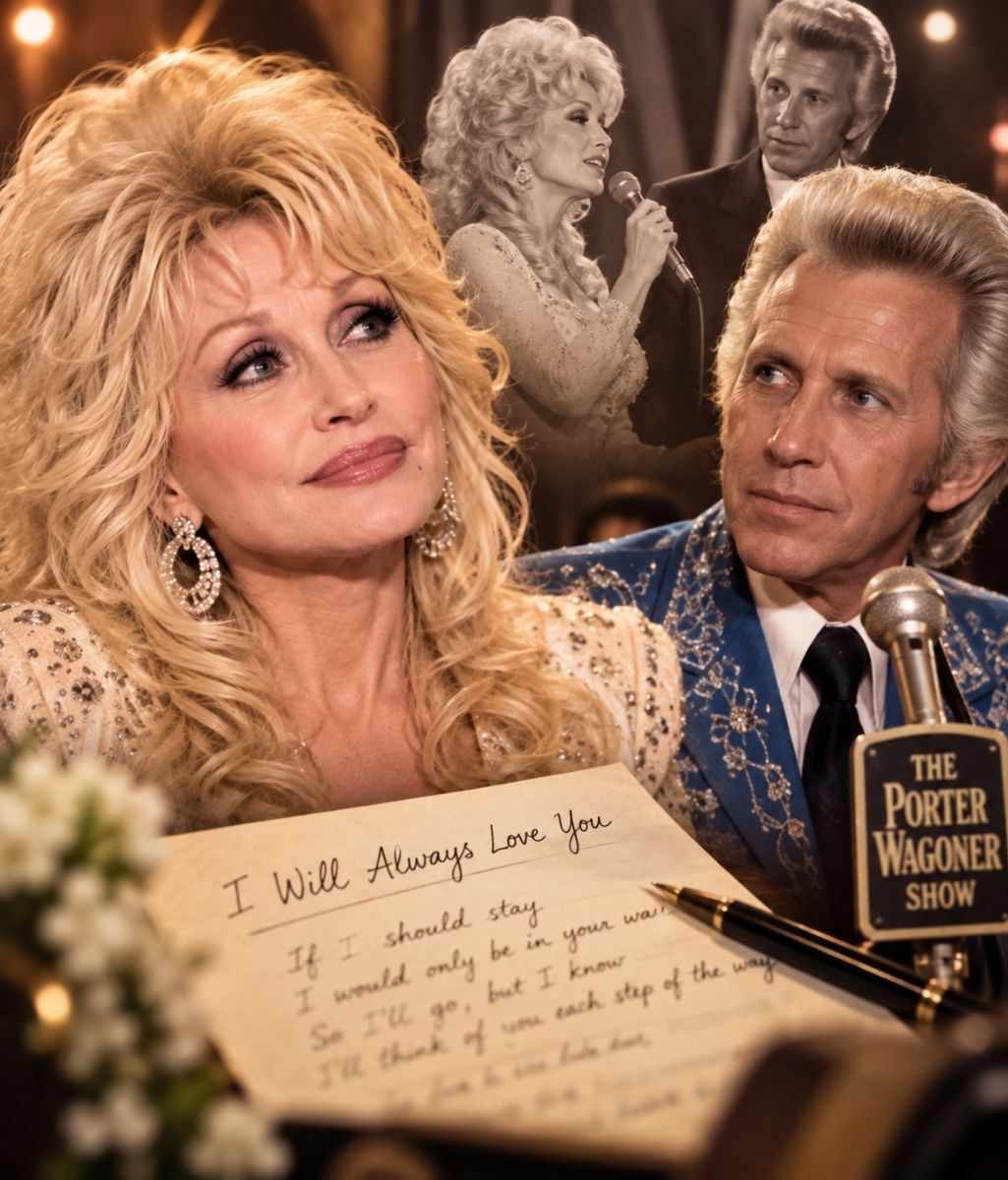
Long before “I Will Always Love You” became one of the most recognizable songs in the world, it began as something far more personal: Dolly Parton trying to say goodbye to Porter Wagoner in the only way she knew how.
By the early 1970s, Dolly had spent years as Porter’s duet partner on The Porter Wagoner Show. Their partnership had transformed her career, giving her national exposure and helping establish her as one of country music’s rising stars. Together they recorded hit duets, toured, appeared on television, and built one of Nashville’s most recognizable professional partnerships.
But Dolly wanted more.
She had songs of her own to sing and ambitions that stretched beyond being introduced forever as Porter Wagoner’s female partner. Dolly later said she knew she needed to strike out on her own, but convincing Porter was another matter entirely. Their relationship had become so emotionally and professionally intertwined that every discussion about leaving seemed to end in frustration.
Dolly tried telling him directly.
It did not work.
She tried again.
Still nothing changed.
Eventually, she realized there was one language Porter might understand better than an argument.
A song.
Dolly went home and wrote “I Will Always Love You.”
The title later became associated with romantic heartbreak, especially after Whitney Houston’s enormous 1992 recording, but Dolly’s original intention was very different. The song was a farewell to Porter, expressing gratitude and affection while making clear that she still needed to leave.
The message was gentle because Dolly did not want to erase what Porter had meant to her.
He had helped her.
He had believed in her.
But she could no longer remain where she was.
According to Dolly’s own recollection, she returned the next day and asked Porter to sit down because she had something she needed to sing to him. Then she performed the song.
Porter listened from behind his desk.
And he began to cry.
Dolly later remembered him telling her that it was the best song she had ever written. Then, after years of resistance, he finally gave her the answer she had been waiting for.
She could go.
There was just one condition.
Porter wanted to produce the record.
That moment changed everything.
The same man who had struggled to accept Dolly’s departure now became the producer of the very song she had written to leave him.
It is hard to imagine a more fitting ending to that chapter of their partnership.
Dolly recorded “I Will Always Love You,” and the song reached No. 1 on the country chart in 1974. Years later, she recorded it again for The Best Little Whorehouse in Texas, and that version also reached No. 1, making the song a country chart-topper twice before Whitney Houston ever touched it.
The song gave Dolly something even more important than commercial success.
It gave her freedom.
After seven years on Porter’s television show, she finally stepped away in 1974 to build the independent career she had been dreaming about since childhood. Dolly’s official biography describes the departure as a pivotal moment that caused friction but ultimately allowed her to pursue the larger future she had always imagined.
That did not mean the relationship suddenly became easy.
Their professional separation became complicated, and disputes continued after Dolly left. Porter remained contractually involved in producing some of her records, and the two eventually became entangled in legal and business tensions that stretched through the decade.
For a time, the emotional goodbye represented by “I Will Always Love You” seemed almost too graceful compared with what followed.
But their story did not end with bitterness.
Years later, Dolly and Porter reconciled.
They were able to look back on their partnership with greater perspective, and Dolly never denied how important Porter had been in helping her become the artist she eventually became. She continued to speak about him with affection while also acknowledging that leaving had been necessary for her survival as an independent artist.
The most moving symbol of that reconciliation came decades later.
When Porter celebrated his 50th anniversary as a member of the Grand Ole Opry in 2007, Dolly returned to perform “I Will Always Love You” for him again. By then, the song had traveled far beyond the office where Porter first heard it. Whitney Houston had turned it into a global phenomenon, and Dolly had become one of the most famous entertainers in the world.
But in that moment, the song belonged to the two people who had started the story.
Porter died later that same year at age 80 after battling lung cancer.
Looking back, the relationship between Dolly and Porter was never simple enough to describe as either friendship or conflict.
It was both.
Porter opened a door for Dolly when she desperately needed one.
Dolly eventually became too ambitious to remain inside that door forever.
Their partnership produced hits, arguments, success, legal disputes, gratitude, resentment, forgiveness, and one of the greatest farewell songs ever written.
That is what makes the moment in Porter’s office so powerful.
Dolly had spent months trying to explain why she needed to leave.
Arguments had failed.
Reasoning had failed.
Then she sang “I Will Always Love You.”
Porter cried.
And suddenly he understood.
The song did not destroy their relationship.
It changed it.
Dolly walked away from his television show, but she never erased him from her story.
And Porter, despite everything that came afterward, became permanently connected to the song that eventually traveled farther than either of them could have imagined.
What began as one woman trying to tell one man goodbye became a song heard around the world.
But before the Grammys, before Whitney Houston, and before millions of people made it their own, “I Will Always Love You” belonged to Dolly Parton and Porter Wagoner.
It was the goodbye he finally understood.