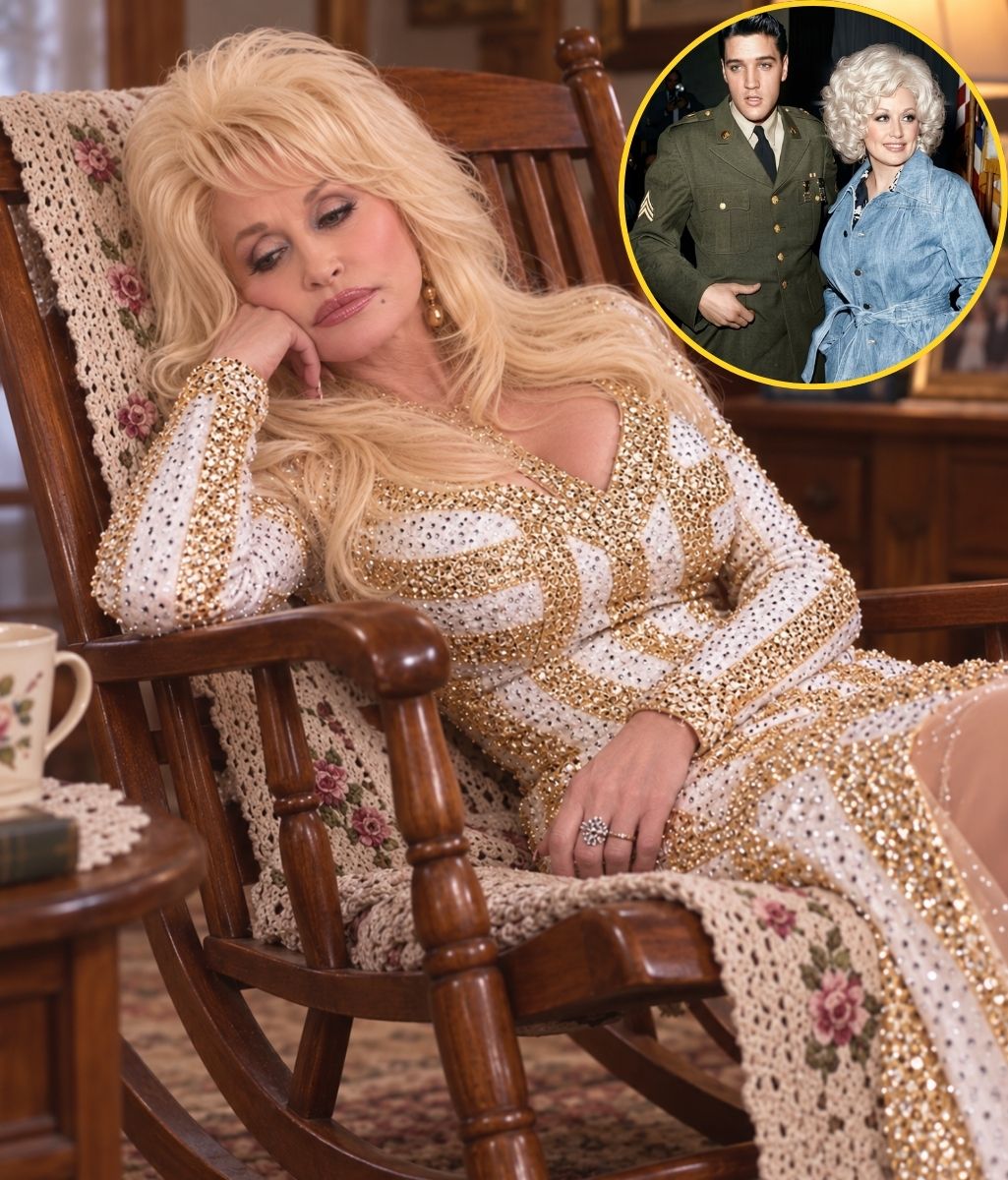
Long before Whitney Houston turned “I Will Always Love You” into one of the biggest songs in pop history, Elvis Presley wanted to record it. For Dolly Parton, the news felt almost impossible to believe. Elvis was already one of the most famous singers in the world, and the thought of hearing him sing a song she had written seemed like the kind of moment a songwriter might wait an entire lifetime to experience.
Dolly later recalled how excited she became when she learned that Elvis loved the song. She admired him deeply, and the idea of his voice carrying her words meant more to her than simply another cover version. It felt like validation from one of the most important performers of the era, and for a time, the recording appeared close enough that Dolly believed it was really going to happen.
Then Colonel Tom Parker, Elvis’s longtime manager, changed everything.
According to Dolly, Parker told her that Elvis generally did not record a song unless his side received a major share of the publishing rights. In the case of “I Will Always Love You,” Dolly said the request was for half of the publishing. That meant she would have to permanently give away 50 percent of the ownership in a song she had written entirely herself.
For Dolly, the decision became painful almost immediately.
She wanted Elvis to record the song.
But she did not want to give the song away.
Publishing rights were not simply paperwork. They determined who controlled the composition and who would benefit financially every time it was recorded, licensed, performed, or used in the future. Dolly understood that even then, and although saying no meant losing an extraordinary opportunity, she refused to surrender half of what she had created.
She later admitted that she went home and cried all night.
That detail has become one of the most famous stories of Dolly’s career because it reveals the conflict behind the decision. She was not rejecting Elvis out of pride or ego. She was devastated because she genuinely wanted to hear what he would do with the song.
But she also trusted her instincts as a songwriter and businesswoman.
That trust would eventually prove remarkable.
Elvis never released a completed commercial recording of “I Will Always Love You,” so Dolly never got the version she had once imagined hearing. The deal ended before that dream could become reality, leaving behind one of music history’s biggest “what if” moments.
What would Elvis have done with the song?
Would he have made it bigger?
Would it have become one of his signature ballads?
No one can know.
What is known is that Dolly kept the publishing.
Years later, that decision changed the financial history of the song completely.
In 1992, Whitney Houston recorded “I Will Always Love You” for The Bodyguard. Her version became a global phenomenon, spending 14 weeks at No. 1 on the Billboard Hot 100 and introducing Dolly’s composition to millions of listeners who may never have heard the original country recording.
Dolly later described hearing Whitney’s version for the first time while driving. She was so overwhelmed by the power of the recording that she said she had to pull over because she feared she might wreck.
By then, the decision she once cried over looked very different.
Because Dolly had refused to surrender her publishing rights, she still owned the song when Whitney’s version exploded around the world. Every new life the composition found reinforced the value of the choice Dolly had made years earlier, when there had been no guarantee that another opportunity would ever come along.
That story is one reason Dolly became respected as far more than a singer.
Behind the rhinestones, humor, and larger-than-life personality was someone who understood ownership extremely well. Dolly knew that writing a song and owning a song were not the same thing, and she spent much of her career protecting the work she created.
The Elvis episode may have been one of the clearest examples.
Dolly could have accepted the deal and celebrated the prestige of having Elvis Presley record her composition.
Instead, she chose long-term control over short-term glory.
At the time, it hurt.
Years later, it looked almost prophetic.
There is another Presley detail that makes the story even more emotional. Priscilla Presley later told Dolly that Elvis had sung “I Will Always Love You” to her privately while they were leaving the courthouse after their divorce. Dolly said hearing that story touched her deeply, because it meant the song had still found its way into Elvis’s life even though he never officially recorded it.
That may have been the closest Dolly ever came to hearing what the song meant to him personally.
It also adds another layer to the story.
The song Dolly refused to give away still reached Elvis.
Just not in the way she had originally imagined.
Looking back, the episode feels like a perfect summary of Dolly Parton’s career.
She followed her emotions.
But she also followed her instincts.
She could be sentimental enough to cry all night over losing the chance to work with Elvis, yet practical enough to protect the ownership of her work when the deal did not feel right.
That combination mattered.
Without it, “I Will Always Love You” might have followed a completely different path.
Instead, Dolly kept control.
Whitney later transformed the song into a worldwide anthem.
And Dolly’s decision became one of the most famous examples of an artist understanding her own value before the rest of the world fully understood it.
She never got the Elvis recording she dreamed about.
But she kept something even more important.
She kept the song.