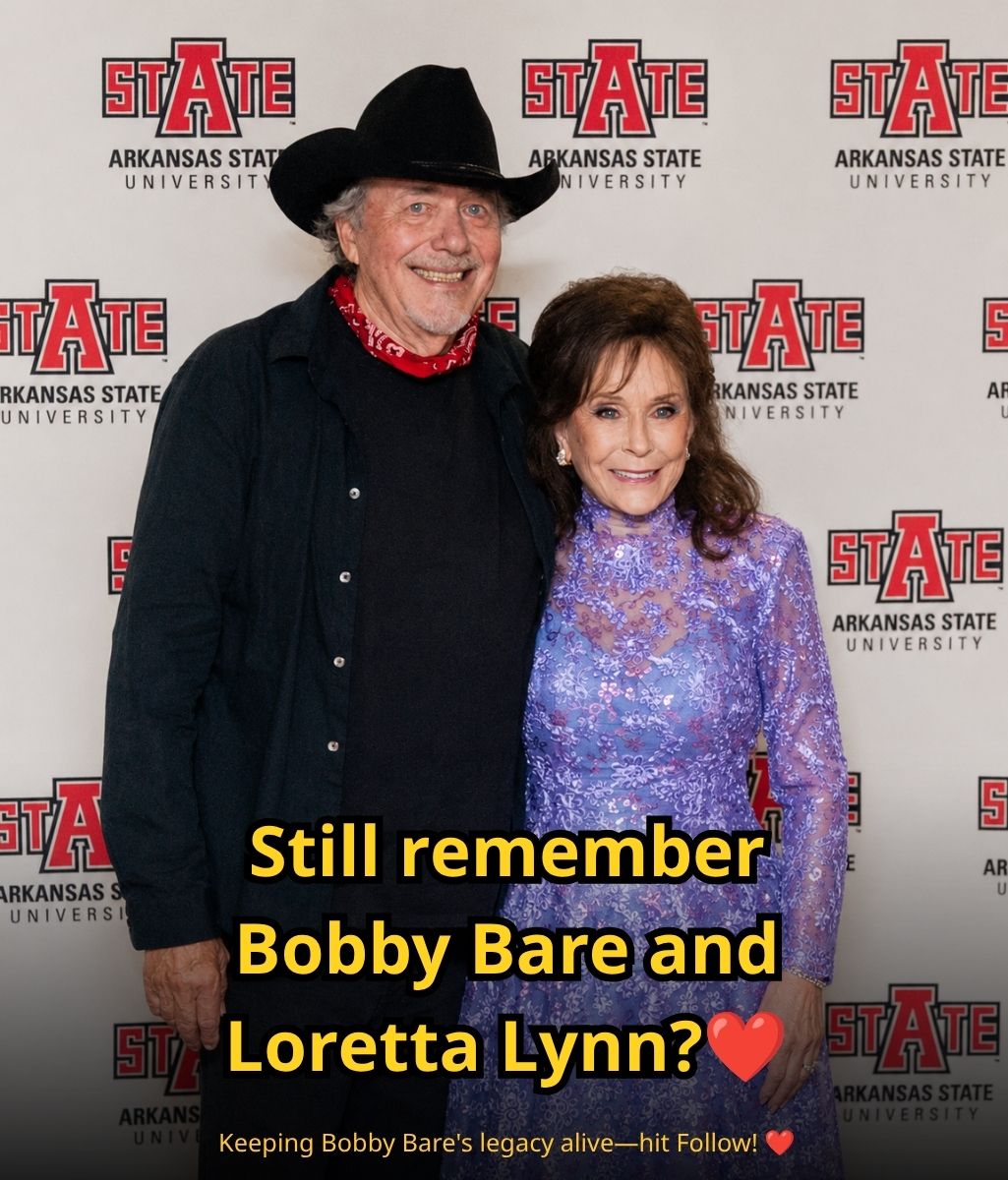
Long before “Detroit City” made Bobby Bare famous and before Loretta Lynn became the voice behind “Coal Miner’s Daughter,” an unreleased recording quietly connected their stories—and Loretta still remembered it more than half a century later.
Long before Bobby Bare and Loretta Lynn became two of the most respected names in country music, both were trying to find a place in an industry that offered very few guarantees. Bare had already left Ohio and made his way to California, chasing opportunities wherever he could find them. He sang in clubs, worked with musicians on the West Coast, wrote songs, and struggled through recordings that failed to give him the breakthrough he wanted. According to Bare’s official biography, he became associated with guitarist Speedy West, wrote material for West’s publishing company, and continued searching for a way into the music business. This was years before “Detroit City,” “500 Miles Away from Home,” or the Country Music Hall of Fame. He was simply a young singer and songwriter hoping somebody would hear something worthwhile in the songs he was carrying.
At roughly the same time, Loretta Lynn was beginning a journey of her own. In 1960, she recorded “I’m a Honky Tonk Girl,” the record that would become her first important step toward national recognition. Loretta was not yet the celebrated songwriter whose honest stories about working-class women would eventually change country music. She was still fighting to be heard, traveling from radio station to radio station and helping promote her own record. Yet during those earliest recording sessions, something happened that would connect her story to Bobby Bare’s in a way that remained largely forgotten for decades.
More than fifty years later, Loretta herself recalled it.
While discussing Bobby Bare before the 2014 Johnny Cash Music Festival at Arkansas State University, Loretta remembered that when she cut her first record, “Honky Tonk Girl,” she also recorded a song written by Bobby Bare. That recording was never officially released. Loretta did not even need to remember it publicly after so many years, but she did—and she described Bare’s composition as “a heck of a good song.” It was a brief recollection, yet for anyone interested in the early lives of these two country legends, it reveals something remarkable. Before either career had reached its greatest heights, Loretta Lynn had already heard something in a Bobby Bare song worth taking into the studio.
There is an important distinction to make. Available documentation does not establish that Loretta was definitively the first artist ever to record a Bobby Bare composition, nor does the surviving account identify the title of the unreleased song. But the central story comes directly from Loretta’s own recollection: during the making of her first record, she cut a Bare song that remained unreleased. That alone gives the moment extraordinary historical significance.
Think about where both artists were at the time. Bobby Bare had not yet become the Grammy-winning voice behind “Detroit City.” His breakthrough years at RCA were still ahead of him. His early career had been filled with false starts, unsuccessful singles, club work, songwriting, and the uncertainty familiar to almost every young musician trying to survive. Loretta, meanwhile, had not yet recorded “Coal Miner’s Daughter,” “You Ain’t Woman Enough,” or the many songs that would turn her into one of country music’s defining female voices. Neither knew exactly what history had waiting for them.
That is what makes Loretta’s decision to record Bare’s song so meaningful in retrospect.
For an unknown or struggling songwriter, having another performer choose one of your songs can mean far more than royalties or a name printed on a record label. It is evidence that someone else heard the idea and believed it deserved a voice. Even though Loretta’s recording was never released, the act itself represented recognition at a time when Bare was still fighting for recognition almost everywhere else.
Bare knew that struggle well. His official biography describes an early career in California filled with opportunity followed by disappointment. He recorded for Capitol, later moved to Challenge, and watched several records fail to connect. Even his first major success, “The All-American Boy,” became complicated when it was released under the name of his friend Bill Parsons while Bare was serving in the Army. Years would pass before Chet Atkins brought him to RCA and his career finally found the direction he had been searching for.
Loretta’s own rise required extraordinary persistence. “I’m a Honky Tonk Girl” did not become successful because an enormous Nashville machine immediately placed her at the center of country music. Loretta and her husband famously traveled to radio stations promoting the record themselves. Her career grew through determination, touring, songwriting, and an ability to speak directly about experiences many women recognized but rarely heard expressed so plainly in popular country songs.
Eventually, both of those struggling artists became legends.
Bare would build a career around songs such as “Detroit City,” “500 Miles Away from Home,” “Marie Laveau,” and “Daddy What If,” while becoming famous for his respect for great songwriters. Loretta would become one of the most influential singer-songwriters in country history. Their paths would continue crossing over the years, and by 2014 they were sharing a bill connected to another old friend and legend, Johnny Cash.
But perhaps the most revealing part of the story is that Loretta still remembered that forgotten recording.
The song never became a hit. It apparently never reached the public. Most fans have never heard it, and its title is not identified in the surviving account. Yet Loretta Lynn carried the memory for more than half a century. When Bobby Bare’s name came up, she remembered the young songwriter behind a song she had once considered good enough to record.
Country music history is usually told through No. 1 records, awards, sold-out concerts, and famous photographs. But sometimes the most human stories happen before any of that exists. A songwriter writes something in uncertainty. Another young artist hears it. She decides it deserves a chance.
The record may have disappeared into the vaults, but the gesture did not disappear from memory. Long before Bobby Bare and Loretta Lynn became legends, one unreleased song quietly connected them—and more than fifty years later, Loretta still remembered how good it was.