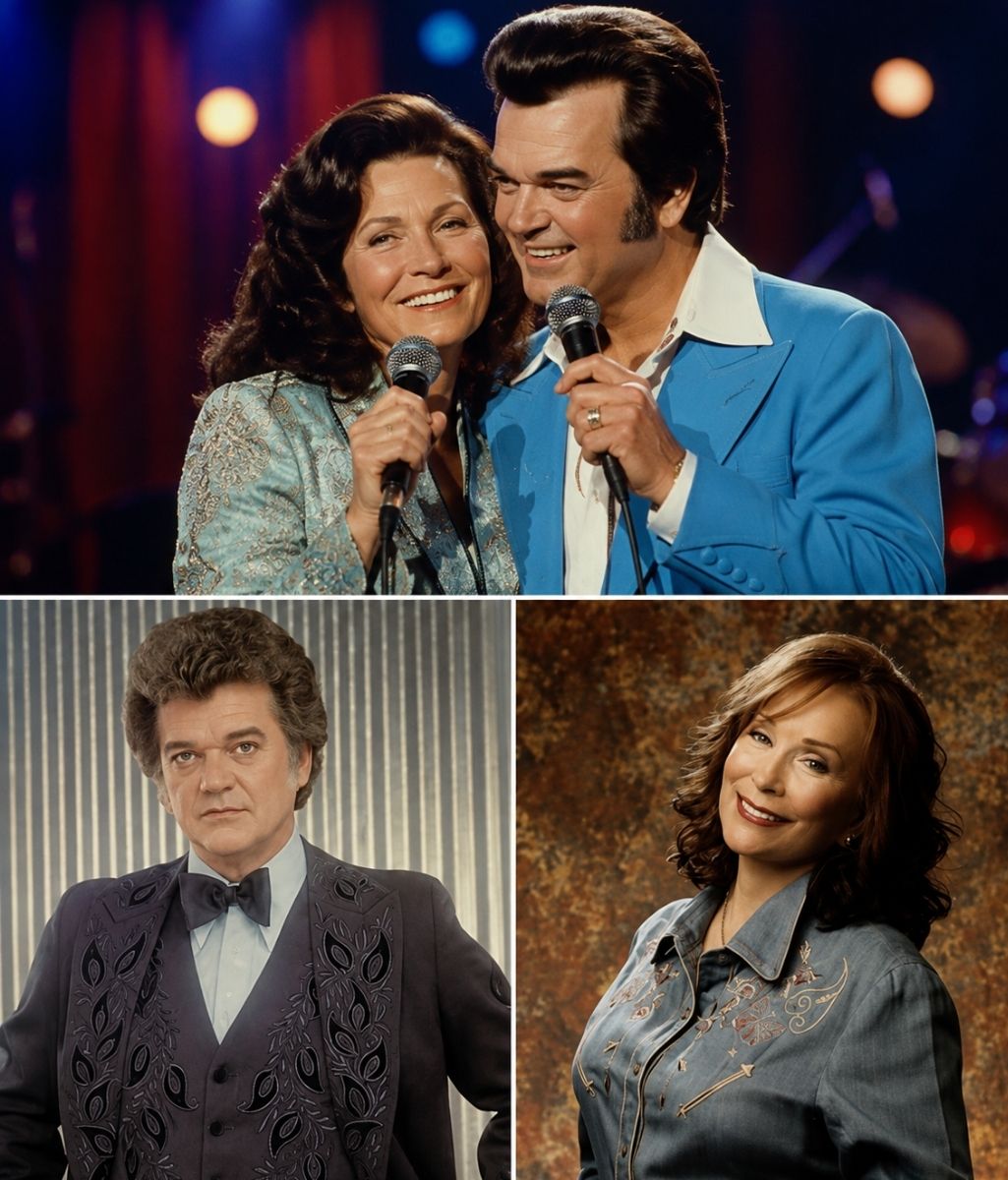
For more than two decades, Conway Twitty and Loretta Lynn had stood together beneath stage lights and behind studio microphones, creating some of the most unforgettable duets in country music history. If their fans had imagined a final meeting between them, they might have pictured one more song, one more concert, or perhaps one last quiet moment in a recording studio. Instead, fate brought Conway and Loretta together one final time in the most unexpected place imaginable — a Missouri hospital, during the last hours of Conway’s life.
The strange chain of events began after Conway performed on June 4, 1993, in Branson, Missouri. At 59, he was still doing what he had done for decades: traveling, performing, and bringing the songs people loved to audiences who had followed him for years. There was no farewell tour and no announcement that this would be the final performance of his life. When Conway left the stage that evening, neither he nor the people who had watched him could have known that he would never perform another song in public.
After the show, Conway became seriously ill while traveling on his tour bus. What had begun as another evening on the road suddenly turned into a medical emergency, and he was rushed to Cox Medical Center South in Springfield, Missouri. Doctors discovered that Conway was suffering from a serious abdominal condition, and emergency surgery followed. The situation had changed with frightening speed, but an extraordinary coincidence was already waiting inside that same hospital.
Loretta Lynn was there.
She had not come because she knew Conway was ill. She had not been summoned to say goodbye to her longtime duet partner, and she had no reason to expect that Conway would suddenly be brought through those hospital doors. Loretta was at the hospital because her husband, Oliver “Doolittle” Lynn, was recovering after heart surgery. Through an almost unbelievable turn of events, two people whose careers had been connected for more than twenty years found themselves in the same hospital for completely different reasons.
That coincidence becomes even more emotional when viewed against everything Conway and Loretta had shared. Beginning in the early 1970s, they became one of country music’s defining duet partnerships, recording songs such as “After the Fire Is Gone,” “Lead Me On,” “Louisiana Woman, Mississippi Man,” and “As Soon as I Hang Up the Phone.” Their voices worked together so naturally that generations of listeners became fascinated by their chemistry. Yet behind the famous performances was a friendship and musical partnership that endured long after their greatest duet successes.
They had spent years meeting in places designed for music. Recording studios, concert stages, television sets, award shows — these were the settings where fans expected to see Conway and Loretta together. Their partnership belonged to microphones, harmonies, applause, and songs that sounded like conversations between two people who understood exactly how the other would respond. No one could have imagined that one of their final encounters would happen under hospital lights rather than stage lights.
When Loretta learned that Conway had been brought to the same hospital, the situation must have been deeply unsettling. Reports and later accounts indicate that she was able to see her longtime friend during that final hospital stay. What should be treated carefully, however, are later dramatic versions of the story claiming that Loretta held Conway’s hand as he died and delivered a specific final farewell. Reliable contemporary accounts do not clearly establish those details, and the truth of what we do know is already powerful enough.
Loretta was there.
Conway was there.
And neither had planned for their paths to cross that night.
After emergency surgery, Conway’s condition remained critical. On June 5, 1993, Conway Twitty died at the age of 59, bringing an extraordinary career to an abrupt and unexpected end. The man whose voice had delivered dozens of country classics and whose musical partnership with Loretta had become part of Nashville history was suddenly gone.
For Loretta, the loss was not simply the death of another famous country singer. She had lost the man who had stood opposite her on countless recordings and performances, someone whose voice had become intertwined with hers in the memories of millions of listeners. Following Conway’s death, Loretta spoke of losing both a great duet partner and a great friend, words that captured a relationship far deeper than their chart statistics alone could explain.
That is what makes the hospital coincidence so haunting more than three decades later. Conway and Loretta had no opportunity to plan a grand final duet or decide together how their legendary partnership should end. Life simply placed them in the same building once more, at precisely the moment when Conway’s life was approaching its end. After decades of music created intentionally, their final crossing of paths was something neither of them could have arranged.
There is a strange symmetry to it. When Conway and Loretta first began recording together, nobody could know how important their partnership would become. They simply entered a studio and discovered that two already distinctive voices could create something remarkable when placed side by side. More than twenty years later, neither could know that a completely unrelated medical circumstance would bring them physically close again during the final hours of Conway’s life.
Their music continued after that night, of course, because recordings have a way of preserving what time takes away. Put on “After the Fire Is Gone” today and Conway answers Loretta exactly where he always did. Play “Louisiana Woman, Mississippi Man,” and the energy between them remains untouched by the decades that have passed. The people grow older and eventually leave us, but inside the recording, the duet never ends.
Loretta would live for nearly three more decades after Conway’s death, carrying memories of a partnership that could never be recreated. She continued speaking about him with affection over the years, while new generations discovered the records they had made together. When Loretta herself died in 2022, those old duets acquired yet another layer of meaning: both voices now belonged to history, but whenever someone pressed play, they returned together.
Perhaps that is why the story of June 1993 feels so different from the usual stories surrounding country music legends. There was no carefully scripted farewell. No final duet had been chosen. No stage had been prepared. No audience knew it was witnessing the end. Instead, Conway performed one final show, became gravely ill, and was taken to a hospital where, by extraordinary coincidence, his longtime musical partner was already present because someone else she loved was receiving medical care.
For more than twenty years, Conway Twitty and Loretta Lynn had repeatedly found their way back to each other through music. They met in studios, shared stages, traded verses, and created a body of work that remains one of country music’s most celebrated duet legacies. But when their story reached its final chapter, there was no microphone between them and no crowd waiting for another song.
There was simply a hospital in Missouri.
A longtime friend who happened to be there.
And a final meeting neither could possibly have planned.
Conway and Loretta spent decades creating unforgettable moments together. Yet one of the most moving moments in their story was never recorded at all — fate simply placed them in the same place one last time, on the final night of Conway Twitty’s life.