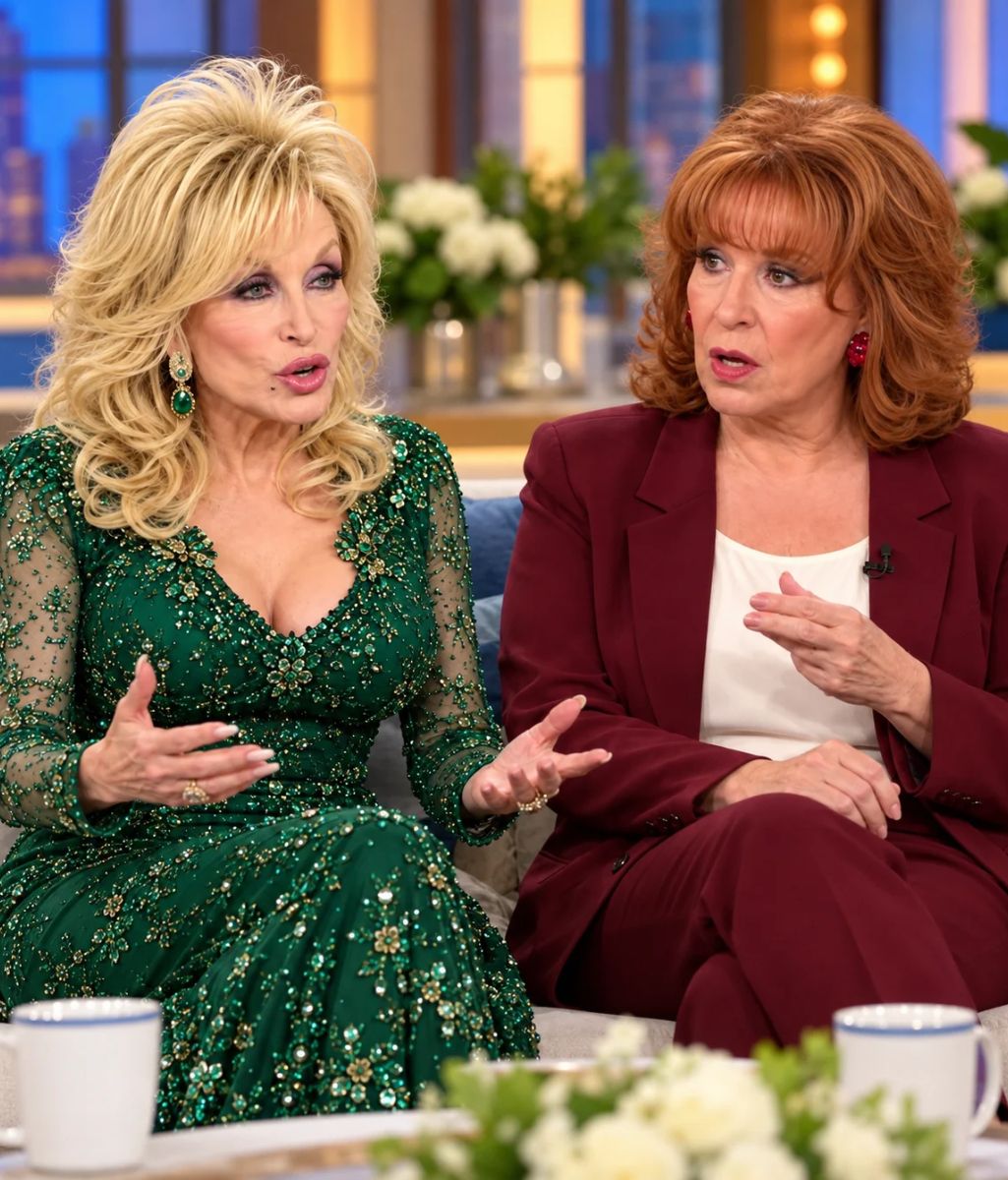
For months, social media has circulated dramatic stories claiming that Dolly Parton confronted Joy Behar on The View, delivered a devastating response, and left the studio audience in an uproar. The scene is easy to imagine because Dolly has long been known for quick wit, Southern charm, and the ability to answer uncomfortable questions without losing her composure. Yet the real story behind the supposed showdown is far less explosive than the viral headlines suggest.
The controversy actually began with Joy Behar’s comments about “Jolene.” During a discussion about Beyoncé’s reworked version of the song, Behar said she preferred the newer interpretation and described Dolly’s original lyrics as “anti-feminist” because the narrator pleads with another woman not to take her man. The comment immediately drew attention because “Jolene” is one of the most beloved songs in country music history and because Dolly herself has long been admired as a symbol of independence, resilience, and female ambition.
What often disappears in the retelling, however, is that Behar also made clear she was not attacking Dolly personally. She said she loved Dolly and pointed to projects such as “9 to 5” as examples of her feminist credentials. In other words, Behar was criticizing the perspective of one song, not dismissing Dolly Parton as a woman or artist.
That distinction did not stop the internet from doing what it does best.
The comment was quickly transformed into a feud.
Videos began appearing with titles suggesting that Dolly had walked onto The View, confronted Behar face to face, and delivered a response so sharp that the audience erupted. Some versions described a tense exchange, others claimed Dolly “humiliated” Behar, and still others framed the moment as a battle between country values and television commentary.
The problem is that reliable reporting does not document such a confrontation.
At least one of the most widely circulated videos openly states that its story is fictional and dramatized, with dialogue and situations created for entertainment rather than taken from an actual broadcast. That matters because viewers who see only the title or thumbnail can easily mistake a scripted story for a real television moment.
The irony is that Dolly does not need a fictional confrontation to prove she can hold her own.
Throughout her career, she has shown a remarkable ability to deal with criticism without turning every disagreement into a fight. Her public style has usually been to answer with humor, redirect attention, or simply let the work speak for itself. That approach has allowed her to move comfortably through very different audiences without constantly becoming trapped in cultural battles.
Dolly’s history with Joy Behar also makes the viral “feud” narrative look even less convincing.
In a 2009 interview hosted by Behar, the tone between them was warm and friendly. Behar told Dolly that people at The View loved her, while Dolly responded enthusiastically and complimented Behar’s show. The exchange sounded like two entertainers who knew each other and were comfortable talking, not like longtime enemies waiting for a confrontation.
That does not mean Behar’s criticism of “Jolene” went unnoticed.
Many country fans pushed back strongly because they felt the song was being judged outside the emotional context in which it was written. “Jolene” is not a political statement or a manifesto about how women should behave. It is a character-driven song about insecurity, fear, admiration, and vulnerability. Part of its power comes from the fact that the narrator does not sound strong or triumphant; she sounds afraid.
That emotional honesty is precisely why the song has lasted for decades.
Dolly did not write “Jolene” to create the perfect example of empowerment. She wrote a story about a woman who feels threatened and admits it. Listeners recognized the vulnerability because it felt human, not because it fit neatly into a modern ideological category.
That is also why the debate around Behar’s comment became so intense.
For longtime Dolly fans, criticizing the song felt almost like criticizing a memory. “Jolene” has been part of weddings, road trips, family gatherings, radio stations, and personal histories for generations. The song carries emotional weight that goes far beyond the literal story inside the lyrics.
When someone questions a song like that, audiences do not always hear a literary critique.
They hear someone challenging something they love.
The internet then turns that emotion into a much simpler story: Joy attacks Dolly, Dolly fires back, the audience goes wild.
It is a perfect viral narrative.
It just does not appear to be what actually happened.
The real story is more interesting because it shows how quickly celebrity commentary can become mythology. One remark on a talk show becomes a feud, the feud becomes a fictional confrontation, and the fictional confrontation eventually gets repeated so often that viewers begin treating it as historical footage.
Dolly Parton’s reputation does not need that kind of invention.
She has spent decades proving that strength does not always require shouting, and that humor can be more effective than humiliation. She has faced criticism, industry pressure, stereotypes, and attempts to underestimate her without needing to turn every disagreement into a public battle.
Perhaps that is the more fitting ending.
Dolly Parton never needed to “destroy” Joy Behar on live television, because the music, the career, and the decades of respect she earned had already said more than any viral comeback ever could.