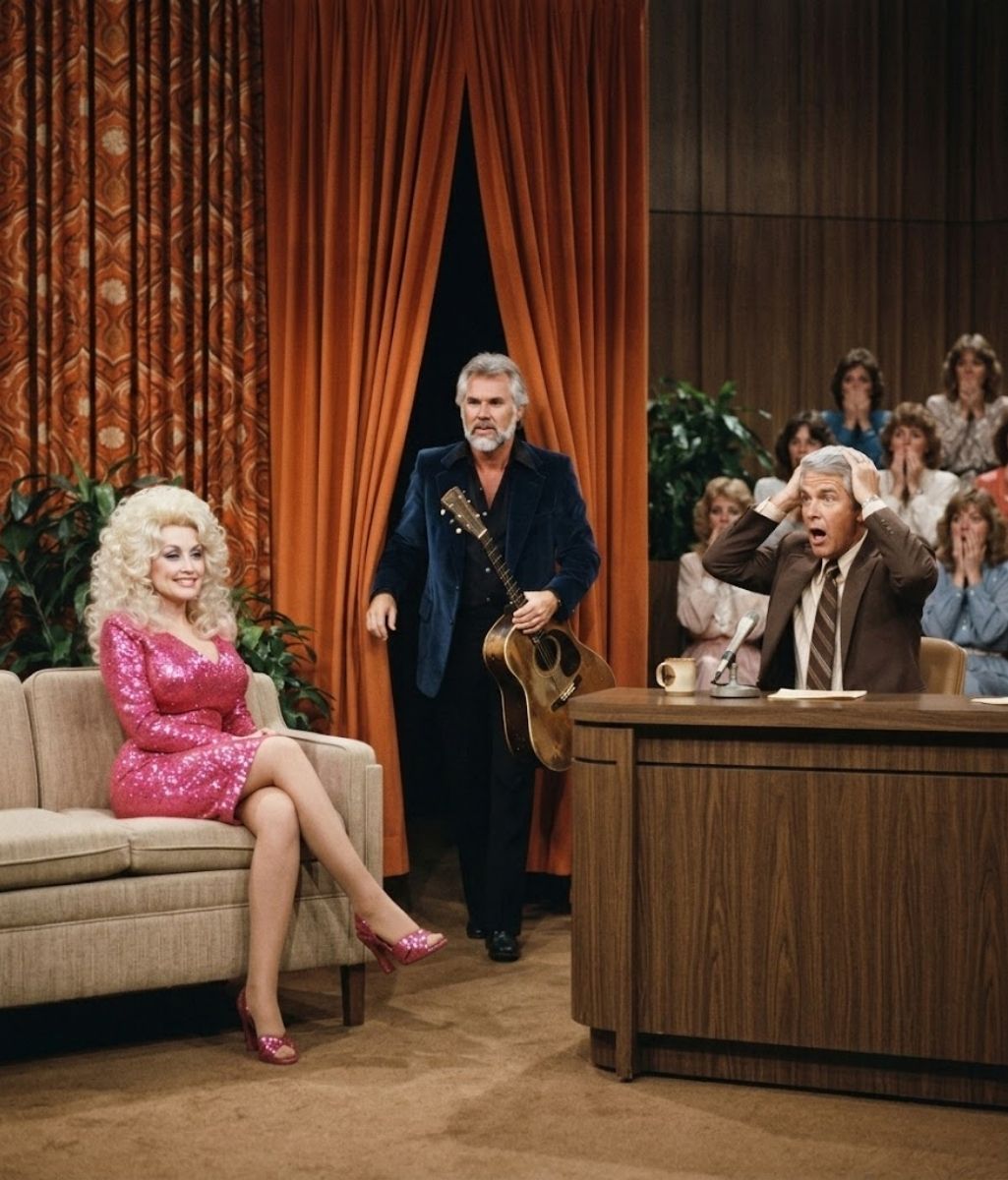
There are stories in country music that become so irresistible that, over time, the dramatic version begins to overshadow the truth. One recent story imagines Dolly Parton sitting on television and speaking candidly about Kenny Rogers, only for Kenny himself to suddenly walk onto the stage, guitar in hand, and answer her in front of a stunned audience. It is a wonderful scene, but the video that popularized it openly describes the moment as a dramatized retelling, with dialogue and certain events recreated for storytelling purposes.
The real relationship between Dolly and Kenny hardly needs embellishment.
Long before “Islands in the Stream” made them one of the most beloved duos in country music, the two already knew each other through Nashville. Dolly later remembered Kenny as someone who had been there for her when she needed support. When she was hosting her own syndicated television show and struggling to attract major guests, Kenny agreed to appear. Dolly never forgot that gesture, later saying that he had always been there for her as a friend.
That detail reveals something important about their bond. Their friendship was not created by a hit song. The hit song simply gave the public a reason to notice what was already there.
By the early 1980s, Kenny Rogers had become one of the most recognizable voices in popular music. His greatest strength was storytelling. Whether he was singing “The Gambler,” “Lucille,” or “Lady,” Kenny could make someone else’s words feel as if they had come directly from his own life. Dolly understood that ability because she was a master storyteller herself, although her path was different. She wrote much of her own material and built songs from memories, characters, family, and personal experience.
Their different strengths made them unusually compatible.
That became obvious in 1983, when Kenny was working with Barry Gibb on a song called “Islands in the Stream.” The track was not working the way Kenny wanted, and he was reportedly ready to abandon it. Barry Gibb suggested that they needed Dolly Parton.
By coincidence, Dolly was nearby.
Kenny later recalled that once Dolly entered the room and began singing, the song immediately changed. What had felt incomplete suddenly had personality, contrast, and emotional energy. Their voices did not sound identical, and that was exactly why the duet worked. Kenny’s warm, weathered tone balanced Dolly’s brighter, unmistakable voice in a way that felt natural almost immediately.
The record became a huge success.
But something even more important happened after the song became a hit.
Audiences wanted to see them together.
Dolly and Kenny began appearing on television, recording more music, performing concerts, and developing the kind of onstage chemistry that made people wonder whether there was something romantic between them. Both denied that idea over the years. Kenny described their flirting as harmless, while Dolly often joked about the question. What remained after the jokes was a friendship both of them repeatedly described as unusually easy and enduring.
Kenny once explained that Dolly was the kind of person he could go years without seeing and then immediately feel as if no time had passed.
That is a rare kind of friendship, especially in entertainment.
Their chemistry came from trust rather than mystery. They knew how to tease each other without cruelty, how to share a stage without competing for it, and how to let the other person shine without feeling diminished. That balance is visible in old interviews and performances, where the most memorable moments often happen between songs rather than during them.
They laughed easily.
They interrupted each other.
They told familiar stories.
And then, almost without effort, they would begin singing and remind everyone why the partnership had lasted.
One television appearance on Dolly’s 1980s variety show captured that warmth beautifully. After performing “Islands in the Stream,” the two interacted with the audience, and Kenny surprised Dolly with a birthday cake. It was not a dramatic confrontation or an unexpected confession. It was something much simpler: one longtime friend making another feel celebrated.
That kind of moment tells us more about their relationship than any fictional surprise entrance ever could.
Their partnership continued through Christmas recordings, television specials, tours, and later reunions. By the time Kenny prepared to retire from touring, Dolly remained one of the people most closely associated with his career. Their final major performance together carried the weight of decades because the audience had watched their friendship grow alongside the songs.
When Kenny died in 2020, Dolly’s response made clear how much he had meant to her. She did not speak about him only as a duet partner. She spoke about losing a friend, someone whose presence had become part of her life over many years.
That is why stories about Dolly suddenly revealing “the truth” about Kenny continue to attract attention.
Fans want one dramatic moment that explains everything.
One interview.
One unexpected entrance.
One confession.
But real friendships rarely work that way.
They are built through small acts repeated across years.
Kenny agreeing to appear on Dolly’s television show when she needed support.
Dolly walking into a recording studio and rescuing a song Kenny was ready to abandon.
The two of them standing side by side night after night, still laughing at each other’s jokes after hearing them dozens of times.
Those moments created the real story.
The greatest surprise was never that Kenny Rogers might walk unexpectedly onto a television stage. It was that one song could reveal a friendship strong enough to last for decades — and warm enough that audiences could still feel it every time Dolly and Kenny stood together.