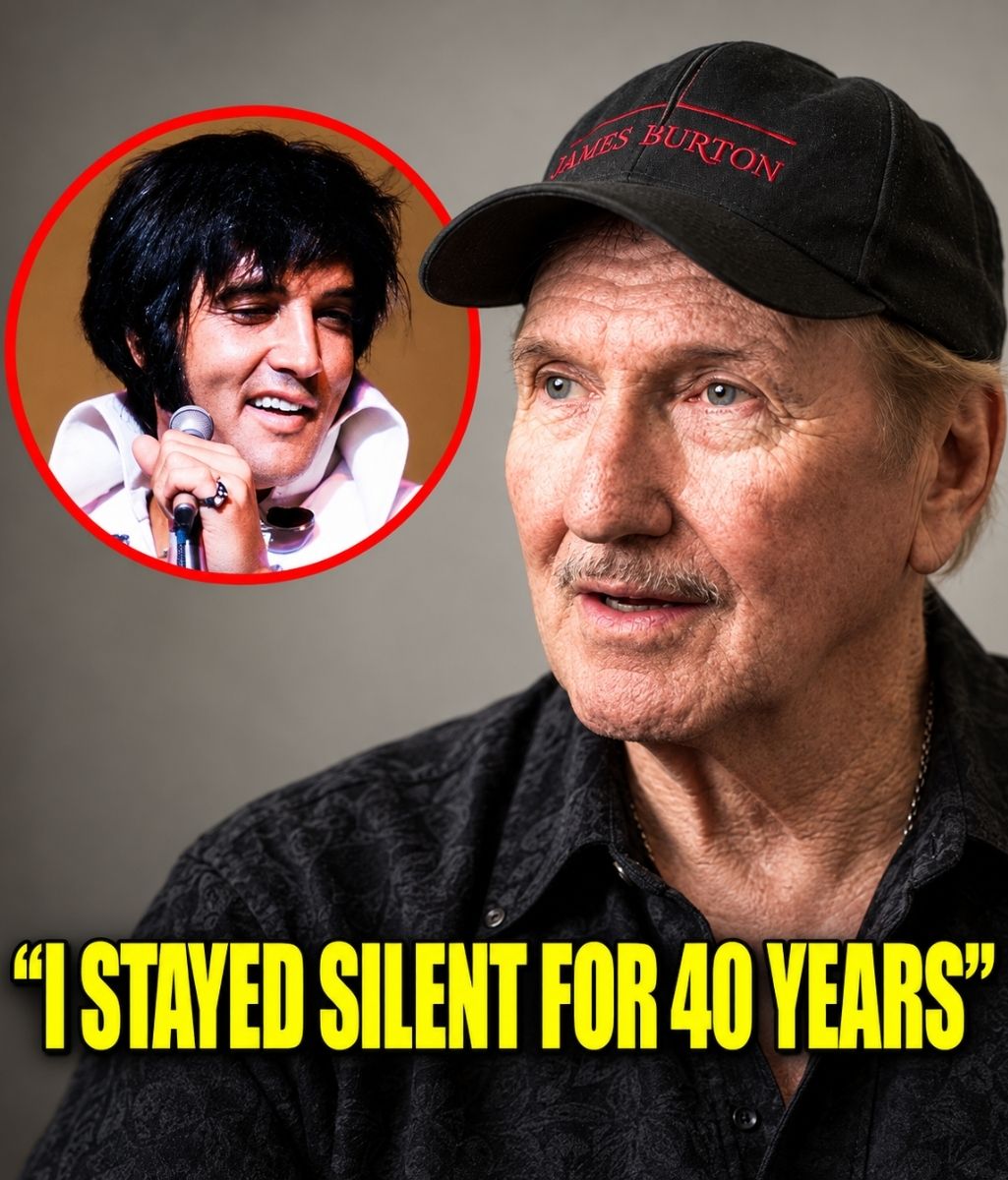
For millions of fans, Elvis Presley will always be remembered as the King of Rock ’n’ Roll, the man at the center of the stage while thousands screamed his name. But for guitarist James Burton, Elvis was something much more personal. Burton stood only a few feet away from him night after night, heard the changes in his voice, watched him interact with musicians when the cameras were gone, and remained part of the TCB Band until Elvis’s final year. Decades later, his memories offer a rare portrait of the man behind the legend.
Burton was already one of the most respected guitarists in American music when Elvis asked him to become part of his return to live performance in 1969. Before that, Burton had worked with Ricky Nelson and built a reputation for a sharp, instantly recognizable Telecaster style that would influence generations of players. When the opportunity came to help assemble Elvis’s new Las Vegas band, Burton accepted and became a central part of what would later be known as the TCB Band.
From the beginning, Burton noticed that Elvis treated his musicians with unusual respect. He later recalled that Elvis was deeply considerate and gave the band room to reshape his songs onstage. Burton said Elvis loved the way the musicians could take familiar material and push it “into another dimension,” which says a great deal about how much trust existed between the singer and the people behind him.
That trust was especially important because Elvis’s live shows were never identical from night to night. The arrangements could stretch, change, and respond to the energy in the room, and Burton became one of the musicians Elvis relied on most heavily. Fans became familiar with the shout “Play it, James!”, a cue that often sent Burton into one of his signature guitar breaks. Those moments sounded spontaneous because, in many ways, they were built on years of musical instinct between two men who understood each other without needing long explanations.
Burton later explained that he and Elvis had a great deal in common musically. Both had grown up surrounded by gospel, country, and rhythm and blues, and that shared background made communication easy. Elvis was not simply a rock-and-roll singer in Burton’s eyes. He was someone whose musical vocabulary stretched across several traditions and who understood where those sounds came from.
That broader musical taste was one reason Burton enjoyed working with him.
Elvis could move from a hard-driving rock number into a country ballad, then turn toward gospel with complete sincerity. Burton saw that versatility from the best possible vantage point: inside the band itself. He knew how seriously Elvis listened to the musicians around him, and he remembered a performer who valued strong players rather than treating them as background decoration.
The two also developed a personal friendship.
Burton has spoken about Elvis as someone who cared about the people in his circle and paid attention to their lives. That image is very different from the distant superstar some fans might imagine. Around the band, Elvis could joke, talk music, and show the kind of Southern manners Burton recognized from his own upbringing. Their connection was rooted as much in shared background and mutual respect as in fame.
Burton’s famous pink paisley Telecaster became part of that story as well. He once worried that Elvis might dislike the unusual guitar onstage, but Elvis surprised him by saying it looked and sounded great and encouraging him to keep using it. The moment was small, but it revealed something Burton remembered clearly: Elvis was willing to let the musicians around him have their own identities.
For nearly eight years, Burton remained beside Elvis through Las Vegas residencies, tours, television appearances, and the increasingly demanding schedule of the 1970s. He was one of the rare musicians who never missed a show during that entire period, which meant he witnessed both the extraordinary high points and the difficult final chapter.
That final chapter still carries enormous weight in Burton’s memories.
In August 1977, Burton and the TCB Band had already left Las Vegas on a chartered plane to begin another tour. They were heading toward Portland, Maine, when word came that they needed to turn back. After stopping in Pueblo, Colorado, to refuel, the musicians learned that Elvis had died. Burton later described the return flight as deeply emotional, with the band trying to absorb the fact that the man they had performed beside for years was suddenly gone.
For Burton, the shock was not only professional.
The tour had been planned.
The band was ready.
Everything was supposed to continue.
Then, in a matter of hours, the world they had known disappeared.
That abrupt ending is one reason Burton’s memories of Elvis remain so powerful. He did not know during those final shows that he was watching the end of an era. He was simply doing what he had done for years: standing onstage, listening for Elvis’s cue, and answering with his guitar.
Looking back, Burton has never needed to turn Elvis into a perfect figure to make him memorable. His stories focus instead on the musician, the man who loved strong arrangements, respected the people behind him, and understood the shared roots of country, gospel, blues, and rock and roll.
That perspective matters because Elvis’s legend became so large that the working musician inside it is sometimes forgotten.
James Burton remembers that part clearly.
He remembers the singer who listened.
The bandleader who trusted his musicians.
The Southern man who could sit backstage and talk about the same gospel and country songs Burton had grown up with.
And he remembers the silence that came after the final tour never began.
To the world, Elvis Presley was the King. To James Burton, he was the man who turned around onstage, trusted his band completely, and said the words Burton would never forget: “Play it, James.”