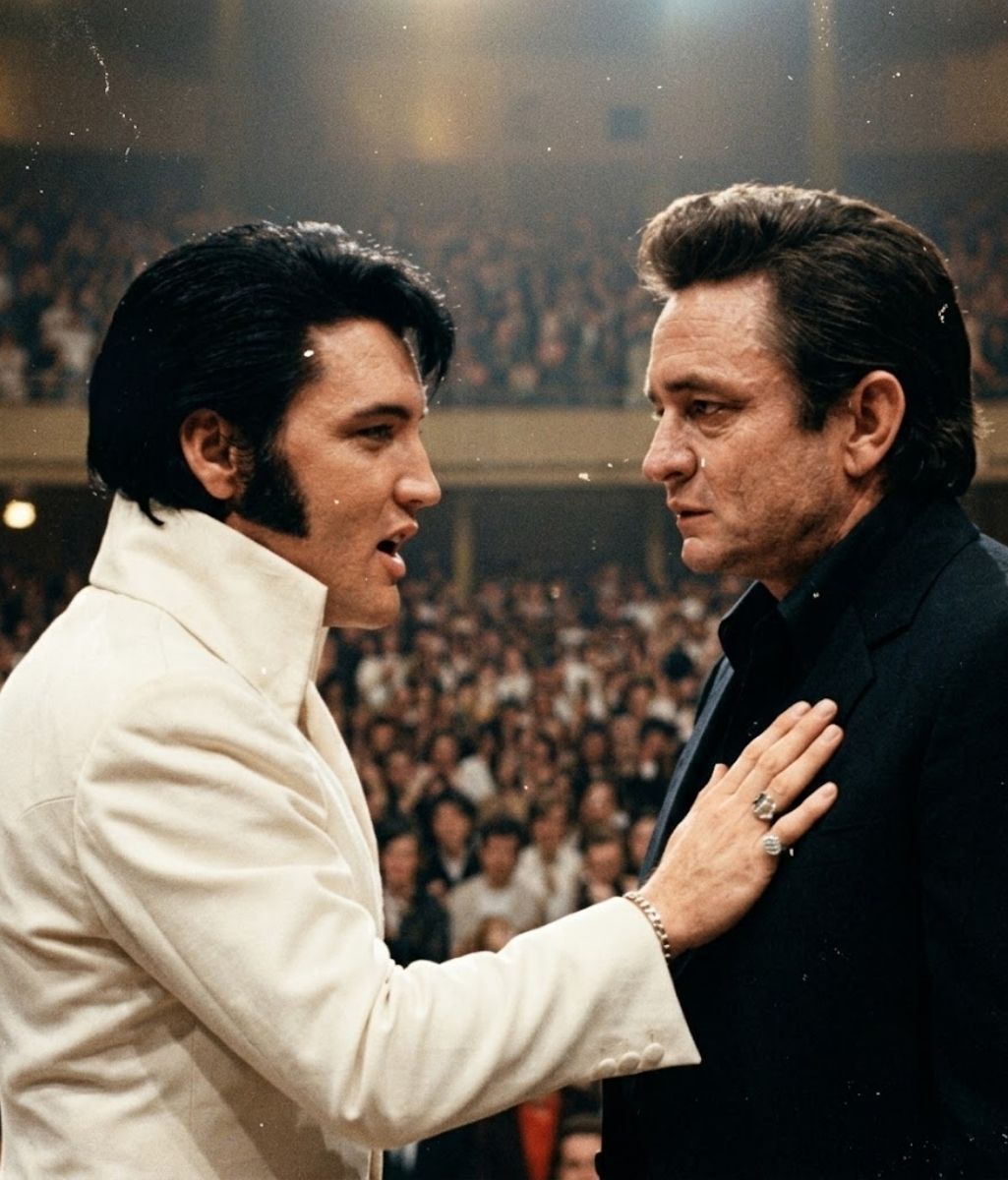
Long before Elvis Presley became the King of Rock ’n’ Roll and Johnny Cash became the Man in Black, both men had already been shaped by the same kind of music. They grew up hearing gospel in churches, on the radio, and in the communities around them, and those songs stayed with them even after fame carried both men far beyond the worlds they had known as boys.
That shared foundation created a bond between Elvis and Cash that many fans never fully understood. Johnny Cash later recalled that when they appeared on the same shows, the two of them often ended up singing together backstage. He said that gospel repeatedly became the music they returned to, especially Black gospel, because both men knew those songs deeply and had grown up surrounded by them.
That connection became part of music history on December 4, 1956, when Elvis, Johnny Cash, Carl Perkins, and Jerry Lee Lewis found themselves together at Sun Studio in Memphis. The spontaneous gathering became known as the Million Dollar Quartet, and the surviving recordings show just how naturally gospel entered the session. What began as an informal meeting quickly turned into hours of music, with sacred songs appearing alongside blues, country, and early rock and roll.
The session mattered because it revealed something audiences rarely saw from the stage. Elvis was already one of the biggest stars in America, but inside that studio he did not need the dramatic entrances, screaming crowds, or image that had turned him into a phenomenon. He could sit at the piano and sing the songs that had meant something to him long before anyone called him the King.
Johnny Cash understood that side of Elvis because he had been shaped by much of the same musical tradition. Gospel was not simply another genre either man could perform when convenient. It was part of the emotional language they had carried from childhood into adulthood. For both singers, those songs connected fame to something older and more personal.
That is why later stories about Cash challenging Elvis to sing gospel in front of an audience have remained so compelling. The exact dramatic scene described in some retellings is difficult to document, but the deeper idea behind it fits what Cash himself said about their relationship. He knew that gospel could bring out a side of Elvis that rock-and-roll audiences did not always get to see.
Elvis could electrify a room with songs like “Hound Dog,” “Jailhouse Rock,” or “Heartbreak Hotel,” but gospel demanded something different from him. The music allowed him to slow down, focus on the lyric, and sing with a kind of emotional directness that did not depend on movement or spectacle. In those moments, the performance could feel less like entertainment and more like testimony.
Cash recognized that difference.
He had his own complicated relationship with faith and gospel throughout his career, repeatedly returning to sacred music even while becoming famous for songs about prisoners, hardship, regret, and the darker edges of American life. He knew that a singer could carry contradictions and still find something honest inside a gospel song.
Elvis was no different.
Behind the famous image was a man who loved quartets, harmony singing, spirituals, and church music. Gospel remained important enough to him that he recorded it throughout his career and won major recognition for sacred performances even while the public continued to associate him primarily with rock and roll.
That helps explain why the imagined challenge from Johnny Cash feels so powerful. It was never really about proving whether Elvis could sing gospel. Cash already knew that he could. He had heard him do it privately. They had shared those songs in dressing rooms and at Sun Studio, long before later generations turned every meeting between legends into a contest.
The real challenge would have been something else: whether Elvis was willing to let an audience see the quieter singer behind the King.
In that sense, gospel stripped away the mythology.
There was no need for swagger. There was no need for competition. Johnny Cash did not have to prove that he understood gospel better, and Elvis did not have to show that he could overpower another singer. Their connection came from recognizing the same musical roots in each other.
That is what makes their history more interesting than any exaggerated story about one legend defeating another.
Cash admired Elvis as a performer, but he also remembered the man who would sing with him away from the crowd. Elvis respected Cash because Cash understood music as something more than show business. Both men knew what it was like to become public symbols while still carrying private parts of themselves that fame could never fully explain.
The surviving Million Dollar Quartet recordings remain one of the clearest windows into that world. They capture future legends before history had fully decided what they would become, singing songs they knew simply because they loved them. Much of the music is gospel, and that fact says more about their connection than any dramatic confrontation ever could.
Perhaps that is why the story of Johnny Cash asking Elvis to sing gospel continues to resonate.
It speaks to the idea that underneath the rhinestones, the black clothes, the hit records, and the famous nicknames were still two men shaped by songs they had learned long before fame arrived.
Johnny Cash did not need to challenge the King to prove anything. He already knew that when Elvis sang gospel, the legend faded for a moment and the man behind it finally came through.