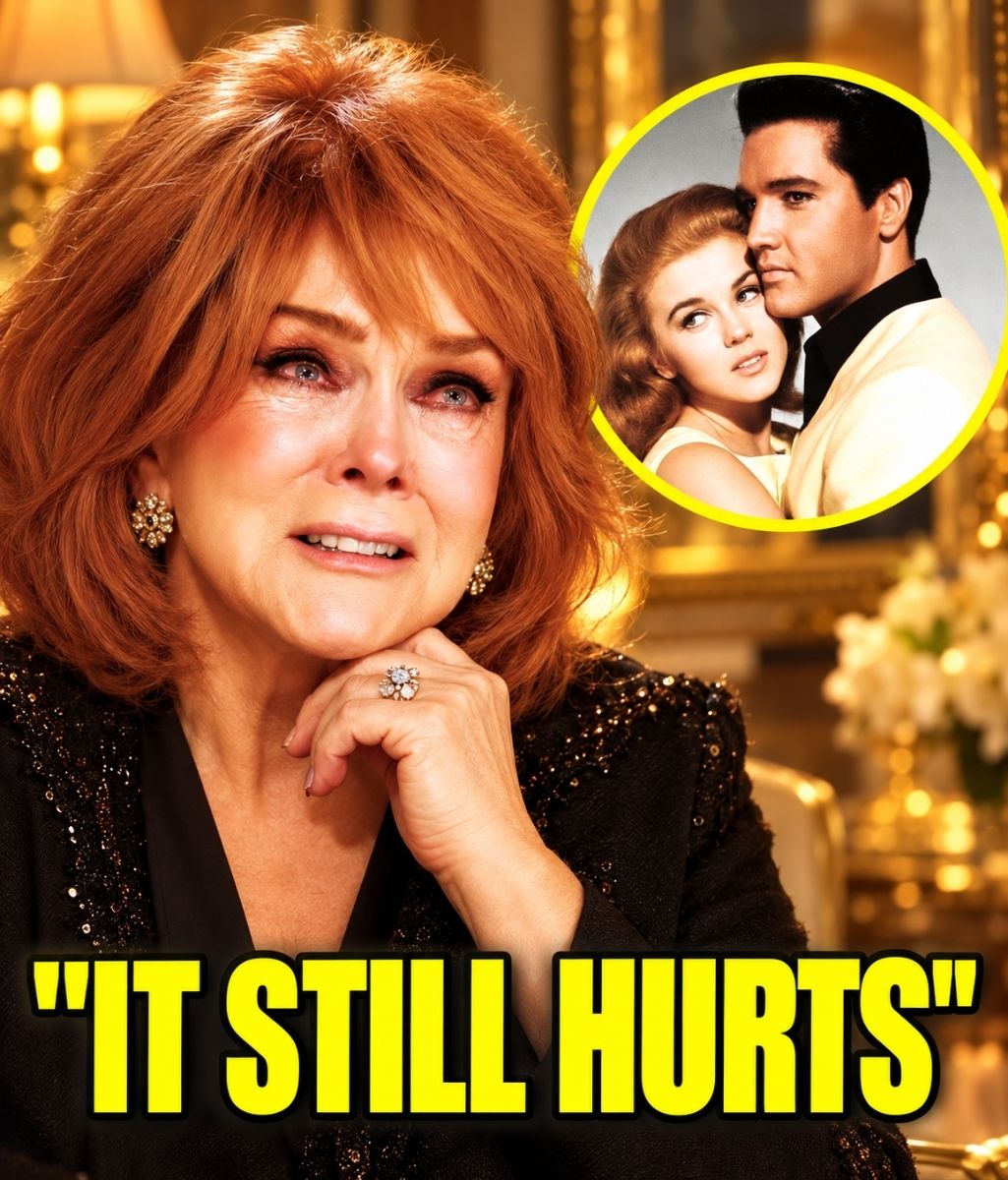
For years after Viva Las Vegas brought Ann-Margret and Elvis Presley together, their lives moved in different directions, but the connection between them never completely disappeared. They built separate careers, formed other relationships, and rarely discussed the most personal parts of their history in public. Yet even after the intense chapter they shared in the 1960s had passed, Elvis continued to remember important moments in Ann-Margret’s career in a way that became almost a private tradition between them.
Whenever Ann-Margret opened a new engagement, Elvis would send her a guitar-shaped arrangement of flowers. According to her memoir, he continued the gesture for roughly a decade. It was simple compared with the extravagant world both of them inhabited, but its consistency gave it meaning. No matter how much time had passed or how busy their lives had become, the flowers were a quiet reminder that Elvis had remembered her.
Then came August 15, 1977.
Ann-Margret was opening at the Hilton in Las Vegas, and for the first time in years, the familiar flowers from Elvis did not arrive. There was no guitar-shaped arrangement, no telegram, and no message. She completed two performances that evening, but later recalled that the absence troubled her enough that she planned to make calls the following day. Something about the broken tradition felt wrong.
By then, Ann-Margret had already heard troubling reports about Elvis’s health. Earlier in 1977, while performing in Las Vegas, she had questioned Joe Esposito, one of Elvis’s closest associates, because she was worried about what she had been hearing. She later wrote that she sensed there were serious problems even though she was reassured that matters were being handled. Looking back, that knowledge made the missing flowers even harder to dismiss.
The following morning, August 16, 1977, the phone rang despite instructions that Ann-Margret and her husband, Roger Smith, were not to be disturbed. Roger answered, and Ann-Margret immediately saw something change in his expression. The call came from Shirley Dieu, who was connected to Joe Esposito, and Ann-Margret understood almost instantly that something terrible had happened to Elvis.
The news confirmed what she feared.
Elvis Presley was dead at only 42 years old.
For millions of people, the announcement was shocking enough to feel impossible. Elvis had been so visible for so long that the idea of him suddenly being gone seemed almost incompatible with the image the public carried of him. For Ann-Margret, however, the loss was not simply about the death of the King of Rock ’n’ Roll. She had known the man away from the crowds, long before the final years had become surrounded by concern and speculation.
Their most famous chapter began in 1963, when they worked together on Viva Las Vegas. The chemistry between them was immediately obvious on screen and became one of the reasons the film remained so memorable. Ann-Margret later wrote openly about the closeness they developed, while also acknowledging that their paths could never remain joined in the way some fans imagined. Their lives moved forward separately, but the friendship and affection did not vanish.
That is why the flowers mattered.
They were not a public declaration meant for newspapers or photographers. They were something Elvis continued doing privately, year after year, long after the movie cameras stopped rolling. When that ritual suddenly disappeared, Ann-Margret felt the silence before she knew its cause.
The day after Elvis died, she and Roger traveled to Memphis. Ann-Margret attended the private funeral at Graceland on August 18, alongside family members and a small group of friends and associates. Contemporary coverage confirms that she and Roger Smith were among those present as enormous crowds gathered outside to mourn Elvis.
Inside Graceland, the scene was deeply emotional. Ann-Margret later remembered holding Elvis’s father, Vernon Presley, as the two of them cried. According to her account, Vernon told her that Elvis had been proud of her. At Forest Hill Cemetery, she found it difficult even to look toward the casket before Roger gently led her away.
The loss followed her beyond the funeral.
Only months later, Ann-Margret was asked to participate in a television tribute to Elvis. She later described the work as extraordinarily difficult because watching footage of him made maintaining the composed tone required for television almost impossible. The public was celebrating Elvis’s achievements, but for someone who had known him personally, those same images carried a completely different weight.
That distinction helps explain why Ann-Margret has always spoken about Elvis differently from many people who entered his story later.
She did not need to make their history larger than it was.
The story was already large enough.
They had shared a memorable film, an intense friendship, years of continued contact, and a private tradition that lasted long after Hollywood had moved on. Their bond did not need to become a perfect love story to remain meaningful.
What makes August 1977 so haunting is the ordinary detail at its center.
Ann-Margret did not first understand that something was wrong because of a television bulletin or a newspaper headline. She noticed because the flowers did not arrive.
A gesture Elvis had repeated for years suddenly stopped, and within hours she learned why.
For the world, August 16, 1977 became the day the King of Rock ’n’ Roll died. For Ann-Margret, it was also the day a familiar sign of friendship disappeared forever.
The guitar-shaped flowers never came again, and sometimes the smallest missing tradition says more about loss than any grand farewell ever could.