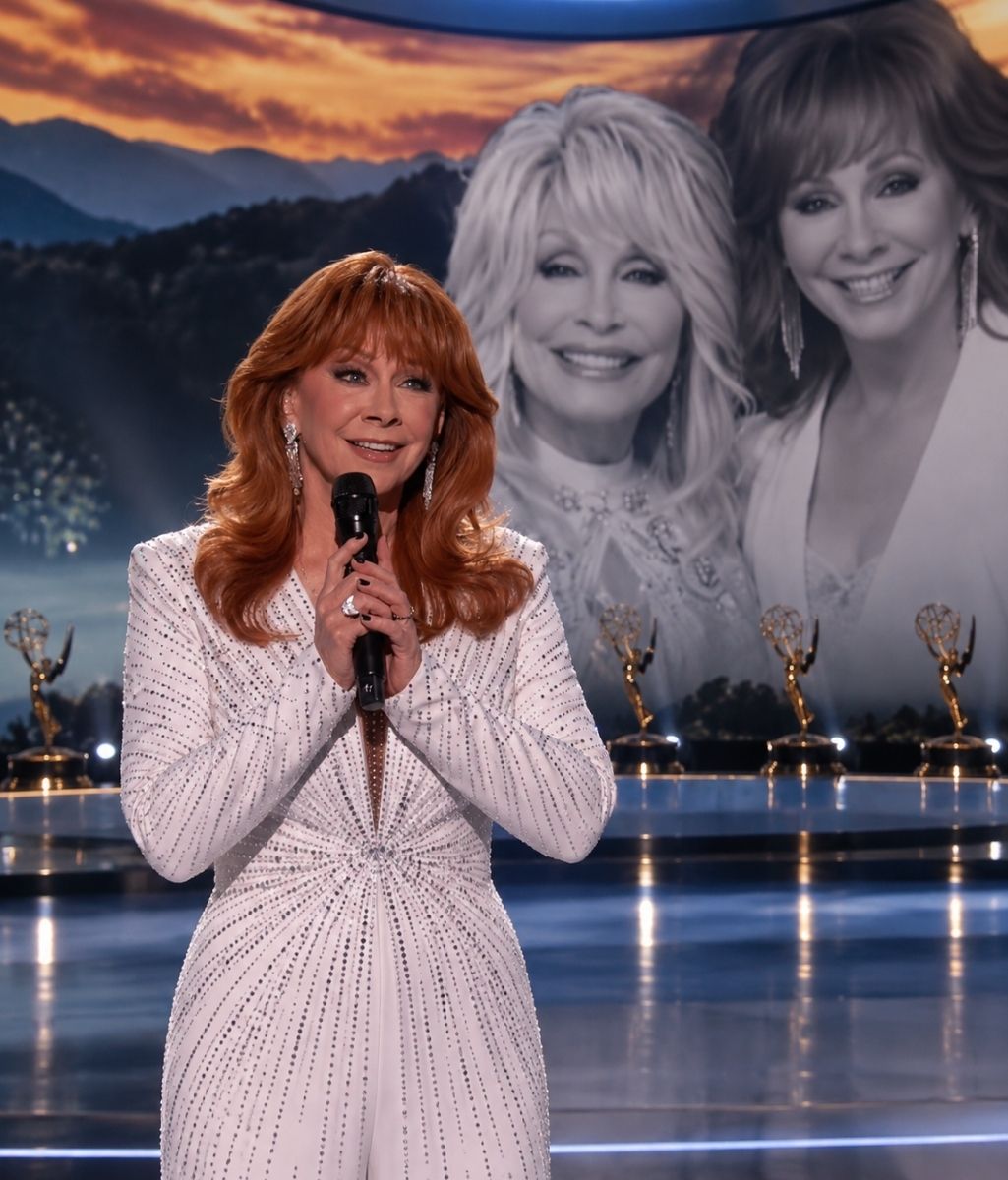
When Reba McEntire walked onto the Emmy stage dressed in sparkling white, the connection to Dolly Parton was almost impossible to miss. The rhinestones, the dramatic silhouette, and the unmistakable country glamour immediately recalled a woman who had spent decades turning sequins and theatrical fashion into part of her identity. But Reba’s appearance was never meant to be only a visual tribute.
The deeper message was in the song.
At the 78th Primetime Emmy Awards, Reba chose to honor Dolly with “Appalachian Memories,” a song Dolly had recorded decades earlier and one that reached far beyond the rhinestones, wigs, and larger-than-life image that made her famous. The choice pulled the tribute back toward the world Dolly had come from, making the performance feel less like a celebration of a superstar and more like a remembrance of the girl who grew up in the mountains of East Tennessee.
That distinction matters.
Dolly spent much of her career surrounded by spectacle. She understood the value of a dramatic entrance, a glittering costume, and an image audiences would never forget. She joked frequently about her own appearance and openly embraced the excess that became part of the Dolly Parton persona. Yet underneath all of that, her songwriting continually returned to much simpler subjects: family, poverty, faith, childhood, home, and the complicated emotions attached to leaving one life behind in order to build another.
“Appalachian Memories” sits directly inside that tradition.
The song looks backward toward the Appalachian world that formed Dolly long before Nashville discovered her. Its emotional power comes from memory rather than celebrity, reflecting on the people, places, beliefs, and family experiences that remain inside a person even after life carries them far away.
That made it an unusually intimate choice for Reba.
She could easily have selected one of Dolly’s biggest global hits. “Jolene” would have been instantly recognizable. “9 to 5” would have produced an enormous audience response. “I Will Always Love You” would have carried an obvious farewell message.
Instead, Reba chose something quieter.
And that choice changed the entire tone of the tribute.
Her wardrobe reinforced the idea. Vogue reported that Reba’s white sequined look deliberately echoed an outfit Dolly wore during her 1983 Live in London era, the same period connected to “Appalachian Memories.” Reba was not simply dressing “like Dolly” in a general sense. The styling linked visually back to a specific chapter of Dolly’s career and helped connect the stage presentation to the song itself.
There was another detail many viewers could not see clearly from their televisions.
Reba was also wearing jewelry that had actually belonged to Dolly.
According to Vogue, Reba’s team contacted Dolly’s family, and her niece Rebecca helped provide pieces from Dolly’s personal collection, including a butterfly ring and rhinestone earrings. That meant Reba was not only recreating an element of Dolly’s style while singing one of her most personal songs. She was literally carrying pieces that Dolly herself had worn.
For anyone who knew how important butterflies and rhinestones were to Dolly’s visual language, the symbolism was difficult to miss.
But the song still carried the heaviest emotional weight.
Dolly’s Appalachian identity was never merely an origin story she mentioned in interviews. It shaped the way she wrote, spoke, believed, gave back, and understood herself. She frequently returned to stories about her parents, the twelve children in the Parton household, church music, mountain traditions, poverty, and the sacrifices that came with growing up in rural Tennessee.
Even after becoming internationally famous, Dolly rarely presented success as evidence that she had escaped her past.
She treated the past as something she carried with her.
That is why hearing “Appalachian Memories” after her death feels so different.
A song about remembering home becomes a song about remembering Dolly herself.
The places and people Dolly once looked back on are now part of the history fans are looking back on when they remember her.
Reba understood that connection in a very personal way.
Her admiration for Dolly went back almost half a century. Reba recently recalled seeing Dolly during her own Grand Ole Opry debut in 1977, when she was still a young singer trying to establish herself. She remembered Dolly arriving in a dramatic black chiffon outfit covered with rhinestone butterflies and said she looked almost like an angel.
That memory makes Reba’s Emmy wardrobe even more poignant.
In 1977, she was the young artist watching Dolly walk into the room covered in rhinestones.
In 2026, she was the country legend wearing rhinestones herself and standing onstage to remember the woman she had once watched in awe.
Their relationship also eventually moved beyond admiration.
Reba has spoken about Dolly’s generosity during one of the darkest periods of her own life. After the 1991 plane crash that killed members of Reba’s band, Dolly reached out and offered practical help, including access to musicians who could help Reba continue working. Reba later remembered that support as evidence of Dolly’s character away from cameras and award shows.
That history gives the Emmy performance another layer.
Reba was not simply honoring an icon.
She was remembering a woman who had personally shown up for her.
That is why the quieter details mattered.
The white outfit recalled Dolly visually.
The jewelry connected Reba physically to something Dolly had worn.
But “Appalachian Memories” reached deeper than either of those things.
It brought the tribute back to Dolly before the fame.
Before Hollywood.
Before Dollywood.
Before millions of records.
Before the world knew exactly what a Dolly Parton entrance looked like.
The song remembered the mountains, the family, the faith, and the emotional landscape that created everything that followed.
That may be why Reba did not need to explain the tribute in a long speech.
The clothes said Dolly.
The rhinestones said Dolly.
The butterflies said Dolly.
But the song told listeners why Dolly was Dolly.
And for anyone who understood what “Appalachian Memories” meant to her story, Reba’s performance was not simply another glamorous tribute to a country legend.
It was a journey back home.