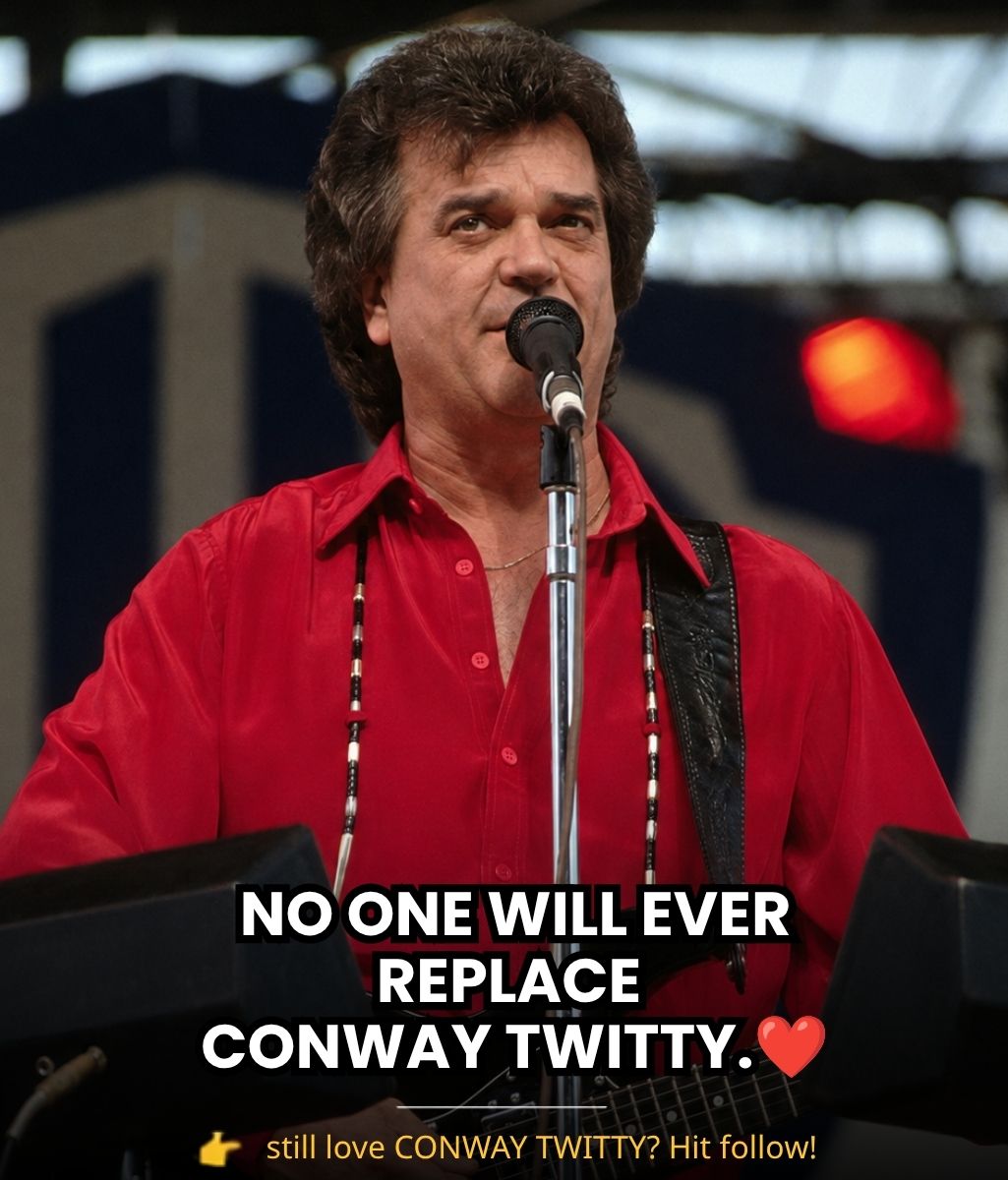
There was no farewell announcement, no carefully planned final concert, and no moment when Conway Twitty stood beneath the stage lights and told his fans goodbye. He simply finished another performance, walked away from the stage, and expected there would be another night, another crowd, and another song waiting for him. No one watching could have known what that evening would eventually mean. On June 4, 1993, Conway performed at the Jim Stafford Theatre in Branson, Missouri. What appeared to be another night in the long career of one of country music’s most recognizable voices would become something far more emotional in hindsight: the final performance of Conway Twitty’s life.
For decades, Conway had made walking onto a stage look almost effortless. By then, audiences knew the voice immediately. They knew the songs, the mannerisms, and the unmistakable presence of a performer who had become part of country music history. To the people sitting in the audience that evening, there was little reason to think they were witnessing the closing chapter of an extraordinary career. They were simply watching Conway Twitty do what Conway Twitty had done for generations — sing country music to the people who loved hearing him sing it. That ordinary quality is precisely what makes the story so haunting today.
There is something comforting about believing we will recognize an important moment while it is happening. We imagine that endings will somehow announce themselves. There will be a final speech, a final wave, or at least some unmistakable sign that tells us to pay closer attention. Life rarely works that way. Sometimes the moments that become most meaningful are the ones that seemed completely ordinary when they happened. Conway’s final performance became one of those moments. There was no grand goodbye written into the evening because no goodbye had been planned.
After the performance, Conway became seriously ill. He was taken to a hospital in Springfield, Missouri, where his condition worsened. On June 5, 1993, Conway Twitty died at the age of 59. The news stunned the country music world. A performer whose career had stretched across decades and whose voice had become instantly familiar to millions was suddenly gone. Only then did the previous evening take on a meaning nobody in that audience could have understood while Conway was standing before them.
They had witnessed his final performance without knowing it.
Imagine being one of those fans years later. Perhaps you remembered buying the ticket, finding your seat, hearing the opening notes of a familiar song, or watching Conway walk onto the stage. At the time, those details might have seemed ordinary. But once you knew what happened afterward, every memory from that evening would become precious. A song would no longer be simply a song. A wave from the stage would become something worth remembering. Even the moment Conway disappeared from view at the end of the show could suddenly feel different.
That is what time does to certain memories. It gives ordinary moments meanings they never had when we first lived them.
Conway Twitty had spent much of his life building an extraordinary connection with listeners. His success was not based only on having recognizable songs. There was something in his delivery that made his recordings feel personal. He could take a lyric about devotion, regret, family, loneliness, or memories and make the person listening feel as though the words belonged to their own life. That ability helped Conway become one of the defining voices of country music across several decades.
His career also crossed generations. Some fans discovered him when they were young adults. Others heard his records because their parents played them at home. Years later, those same songs found their way into new collections, radio programs, tribute performances, and eventually digital playlists. The technology changed, but Conway’s voice remained unmistakable.
That may explain why the story of his final performance continues to carry so much emotion.
It is not simply a story about the last time a famous singer stood onstage. It is a reminder of how unexpectedly an era can end. For the audience in Branson that night, Conway Twitty was still Conway Twitty. There was every reason to believe there would be another concert somewhere down the road. Another familiar introduction. Another round of applause.
But there wasn’t.
And perhaps that is why his final show feels more powerful today than any carefully planned farewell could have been. There was no attempt to manufacture emotion because nobody knew emotion would later surround that night. The meaning came afterward.
For longtime country fans, Conway’s passing marked more than the loss of a successful recording artist. His music had become connected to personal memories — old cars, family homes, weekend dances, kitchen radios, record players, and people whose faces may now exist only in photographs. When those songs play today, listeners are not necessarily remembering Conway alone. They may be remembering entire chapters of their own lives.
That is the strange power of music. A voice can remain exactly the same while everything around the person listening to it changes.
More than three decades have passed since Conway Twitty walked onto a stage for the last time. The audience from that evening has scattered. The country music world has changed enormously. New artists have arrived, new styles have emerged, and generations have grown up in a completely different musical landscape.
Yet press play on an old Conway Twitty recording and something remarkable happens.
The years disappear.
That voice returns exactly as it was. For a few minutes, the distance between then and now becomes smaller. Someone remembers a parent. Someone remembers a dance. Someone remembers driving down a road they have not traveled in decades. And someone who never had the opportunity to see Conway perform discovers why millions of people once stopped to listen whenever that unmistakable voice came through the radio.
Perhaps that is the real ending to the story of Conway Twitty’s final performance.
There was no goodbye. No planned farewell. No final bow meant to close the story. There was simply one more evening of music, followed by a silence nobody expected.
But the silence never truly won.
Because Conway left behind something stronger than a final goodbye: the songs.
And as long as someone somewhere presses play, remembers those years, and hears that voice again, Conway Twitty never completely leaves the stage