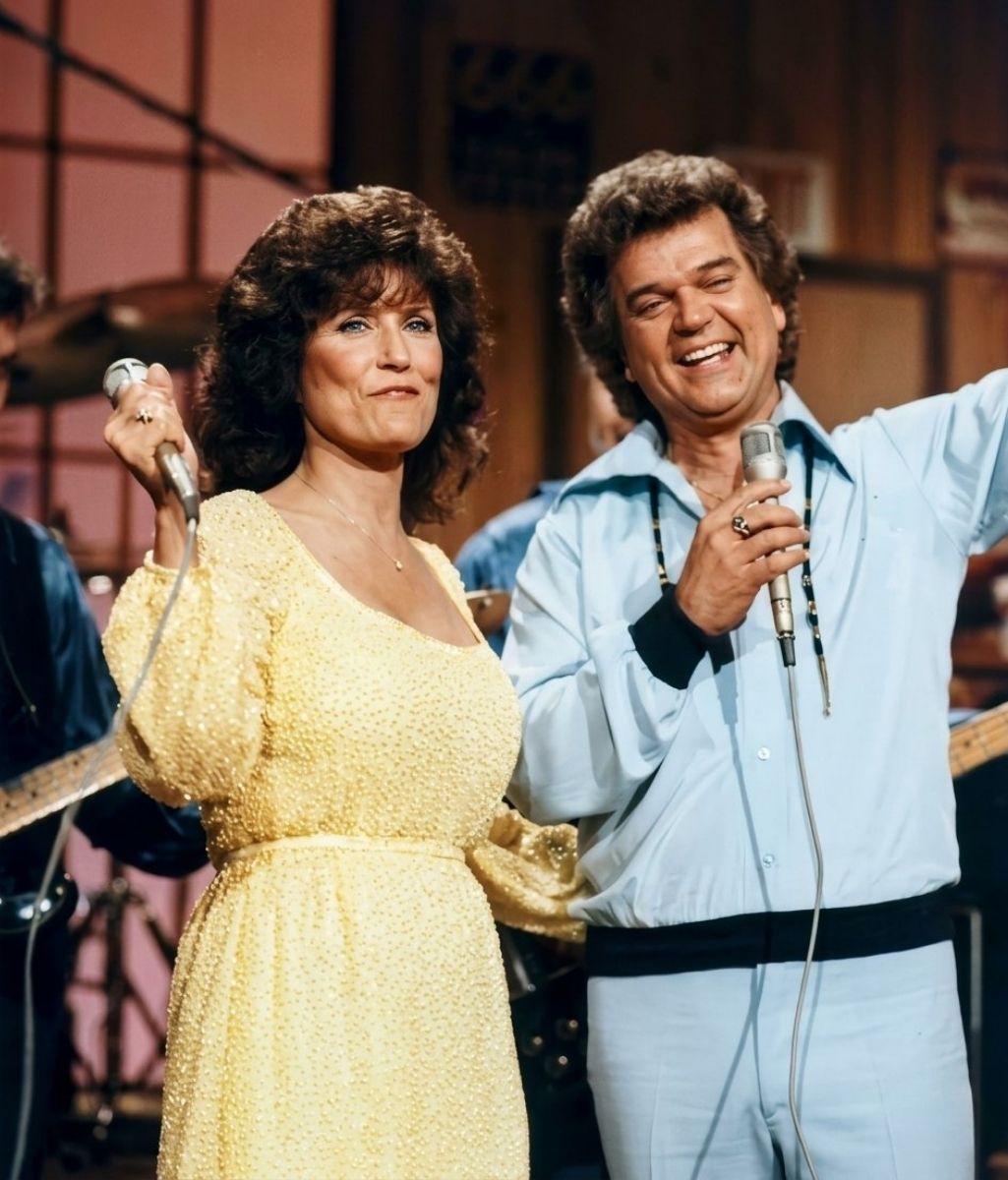
Some country duets work because two voices sound good together.
Others work because the singers make you believe every word.
For Loretta Lynn and Conway Twitty, “Louisiana Woman, Mississippi Man” became one of those rare songs where the chemistry between two performers made a simple love story feel larger than life. The song was about a man and woman separated by the Mississippi River, but the real magic came from the way Loretta and Conway sang it as though no distance, no obstacle, and certainly no river could ever keep them apart.
By the time they recorded the song in 1973, Loretta and Conway had already proven that their partnership was something special. Both were major solo stars, and together they had already scored No. 1 duet hits with “After the Fire Is Gone” and “Lead Me On.” PBS notes that their collaboration eventually produced five No. 1 songs and helped them win the CMA award for Vocal Duo of the Year every year from 1972 through 1975.
Yet “Louisiana Woman, Mississippi Man” felt different from the slower, emotionally complicated songs that had first defined them.
It moved faster.
It sounded playful.
And it gave their chemistry a completely different kind of energy.
The song was written by Jim Owen and Becki Bluefield, but the person who helped bring it to Loretta and Conway was someone especially close to Loretta: her husband and manager, Oliver “Doolittle” Lynn. Loretta later explained that Doo found the song while they were on tour and immediately recognized that it could work for the duo.
He was right.
The lyrics created a vivid picture almost instantly. One lover is in Louisiana, the other in Mississippi, and the Mississippi River stands between them. Instead of treating that river as an impossible barrier, the song turns it into something almost playful. The couple insists that their love is simply too strong for geography to matter, with each side promising to cross the distance somehow.
That image gave the song its hook.
But Conway and Loretta gave it personality.
Conway’s deep, smooth delivery had always carried confidence, while Loretta’s voice brought a sharper, more conversational edge. When those two sounds met, the duet felt less like two singers taking turns and more like two characters talking directly to each other.
That quality had always been central to their success.
Their best duets rarely sounded detached.
They sounded like arguments, confessions, flirtations, or private conversations listeners had somehow been allowed to overhear.
“Louisiana Woman, Mississippi Man” pushed that dynamic into something brighter.
Rather than singing about betrayal, regret, or a relationship already falling apart, they sang about two people determined to get closer no matter what stood between them.
The production helped make the song feel even more alive.
Recorded during sessions at Bradley’s Barn in Mount Juliet, Tennessee, the track was produced by legendary Nashville producer Owen Bradley, whose work had already shaped much of Loretta’s career. Billboard praised the recording at the time for its lively, up-tempo Cajun feel and noted how naturally the pair came together on the performance.
The public agreed.
Released in 1973, “Louisiana Woman, Mississippi Man” climbed to No. 1 on Billboard’s country chart, becoming Loretta and Conway’s third consecutive No. 1 single as a duo. It also reached No. 1 on Canada’s country chart.
The album of the same name followed in July 1973 and became their first collaborative album to reach No. 1 on Billboard’s country albums chart. Loretta’s official discography notes that the record marked another major step in their partnership and became the first of several No. 1 albums they would score together.
That success mattered because Conway and Loretta were doing something unusual.
They were not simply two stars occasionally appearing on the same record.
They were building a second career together.
Both continued releasing major solo material, yet audiences also began expecting a separate world whenever their names appeared side by side.
That world had its own sound.
Its own tension.
Its own kind of storytelling.
And “Louisiana Woman, Mississippi Man” became one of the clearest examples of why the pairing worked.
The song also benefited from the mystery surrounding their chemistry.
Loretta and Conway were close friends and professional partners, but because they sounded so believable together, fans often wondered whether something romantic existed behind the music. That speculation followed them for years.
The performances encouraged it without ever needing to confirm anything.
A song like “Louisiana Woman, Mississippi Man” sounded convincing because both singers understood how to inhabit a character. Loretta could make the listener believe she was the Louisiana woman ready to cross a river, and Conway could answer as though he had been waiting on the opposite bank all along.
That was performance.
But it was extraordinarily good performance.
Their friendship also allowed them to trust each other musically. They knew when to push, when to hold back, and when to let the other voice carry the moment. That familiarity made even highly theatrical songs feel natural.
Decades later, that is one reason the duet still holds up.
The production clearly belongs to classic 1970s country, yet the emotional setup is timeless.
Two people are separated.
Both are determined to close the distance.
Neither is willing to accept that something outside their control should decide whether they can be together.
It is a simple idea, but great country music has always known that simple ideas can carry enormous emotion.
For Loretta and Conway, the song became more than another chart-topper.
It helped define the image of them as country music’s great conversational duet partners, two voices that could make audiences believe they were watching a relationship unfold in real time.
They would record many more songs together and remain linked in country history long after their final studio collaborations.
But “Louisiana Woman, Mississippi Man” captured something especially joyful.
It had no interest in asking whether the relationship was practical.
It only asked whether the love was strong enough.
And in Loretta Lynn and Conway Twitty’s hands, even the mighty Mississippi River never stood a chance.