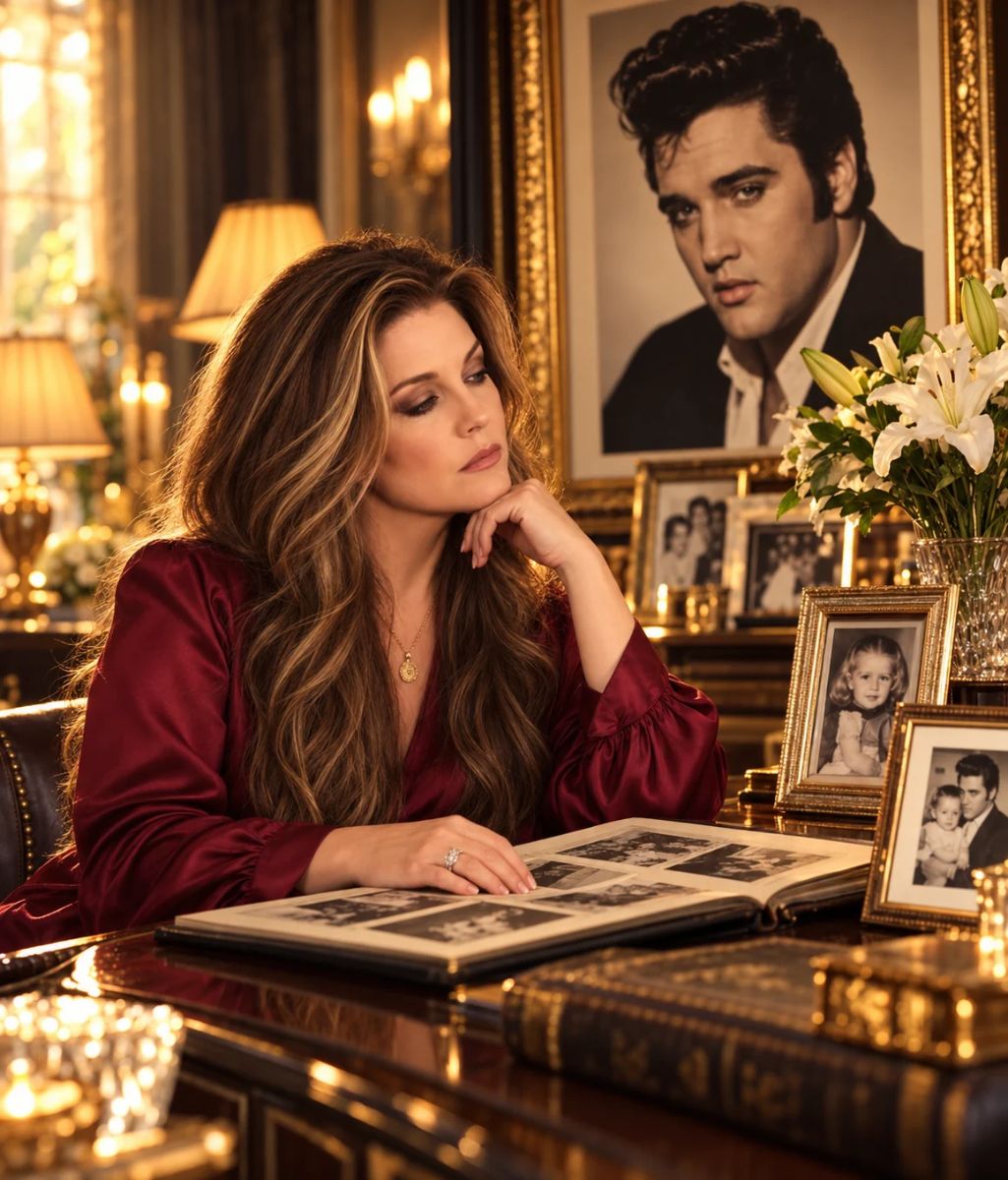
From the moment Lisa Marie Presley was born, fame was already waiting for her. She did not have to seek it, earn it or even understand it before the world decided who she was supposed to be. As the only child of Elvis Presley, she grew up inside one of the most famous families in American music and was surrounded from childhood by cameras, speculation and expectations that few people could ever fully understand. Yet as she grew older, Lisa Marie repeatedly tried to make one thing clear: she did not want fame to become the only thing that defined her.
When she finally stepped forward as a recording artist in the early 2000s, Lisa Marie explained that she was not making music because she wanted more attention. In fact, she often said that public attention made her uncomfortable and that she had never been drawn to celebrity for its own sake. What she wanted was the chance to be heard on her own terms and to create something that belonged to her rather than simply inheriting another layer of fame from the Presley name.
That distinction mattered because Lisa Marie had spent her entire life being famous for reasons she did not choose. She was known because of her father, because she grew up at Graceland, because of her high-profile marriages and because newspapers and television programs followed nearly every important chapter of her private life. By the time she released her debut album To Whom It May Concern in 2003, she wanted people to hear her voice without immediately treating her as an extension of Elvis.
In interviews around that period, Lisa Marie said she hoped listeners could move beyond the novelty of who she was and recognize her as an artist in her own right. She had no interest in becoming a pop icon simply because the Presley name guaranteed attention. What mattered to her was credibility and the feeling that she had created something through her own choices, work and experience rather than simply benefiting from the legacy she inherited.
That desire also helps explain why she waited so long to release music publicly. Lisa Marie had been writing songs for years before audiences ever heard them, and she described songwriting as something personal and cathartic rather than a shortcut into the entertainment industry. She knew that once she released an album, critics would compare her voice, appearance and personality to Elvis, and she understood that almost no ordinary new artist would face the same level of scrutiny from the moment the first song was released.
The pressure was especially intense because Elvis was not simply a famous father but a cultural legend whose image had become deeply embedded in American music history. Almost every decision Lisa Marie made could therefore be interpreted through his legacy. If she sang rock music, people heard Elvis in it; if she mentioned Graceland, some accused her of relying on the family name; and if she avoided talking about him, people wondered why. Even silence could become part of the public story surrounding her.
That left Lisa Marie with a difficult challenge throughout her adult life. She wanted to acknowledge where she came from without allowing that history to become the only thing the world could see when it looked at her. Her answer was to insist on creating her own material and to avoid building her career primarily around her father’s songs. She said she needed to establish an identity of her own before she could comfortably participate in projects involving Elvis’s music without feeling that she was simply borrowing from his success.
That independence also shaped the way she talked about celebrity itself. Lisa Marie often sounded deeply skeptical of the idea of becoming famous simply for being famous, and she expressed frustration with a culture in which public attention could sometimes matter more than the work behind it. Coming from someone who had been famous before she was old enough to understand what fame meant, those comments carried unusual weight because she had already experienced both the privileges and the limitations that celebrity could bring.
Lisa Marie never had the possibility of true anonymity. Ordinary moments could become public stories, and nearly every friendship or relationship could be viewed through the lens of the Presley name. That kind of constant exposure made her determination to have an identity of her own feel less like rebellion and more like a basic need to control some part of her life.
Music became one of the few places where she could do that. Through songwriting, Lisa Marie could speak about family, anger, grief, disappointment and identity without relying on someone else to interpret her experiences first. Much of her work carried an autobiographical quality because she had spent most of her life watching other people tell her story, and writing songs gave her a chance to decide for herself which parts of that story belonged in public.
That is why her comments about fame feel different now. After Lisa Marie’s death in 2023, many headlines still described her primarily through the people around her. She was Elvis Presley’s daughter, Priscilla Presley’s daughter, Riley Keough’s mother and the former wife of Michael Jackson. All of those descriptions were true, but they were also exactly the kind of labels she had spent years trying to move beyond.
Lisa Marie wanted to be recognized as someone who had her own thoughts, music, mistakes, ambitions and struggles. She never denied the importance of her father or the extraordinary legacy she inherited, but she also resisted the idea that inheritance should become the complete definition of her life. She understood that the Presley name would always follow her, yet she still wanted the freedom to build an identity that could exist beside it.
That is what makes the sentiment behind “I don’t exist just to be famous” feel so powerful today. Even if those exact words were not a documented quote, they capture something Lisa Marie repeatedly tried to tell the world throughout her adult life. She had been born into fame and inherited a history larger than herself, but she still wanted the right to be seen as an individual rather than simply as another chapter in someone else’s legend.
Lisa Marie Presley did not spend her life trying to escape the Presley name. She spent it trying to prove that there was a whole person living inside it, with a voice, a story and an identity that deserved to be heard on its own.