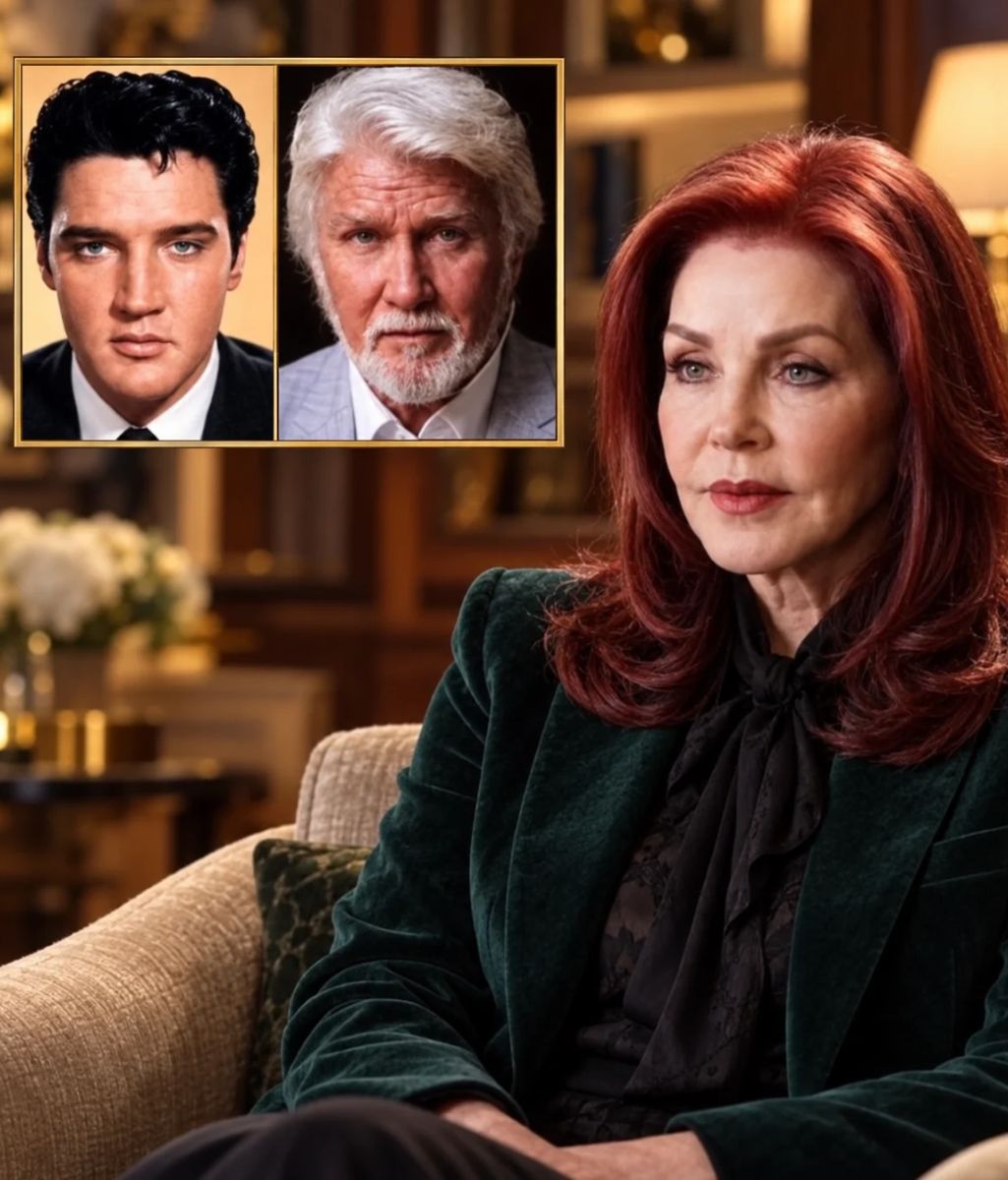
Few celebrity mysteries have survived as long as the belief that Elvis Presley never really died in 1977. Over the years, fans have pointed to supposed sightings, altered photographs, mysterious recordings and countless stories claiming that the King of Rock ’n’ Roll secretly walked away from fame and began a new life somewhere far from Graceland.
In recent years, one name has become more closely connected to that theory than almost any other: Bob Joyce.
Joyce is a pastor and gospel singer from Arkansas whose deep voice, hairstyle and facial features have led some Elvis fans to insist that the resemblance is too strong to be accidental. Videos of him singing religious music have circulated widely online, and with every new clip, the same question returns.
Could Bob Joyce really be Elvis Presley?
The theory became even more dramatic when online videos began claiming that Priscilla Presley had finally spoken out and secretly confirmed the truth.
There is one major problem with that story.
There is no credible public evidence that Priscilla Presley has ever confirmed Bob Joyce is Elvis.
Recent viral articles and videos have presented dramatic scenes in which Priscilla supposedly reveals that her former husband survived, disappeared under a new identity and spent decades hiding from the world. Yet those stories have not been supported by authenticated interviews, official statements, family records or reliable reporting. Some versions appear to be fictional or heavily dramatized retellings rather than documented events.
Bob Joyce himself has also denied the claim.
During an interview with a YouTuber who visited him, Joyce reportedly stated that he was not Elvis Presley. The age difference creates another major problem for the theory. Elvis was born in 1935, while Joyce is significantly younger, making the timelines difficult to reconcile without assuming that virtually every official record connected to both men is false.
Still, the theory refuses to disappear.
Part of the reason is the voice.
Elvis had a deep connection to gospel music throughout his life, and some of his most emotionally powerful performances came from that tradition. Bob Joyce also sings gospel with a low, resonant voice that can remind listeners of Elvis, especially when clips are viewed without much context.
For fans already hoping Elvis somehow survived, that similarity can feel like evidence.
But resemblance is not identification.
Many singers working within gospel, country and blues traditions share vocal phrasing, tone and delivery. Elvis himself was shaped by those same musical traditions, which means another Southern gospel singer sounding familiar is not especially surprising.
The visual comparisons work in much the same way.
Online videos frequently place photographs of Elvis next to images of Joyce, focusing on the eyes, nose, smile or jawline. Some fans find the resemblance remarkable, while others see two different men whose similarities are strengthened by hairstyle, lighting, camera angle and suggestion.
Once someone is told to look for Elvis, it becomes much easier to see Elvis.
That psychological effect helps explain why the theory has remained alive even after repeated denials and fact-checking.
The involvement of Priscilla’s name makes the story even more powerful.
Few people knew Elvis as intimately as she did. They shared years together, had a daughter, Lisa Marie Presley, and remained connected through family and the legacy surrounding Graceland long after their divorce.
Because of that history, any headline suggesting that Priscilla has “finally revealed the truth” immediately feels important.
But importance is not the same as evidence.
Priscilla has spoken publicly many times about Elvis’s life, personality, vulnerabilities and final years. She has described the young man she knew before the legend completely consumed him and has shared personal memories that gave fans a more human understanding of Elvis. What she has not credibly done is announce that Bob Joyce is secretly her former husband.
The historical record remains clear that Elvis Presley died on August 16, 1977, at Graceland in Memphis.
His death was documented by physicians, family members, law enforcement, funeral records and the thousands of mourners who gathered afterward. For Bob Joyce to actually be Elvis, an enormous number of independent records and people would need to have participated in or remained silent about one of the largest deceptions in entertainment history.
No verified evidence has ever demonstrated that such a conspiracy occurred.
That does not mean fans will stop asking questions.
Elvis occupies an unusual place in popular culture because his death came when he was only 42 years old and still enormously famous. When someone that iconic disappears so suddenly, myths naturally grow around the absence.
Fans want another chapter.
They want one more performance.
They want the possibility that the story never really ended.
Bob Joyce became part of that hope because he offers something emotionally powerful: a man with a familiar voice singing gospel songs that Elvis himself might have loved.
That resemblance is enough to inspire curiosity.
It is not enough to rewrite history.
So when headlines claim that Priscilla Presley has finally confirmed Bob Joyce is Elvis, the most important question is not whether the story feels convincing.
It is whether the evidence exists.
So far, it does not.
Bob Joyce may remind some fans of the King of Rock ’n’ Roll, but until verified evidence says otherwise, he remains Bob Joyce — and Elvis Presley remains the legend whose death in 1977 continues to inspire one of music’s most enduring mysteries.