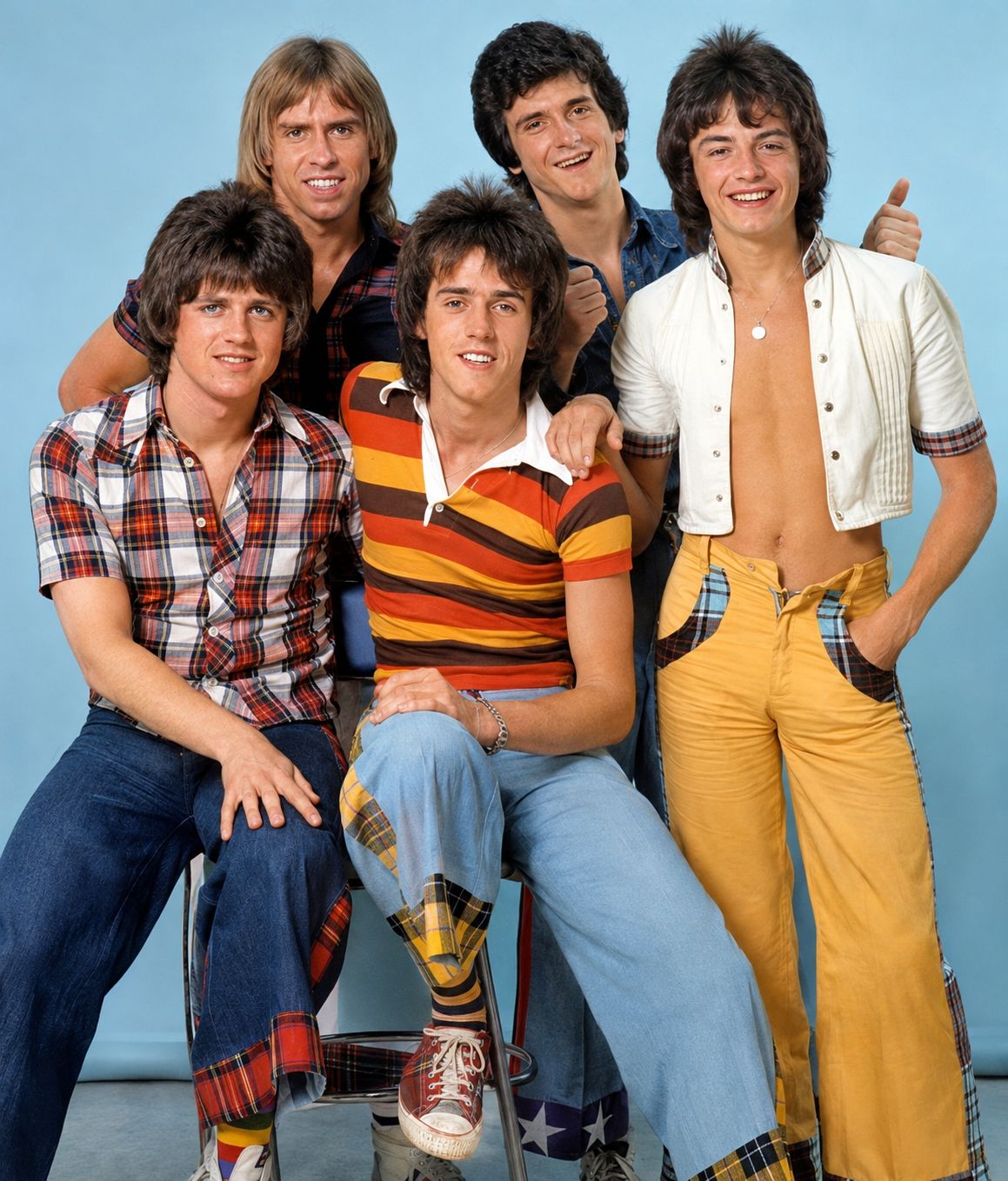
For millions of teenagers in the 1970s, the Bay City Rollers represented pure excitement.
There were tartan scarves, screaming crowds, television appearances and a seemingly endless run of songs that made young fans feel as though they belonged to something enormous. “Shang-a-Lang,” “Bye Bye Baby,” “Give a Little Love” and “Saturday Night” became part of the soundtrack of an era, while the young men at the center of Rollermania appeared to be enjoying one of the happiest success stories in pop music.
Decades later, former members described a very different reality.
Behind the smiling photographs was a group of young musicians who had relatively little control over a machine that was moving faster than they could understand. Their manager, Tam Paton, controlled much of the world around them, and several former Rollers later accused him of using intimidation, drugs and psychological pressure to maintain that control.
Les McKeown, who became the most recognizable frontman of the group, eventually spoke openly about how frightened he had been of Paton.
Les said Paton supplied drugs during the exhausting years of touring and recording, claiming substances were sometimes used to keep the band working through punishing schedules. He later described their relationship with their manager as resembling children living with an abusive parent, where dependence and fear could become almost impossible to separate.
The most painful part of Les’s story emerged much later.
After Paton died in 2009, Les publicly alleged that the manager had raped him during the Rollers years and threatened him if he ever spoke about what had happened. Les connected that experience to the alcohol and drug problems that troubled him for much of his adult life.
He was not the only former Roller to make allegations.
Former guitarist Pat McGlynn later alleged that Paton abused him beginning almost immediately after he joined the group as a teenager. Other men interviewed for the 2023 ITV documentary Secrets of the Bay City Rollers described an environment in which young people were vulnerable to manipulation and exploitation around Paton’s circle.
Paton had already been convicted in 1982 of sexual offences involving teenage boys and was sentenced to prison.
The story continued to develop long after his death. In 2026, the Scottish Child Abuse Inquiry heard testimony from a former care-home resident who alleged that boys had been groomed at parties held at Paton’s home in the early 1980s. Those claims were testimony before an inquiry rather than final judicial findings, but they added another disturbing layer to a story that had already changed the way many fans viewed the Rollermania years.
The sense of betrayal was not limited to personal trauma.
Money became another source of bitterness.
Despite selling millions of records and becoming one of the biggest pop phenomena of the 1970s, former members spent years arguing that they had never received the royalties they believed their success should have generated. In 2007, six former Rollers filed a lawsuit against Arista Records alleging that millions of dollars in royalties had gone unpaid for more than two decades.
The label disputed parts of the claim and maintained that payment problems were complicated by uncertainty over how royalties should be distributed among the former members. Whatever the legal arguments, the dispute became a painful symbol of the gap between the enormous wealth created by Rollermania and the financial reality experienced by some of the men who had created it.
Years of legal battles also exposed fractures inside the group itself.
Former members disagreed about money, ownership of the band’s name, reunions and who had the right to carry the Rollers legacy forward. The friendship audiences imagined between the young men in those famous photographs was far more complicated once fame disappeared and unresolved grievances remained.
For Les, the emotional consequences lasted particularly long.
He later said that painful memories began returning with greater intensity after the deaths of his parents. His drinking worsened, and in 2008 he entered rehabilitation in California. During treatment, he began confronting experiences from the Rollers years that he said had remained buried for decades.
After Les died in 2021, his wife Peko and son Jubei described how much pain he had carried privately. Peko recalled that he sometimes screamed in his sleep, while Jubei said his father’s later disclosure helped the family understand the drinking, anger and self-destructive behavior that had followed him for years.
Yet perhaps the saddest part of the story is that Les never stopped loving the music itself.
After rehabilitation, he returned to performing Bay City Rollers songs because he realized that the records were not responsible for what had happened to him. The songs still made people happy, and audiences still wanted to remember the excitement they had felt when they first heard them.
That created an extraordinary contradiction.
The same music that represented some of the happiest memories of millions of fans was connected, for the men who created it, to years they sometimes remembered with fear, anger and regret.
The tartan was real.
The screaming fans were real.
The success was real.
But it was only one side of the story.
Rollermania looked like a celebration of youth, friendship and endless possibility, yet the people inside it later revealed a world marked by control, financial battles, personal trauma and wounds that survived long after the crowds stopped screaming. The Bay City Rollers gave millions of teenagers memories they would treasure for a lifetime, while some of the men behind those memories spent much of their own lives trying to understand what that fame had cost them.