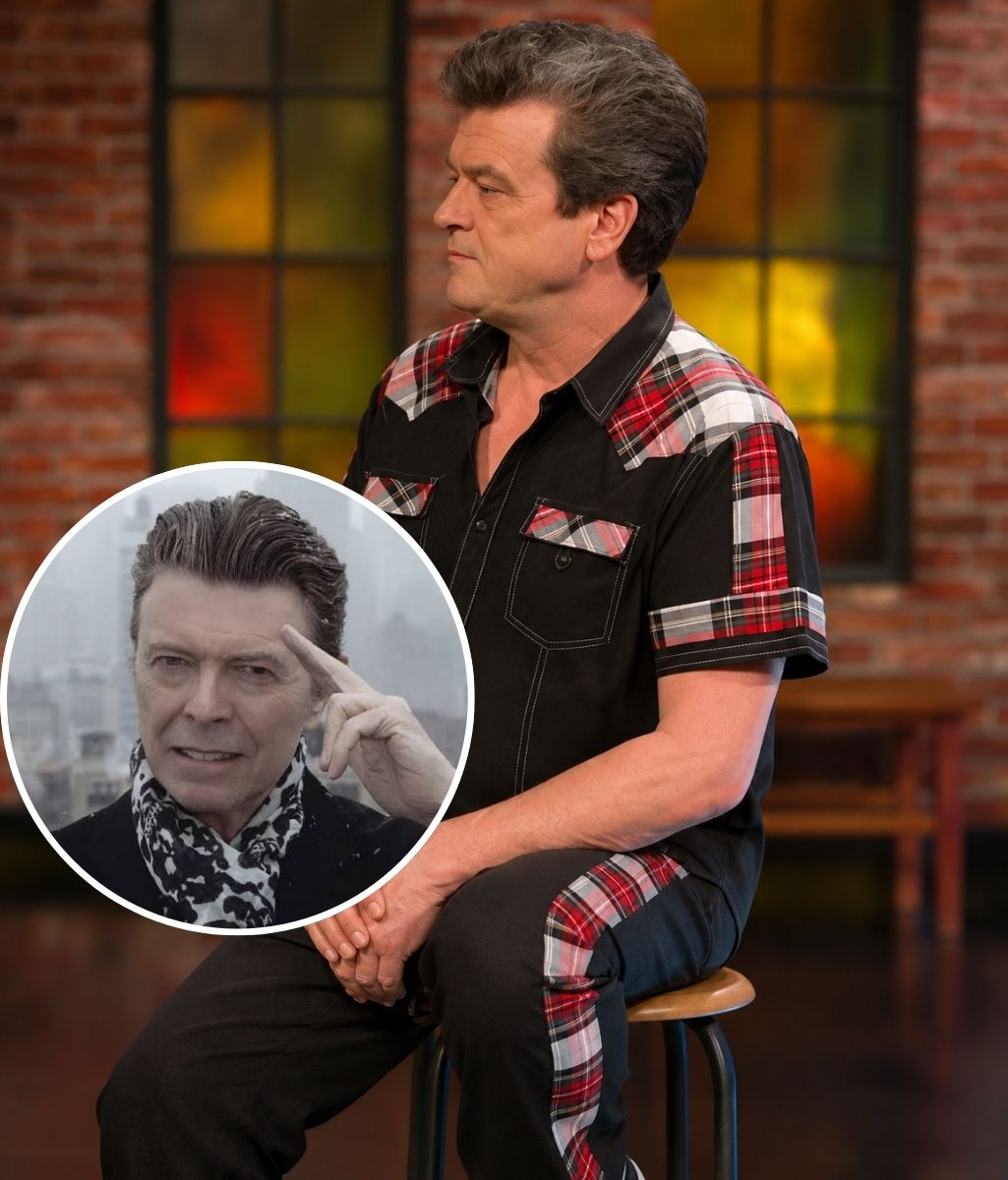
Long before Les McKeown became the face of the Bay City Rollers and found himself surrounded by screaming teenagers, tartan scarves and the chaos of Rollermania, he was simply another young Scottish music fan standing in awe of the artists he admired.
One of those artists was David Bowie.
By the time Les joined the Bay City Rollers in the early 1970s, Bowie was rapidly becoming one of the most fascinating figures in British music. Les had already been captivated by the emerging rock scene, listening to artists such as Led Zeppelin, Roxy Music and Queen, but Bowie occupied a particularly important place in his imagination. Years later, Les would still describe himself as a devoted Bowie fan.
What makes the story remarkable is that Les eventually went from watching Bowie as a fan to actually spending time with him.
In a 2017 interview, when Les was 61, he recalled the period when the Bay City Rollers were working on their 1978 album Strangers in the Wind. The record was produced by Harry Maslin, who had previously worked with Bowie, and the Rollers were recording near Lake Geneva, where Bowie was also spending time.
According to Les, he became acquainted with a woman who was helping look after Bowie’s child, and that connection eventually brought him into Bowie’s private circle. Les remembered staying at Bowie’s home on several occasions, where the conversations were very different from the carefully controlled world he had experienced at the height of Rollermania.
Sometimes Bowie would arrive with other musicians, including Iggy Pop, and Les found himself having casual conversations with artists he had once only imagined meeting.
For a young man who had grown up admiring Bowie, the situation must have felt almost impossible.
Only a few years earlier, Les had been on the other side of the barrier.
He later recalled going to see Bowie in Edinburgh during the early 1970s, when the Ziggy Stardust era was transforming British rock. Les was such an enthusiastic concertgoer that he once joked about climbing a drainpipe to get into the Edinburgh Odeon rather than paying for admission. The moment he heard Bowie’s music, he remembered thinking that something extraordinary was happening.
There was another memory that Les carried with him for decades.
In January 1973, before Rollermania had turned him into an international pop star, Les went to the hotel where Bowie was staying in Edinburgh during the Ziggy Stardust period. He waited around hoping for the chance to meet the singer and managed to have a photograph taken with him.
Years later, when Les and Bowie met again under very different circumstances, Les still had that picture.
He showed it to Bowie.
According to Les’s recollection, Bowie looked at the photograph and immediately burst out laughing, particularly at Les’s long hair in the old picture. What had once been the treasured photograph of an excited young fan had suddenly become a joke shared between two musicians who now knew each other personally.
The irony would not have been lost on Les.
In 1973, he had waited for the chance to meet one of his heroes. Within only a few years, he had become a star himself, fronting a band capable of creating scenes of hysteria that reminded many observers of Beatlemania.
Yet even at the height of his own fame, Les never seemed to lose that admiration for Bowie.
The connection even found its way into the Bay City Rollers’ music. On their 1977 album It’s a Game, the group recorded a version of Bowie’s “Rebel Rebel.” Les later recalled initially wondering how he could possibly sing a David Bowie song because he regarded the original with such reverence.
Bowie’s influence continued after Les left the Rollers.
When Les later experimented with a more theatrical rock project called Ego Trip, he said Bowie and Queen were among the artists who inspired its visual style and musical direction. The flamboyant clothes and more adventurous presentation were deliberately far removed from the tartan image that had defined the Bay City Rollers.
That is what makes Les McKeown’s Bowie story so appealing.
It was not a dramatic feud or a hidden scandal. Instead, it revealed something much more human about a singer audiences thought they already knew.
Behind the Bay City Rollers frontman who had experienced extraordinary fame was still the Scottish teenager who once waited outside a hotel hoping to meet David Bowie.
Years later, he found himself sitting in Bowie’s home, talking with him and people such as Iggy Pop as though the impossible had somehow become ordinary.
Perhaps the most memorable part was that old photograph. Les had kept it because Bowie had once been one of his heroes, but when he finally showed it to the man himself, Bowie simply laughed at his hair. For Les McKeown, it was a small, funny moment that perfectly captured how dramatically his life had changed — from Bowie fan to fellow musician and friend.