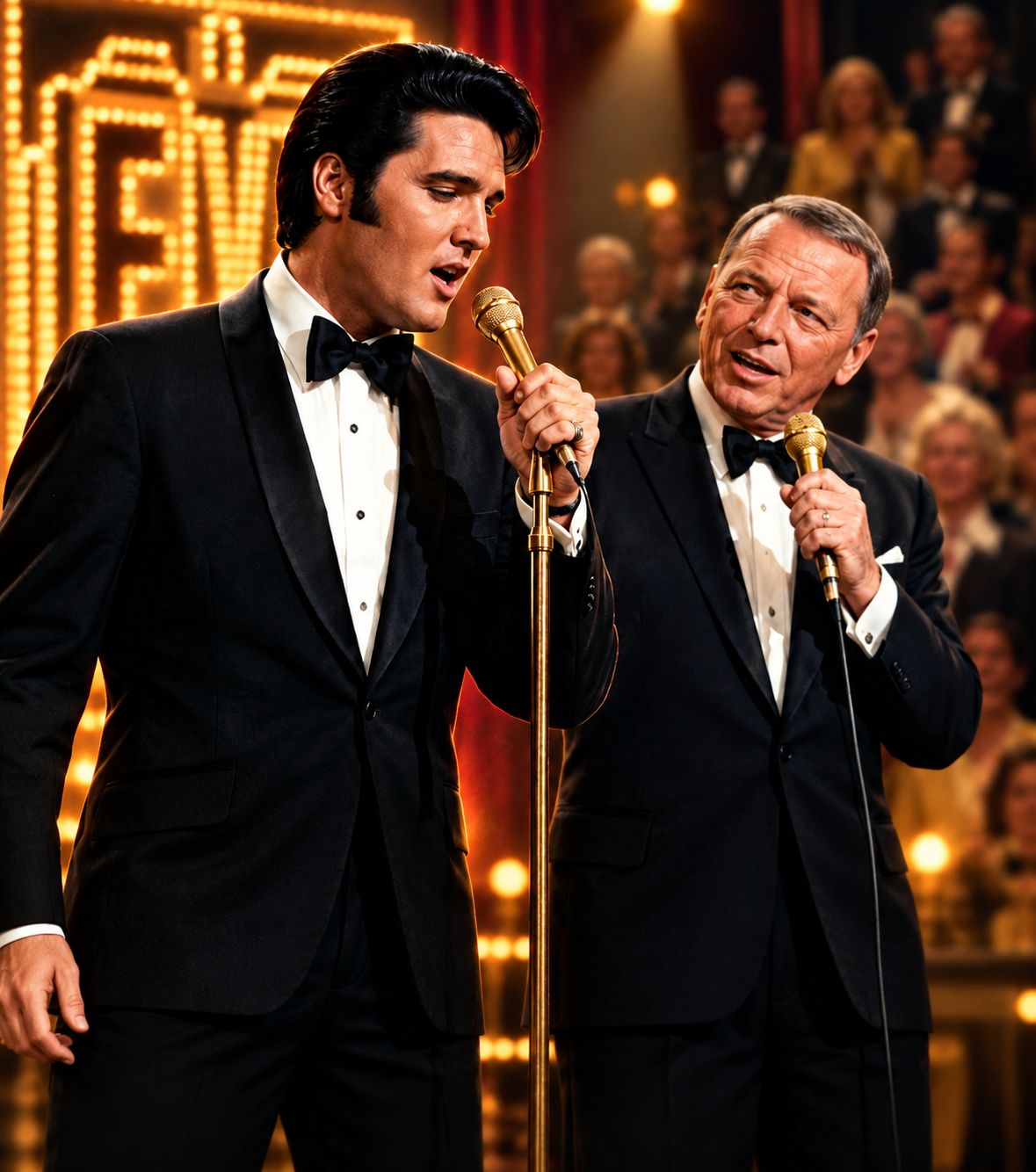
By the spring of 1960, Elvis Presley and Frank Sinatra represented two very different visions of American music. Sinatra belonged to the polished world of orchestras, nightclubs, tuxedos, and carefully shaped phrasing, while Elvis had become the face of a younger and far more disruptive sound. To millions of teenagers, Elvis represented excitement and freedom, but to many members of the older musical establishment, rock and roll still seemed loud, unpredictable, and difficult to understand. That contrast is what made their eventual meeting so fascinating.
Elvis had just returned to the United States after serving two years in the U.S. Army, and the music industry was watching closely to see whether he could reclaim the extraordinary momentum he had left behind. Before entering the military, he had already changed popular culture with records such as “Heartbreak Hotel,” “Hound Dog,” “Love Me Tender,” and “Jailhouse Rock.” His absence had done little to reduce the public’s fascination with him, but returning home meant proving that Elvis Presley was not simply a phenomenon tied to one brief moment in the 1950s.
Frank Sinatra stood at almost the opposite end of the musical spectrum. By 1960, he had already built a reputation as one of America’s most sophisticated singers and entertainers, surviving setbacks and changing tastes while remaining a dominant presence in popular culture. Sinatra had also made his skepticism toward rock and roll very clear during the 1950s, which gave his meeting with Elvis an unmistakable tension. One man represented the established tradition of American popular singing, while the other had helped disrupt that tradition almost overnight.
Their most famous encounter took place at the Fontainebleau Hotel in Miami, where Sinatra was preparing a television special later known as Welcome Home Elvis. Presley arrived in Miami in March 1960 and spent several days rehearsing before the program was taped on March 26. The special aired on May 12 and marked Elvis’s first major television appearance in roughly three years, making the event far more significant than a routine variety-show performance.
For fans looking back decades later, the idea of Elvis rehearsing backstage carries its own sense of drama, especially because “Heartbreak Hotel” had become one of the songs most closely tied to his rise. Released in 1956, it became his first No. 1 pop hit and helped transform him from a regional sensation into a national star. Its haunting sound, unusual production, and emotional delivery immediately announced that Elvis was unlike most singers audiences had heard before.
The often-repeated story that Frank Sinatra suddenly walked in while Elvis was rehearsing that exact song is difficult to verify in reliable historical sources. However, the larger encounter between the two men is well documented, and it carried enormous symbolic weight. For Sinatra, Elvis represented a musical revolution that had challenged the traditions of his generation. For Elvis, Sinatra represented something equally important: proof that an entertainer could survive changing tastes, criticism, setbacks, and the passage of time while still remaining a major star.
That contrast became even more memorable when the two men appeared together on television. Instead of presenting them as rivals from opposing musical camps, the program brought them into the same performance. Elvis sang his new songs “Stuck on You” and “Fame and Fortune,” while one of the evening’s most memorable moments came when Elvis performed part of Sinatra’s “Witchcraft” and Sinatra answered with part of Elvis’s “Love Me Tender.” It was clever television, but it was also a symbolic acknowledgment between two generations of entertainers.
Neither man had to imitate the other for the moment to work. Sinatra did not suddenly become a rock-and-roll singer, and Elvis did not abandon the sound that had made him famous. Instead, they demonstrated that two completely different styles of music could exist side by side and still command respect. That was especially striking because Sinatra had once spoken harshly about rock and roll, while Elvis had become the most visible symbol of the very movement Sinatra had criticized.
For Elvis, the special carried another layer of importance. He had returned from military service to a music industry that had continued changing without him, and there was no guarantee that the excitement of 1956 would simply return. New performers had emerged, audiences had evolved, and even a star as famous as Elvis had something to prove. The Sinatra special answered that question almost immediately: Elvis Presley was still an event, and America was still eager to watch him.
The program also revealed something about Elvis that was often hidden behind his rebellious public image. Although he had become famous for challenging expectations, Elvis had enormous respect for many older performers and musical traditions. He grew up listening to gospel, country, rhythm and blues, and mainstream popular singers, which meant his influences were always broader than the label of “rock and roll” suggested. Sinatra was therefore more than an older rival from another generation; he was also someone Elvis could admire for his longevity, discipline, and ability to reinvent himself.
Sinatra, meanwhile, could no longer dismiss Elvis as a temporary teenage craze. By 1960, Presley had already sold enormous numbers of records, starred in successful films, served in the Army, and returned home to extraordinary public attention. The young singer who had once been treated by parts of the establishment as a passing disturbance was now standing beside one of America’s greatest entertainers on national television.
That is why their shared appearance still matters decades later. It was not the story of one man defeating the other, but of two very different kinds of stars recognizing that there was room for both of them. Sinatra’s elegance did not become less important because Elvis existed, and Elvis’s energy did not lose its power because Sinatra represented an older tradition. Their music came from different worlds, but those worlds could meet without either one disappearing.
The moment also hinted at Elvis’s own future. As the 1960s continued, he would increasingly record ballads, gospel music, movie material, and sophisticated arrangements that moved far beyond the raw rock-and-roll sound associated with his earliest fame. Elvis wanted to be seen not only as a cultural phenomenon, but also as a serious vocalist, and standing beside Frank Sinatra offered an early glimpse of that ambition.
Years later, photographs and footage from Welcome Home Elvis would become enduring images of American entertainment history. Two men from different generations, different musical traditions, and very different public identities stood together under the same lights. The backstage story may have grown more dramatic with time, but the truth behind the larger moment remains powerful enough on its own.
“Heartbreak Hotel” had helped Elvis Presley shake the foundations of popular music in 1956, and only four years later, he was standing beside Frank Sinatra, one of the men who represented the world his music had disrupted. Instead of walking away from each other, they sang together, proving that legends did not have to sound alike to recognize greatness in one another.