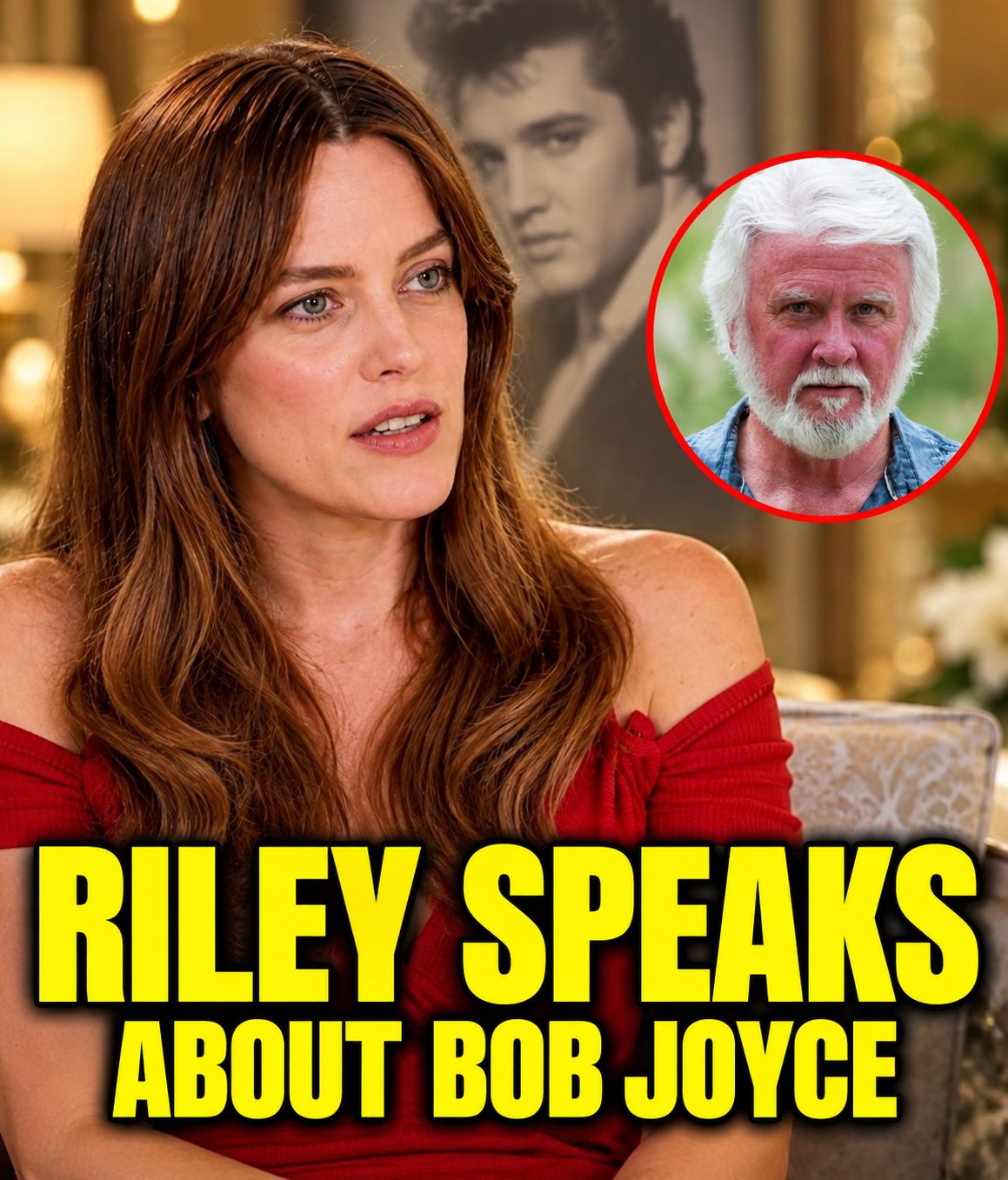
For years, one of the strangest rumors surrounding Elvis Presley has refused to disappear. Long after the world accepted that the King of Rock and Roll died in 1977, a small but persistent group of fans began pointing to Pastor Bob Joyce, a gospel preacher whose voice and appearance reminded some listeners of Elvis. From there, the internet did what it often does best: comparisons became theories, theories became videos, and videos eventually became claims that Elvis had somehow survived and begun a completely different life.
Then Riley Keough, Elvis Presley’s granddaughter, was pulled into the story.
As the daughter of Lisa Marie Presley and the current steward of Graceland, Riley naturally carries a connection to Elvis that no internet theory can manufacture. Every comment she makes about her grandfather, every memory she shares about Graceland, and every reflection on the Presley family is examined closely by fans who continue searching for hidden meaning in one of music history’s most enduring legends.
That is why recent online videos claiming that Riley Keough had finally broken her silence about Pastor Bob Joyce attracted so much attention.
The implication was enormous.
If Elvis Presley’s own granddaughter had something to say about Bob Joyce, fans wondered whether the decades-old mystery was about to take an extraordinary turn.
But the truth is far more complicated.
Despite the dramatic headlines circulating online, there is no verified public statement from Riley Keough identifying Bob Joyce as Elvis Presley. In fact, some videos promoting the theory acknowledge that Riley has never directly addressed the claim at all. Instead, they connect unrelated comments she has made about family history, private letters, Graceland, and Elvis’s legacy to a conspiracy theory that already existed long before her name became attached to it.
That distinction matters.
Riley has spoken openly in recent years about the Presley family’s private history, particularly while helping preserve the memory of her mother, Lisa Marie Presley, and managing the responsibilities surrounding Graceland. Because of that role, anything she says about Elvis immediately carries enormous emotional weight. For fans who have spent decades wondering whether every detail of Elvis’s final chapter has truly been explained, even an ordinary family story can quickly become fuel for speculation.
Pastor Bob Joyce became part of that speculation because of one simple observation repeated across countless social media posts: some listeners believe his singing voice resembles Elvis Presley’s voice.
From there, the comparisons expanded.
People began studying facial features, gestures, vocal phrasing, and old photographs. Some videos placed images of Bob and Elvis side by side, while others suggested that differences in age or appearance could somehow be explained away. As the theory spread, every new video attracted another wave of viewers convinced they had discovered something previous generations had missed.
Yet resemblance is not proof.
A familiar voice is not a birth certificate.
A similar smile is not historical evidence.
And most importantly, no reliable documentation has ever established that Bob Joyce and Elvis Presley are the same person. Independent examinations of the viral claim repeatedly conclude that the story lacks verifiable evidence, while Bob Joyce’s own official ministry has spent years warning about false accounts, fabricated claims, and people using his name online without authorization.
That makes Riley Keough’s supposed involvement especially important to understand correctly.
The most sensational versions of the story go far beyond suggesting that Riley simply commented on an internet rumor. Some posts have claimed that she appeared alongside Bob Joyce, publicly identified him as Elvis, or revealed a hidden Presley family secret.
Those claims have not been backed by credible evidence.
One widely circulated account describing Riley supposedly declaring that Bob Joyce was her grandfather was specifically examined as a piece of viral fiction rather than a documented event. There is no independently verified record showing that Riley made such a declaration.
Still, the fascination refuses to disappear.
Part of the reason is emotional.
Elvis Presley was not simply a famous singer. For millions of fans, he represented a particular time, sound, and feeling that never truly faded. His death at only 42 left generations of listeners wondering what might have happened if he had lived longer. Those unanswered possibilities created fertile ground for stories suggesting that perhaps the ending everyone accepted was not really the ending at all.
Bob Joyce became a perfect figure for that kind of mythmaking.
He sings gospel music.
Elvis loved gospel music.
Some listeners hear similarities in their voices.
And Bob has generally avoided feeding the sensational side of the theory himself, which ironically has made the mystery more attractive to those already determined to believe it.
But the official information connected to Bob Joyce consistently points in another direction.
His ministry warns followers about unauthorized accounts, manipulated videos, fake messages, and people who attempt to profit from rumors surrounding his identity. The official site emphasizes that many online profiles using his name are not actually connected to him and that people should be cautious about sensational claims circulating outside authorized channels.
Riley Keough, meanwhile, has a very different responsibility.
She is carrying forward a family legacy that has already been surrounded by mythology for nearly half a century. Graceland remains one of the most famous homes in American music history, and Elvis’s influence continues to introduce new generations to songs recorded decades before they were born.
For Riley, preserving that legacy means living in a world where fact and folklore often collide.
That may be the most revealing part of this entire story.
The real question is not whether Riley has suddenly confirmed an extraordinary secret about Bob Joyce.
She has not.
The more interesting question is why so many people desperately want such a confirmation to exist.
Perhaps it is because accepting Elvis’s death means accepting that one of music’s greatest stories truly ended too soon.
Perhaps it is because hearing a familiar voice in another man creates a brief emotional illusion that the King never really left.
Or perhaps it is simply because mysteries are more exciting than ordinary reality.
Whatever the reason, the Bob Joyce theory has survived because it touches something deeper than evidence.
It touches nostalgia.
And nostalgia can be extraordinarily powerful.
For Elvis Presley fans who remember where they were when they first heard “Suspicious Minds,” “Can’t Help Falling in Love,” or “How Great Thou Art,” the idea that some part of Elvis might still exist somewhere beyond old recordings can feel strangely comforting.
But Riley Keough’s role in preserving her grandfather’s memory does not make every internet theory true.
What she has inherited is not a hidden conspiracy.
It is a legacy.
And that legacy is already extraordinary enough without rewriting history.
Elvis Presley changed popular music, influenced generations of performers, and created recordings that continue to reach millions of listeners nearly five decades after his death. His granddaughter now stands among the people responsible for protecting that history while navigating a world filled with endless speculation about the man behind the legend.
For now, the Pastor Bob Joyce theory remains exactly that — a theory.
There is no verified statement from Riley Keough confirming it, no reliable historical documentation proving that Bob Joyce is Elvis Presley, and no credible evidence showing that the Presley family has secretly acknowledged such a claim.
And perhaps that is where the story should remain.
Because sometimes the most powerful thing about a legend is not discovering that he never left.
It is realizing that Elvis Presley never truly needed to come back for his music to remain alive.