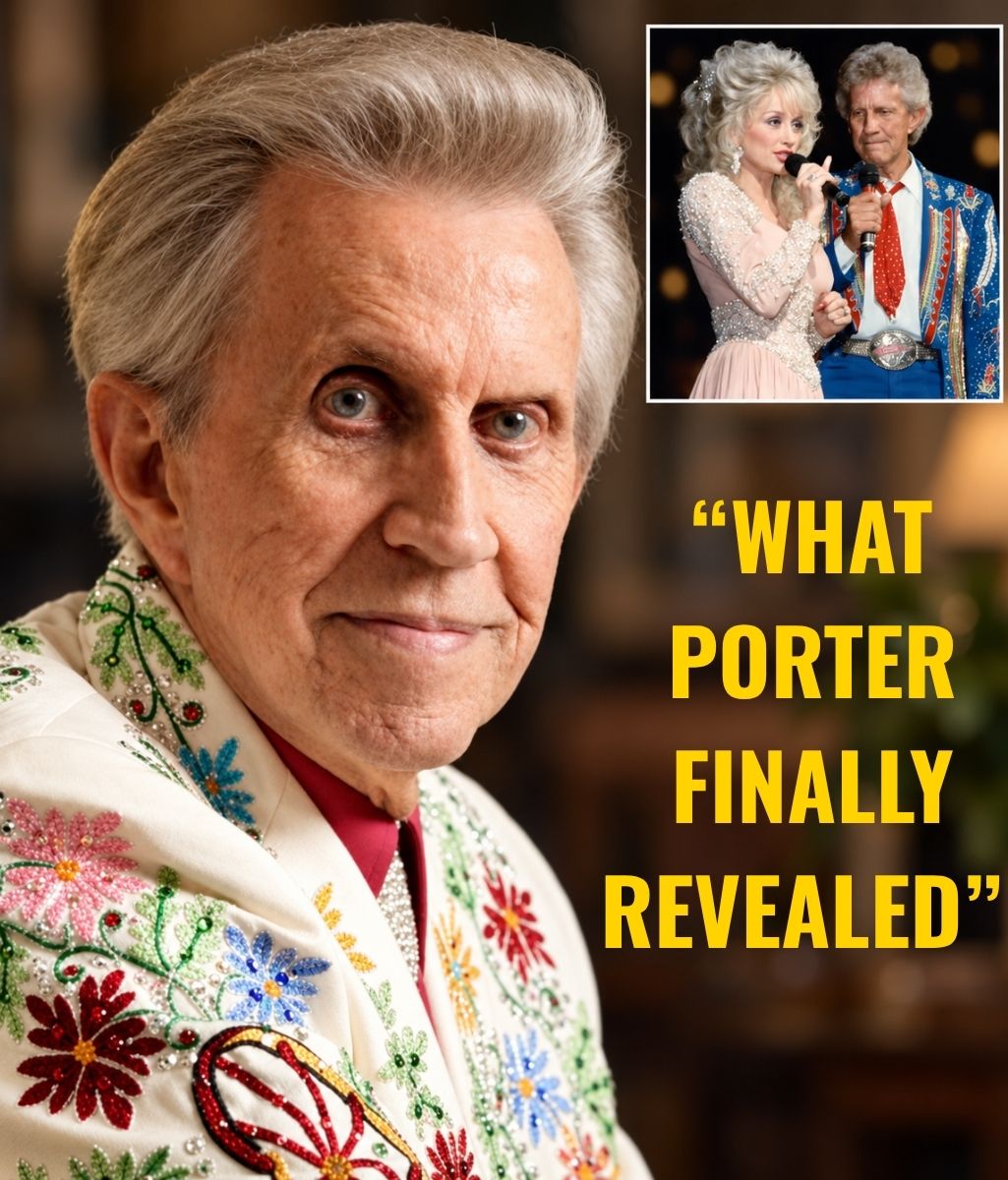
For years, the story of Dolly Parton and Porter Wagoner was told as one of country music’s most complicated breakups. He had helped introduce her to a national audience, she had become one of the brightest stars on his television show, and together they created a run of unforgettable duets. But when Dolly decided it was time to leave, their professional partnership collapsed into bitterness, arguments, and eventually a lawsuit that threatened to overshadow everything they had built together.
By the end of Porter’s life, however, that was no longer the whole story.
The truth was much more complicated.
Porter had hired Dolly in 1967 to replace Norma Jean on The Porter Wagoner Show, and the decision changed both of their careers. Dolly suddenly had a national television platform, while Porter found a duet partner whose songwriting, personality, and unmistakable voice helped create one of the most successful pairings in country music. Their first duet, “The Last Thing on My Mind,” reached the country Top 10, and many more followed. The pair won CMA Vocal Duo of the Year in both 1970 and 1971 and scored hits including “Please Don’t Stop Loving Me,” “Say Forever You’ll Be Mine,” and “Is Forever Longer Than Always.”
But success also made Dolly increasingly aware that she needed to build a career of her own.
By 1974, she had decided to leave Porter’s television show and pursue the larger future she believed was waiting for her. Porter did not take the decision easily. Dolly later explained that ordinary conversations had failed to make him understand why she needed to go, so she turned to the language she knew best.
She wrote a song.
That song was “I Will Always Love You.”
Dolly’s official history describes the song as her public goodbye to Porter, written as she left his show after seven years. It reached No. 1 on the country chart and eventually became one of the most famous compositions in American music.
The song sounded tender.
The real separation was not.
Porter felt abandoned and underappreciated as Dolly’s career accelerated beyond his. Dolly, meanwhile, felt increasingly restricted and believed that parts of their business relationship had become unfair to her. The conflict eventually became legal, with Porter suing his former protégé in 1979. The two ultimately reached a settlement, and Dolly regained control of her song catalog while also agreeing to record with Porter again.
For years, that bitterness became part of the mythology surrounding them.
People wanted to know who had been right.
Was Porter the mentor Dolly had abandoned once she became successful?
Or was Dolly the young artist who had to fight her way out of a controlling professional relationship?
The reality contained pieces of both perspectives.
Porter had given Dolly an enormous opportunity.
Dolly had outgrown the partnership.
Porter felt hurt.
Dolly felt trapped.
And both of them carried scars from the breakup.
What changed the story was time.
As the years passed, the anger softened. The two began appearing together again, and the hostility that once defined their separation gradually gave way to something closer to gratitude. Their reconciliation became undeniable in 2007, when Porter celebrated 50 years as a member of the Grand Ole Opry.
Dolly was there.
And she sang “I Will Always Love You” to him.
The symbolism was impossible to miss.
The song that had once represented her need to leave had become a song she could finally sing to him without anger.
It no longer sounded like an escape.
It sounded like forgiveness.
That moment also revealed something important about Porter.
Whatever resentment he had once felt toward Dolly, he had lived long enough to see exactly what she became. The young woman he had brought onto his television show had grown into an international star, one of country music’s greatest songwriters, and an artist whose success had far exceeded what either of them could have imagined in the late 1960s.
Porter did not spend his final years pretending that history had never happened.
But he also did not die trapped inside their feud.
By then, the two had reconciled, and the Grand Ole Opry itself describes their relationship that way today: a partnership that ended over creative differences, moved through legal battles, and eventually found peace.
Only a few months after the anniversary celebration, Porter became seriously ill with lung cancer.
Dolly went to visit him in the hospital.
At the time, she said he was very weak but still alert enough to joke with her, and she expressed hope that they would sing together again at the Opry when he recovered. That opportunity never came. Porter was transferred to hospice care and died on October 28, 2007, at the age of 80.
Dolly was able to say goodbye.
She later revealed that she spent some of Porter’s final hours with him and his family. She sang for him and prayed with him, saying afterward that she was grateful she had been able to give him a proper goodbye.
That may be the most important truth about their relationship.
It did not end with the lawsuit.
It did not end with the arguments.
It did not even end with Dolly walking away from his show.
It ended with reconciliation.
The two people who had once fought bitterly over career, money, control, and independence found their way back to a place where Dolly could stand beside Porter at the end of his life and remember what existed before the conflict.
There is a reason “I Will Always Love You” remains the perfect song for their story.
It was never a song about hatred.
It was a song about leaving someone while still recognizing what they had meant to you.
For decades, fans focused on the pain behind it.
By the time Porter Wagoner died, the meaning had changed.
Dolly had moved on.
Porter had accepted that she needed to.
And the man who once struggled to let her go ultimately lived long enough to see what happened when she did.
She became Dolly Parton.
And before the end, they finally made peace with that.