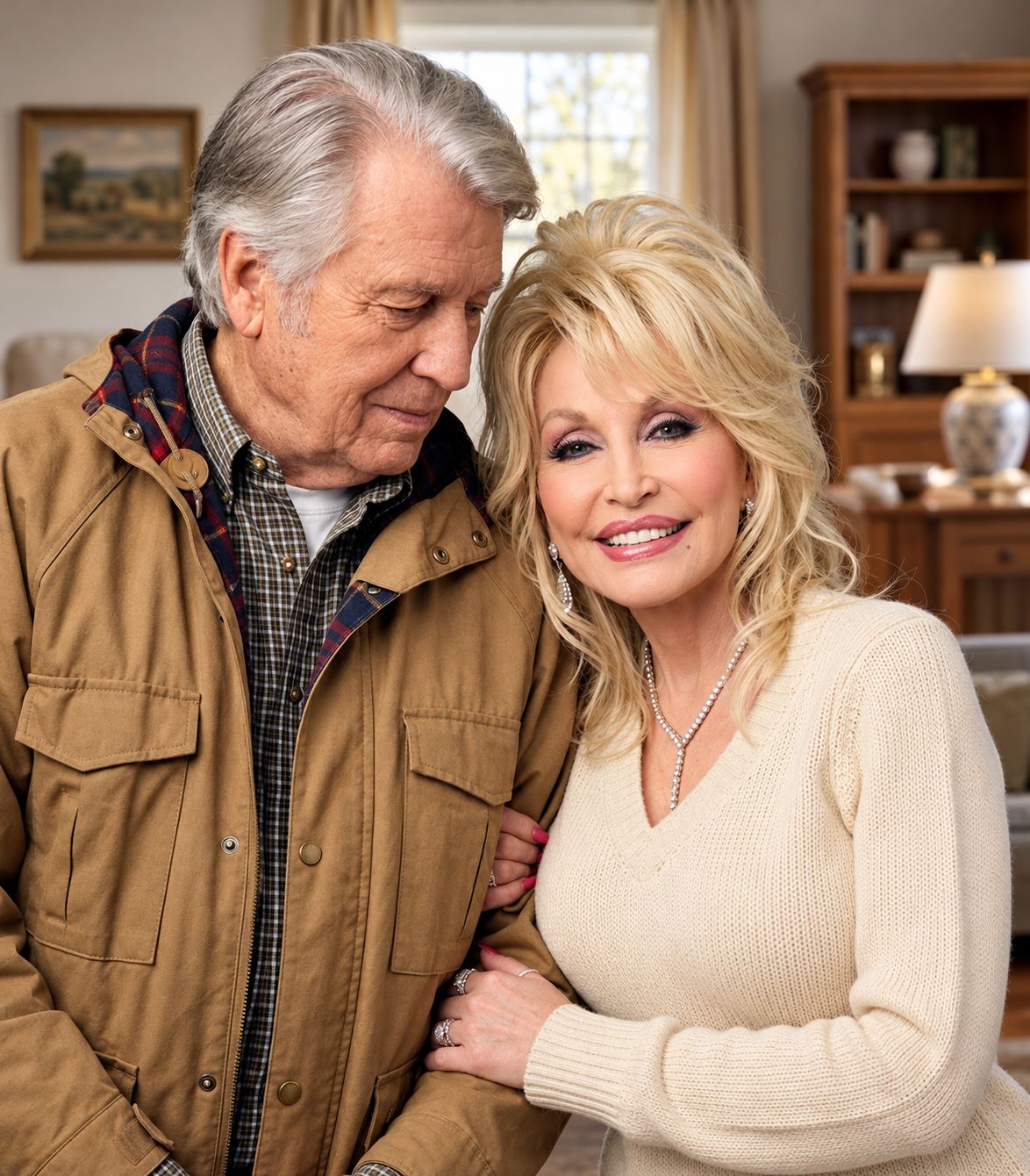
For most of her life, Dolly Parton belonged to the public. Her songs played on radios around the world, her face appeared on television screens for generations, and her unmistakable style made her one of the most recognizable entertainers in American music. She shared stories about her childhood, her career, her dreams, and even the struggles that shaped her. Yet there was one part of her life she protected with remarkable consistency: her marriage to Carl Dean.
Dolly met Carl in 1964, shortly after arriving in Nashville as a young woman determined to build a career in country music. Two years later, in 1966, they married. At the time, Dolly was still at the beginning of the journey that would eventually make her a global icon, while Carl chose a life almost completely removed from the entertainment industry. That contrast would become one of the defining features of their marriage.
As Dolly’s fame grew, Carl remained largely out of sight. He had little interest in red carpets, award shows, interviews, or the constant attention that surrounded his wife. While Dolly became more famous with each passing decade, Carl stayed close to home and kept his distance from the machinery of celebrity. For many fans, that made him seem mysterious, but Dolly never treated his privacy as something strange. To her, it was simply part of who he was.
That privacy may also have been one of the reasons their relationship endured for so long.
Dolly spent much of her professional life surrounded by cameras, fans, business meetings, musicians, and public expectations. Home offered something entirely different. With Carl, she did not have to be the entertainer the world expected to see. She could step away from the stage and return to a quieter life that belonged only to them.
That division between public and private life was something Dolly guarded carefully. Even people who had known her for decades did not necessarily have access to Carl or to the home they shared. Reba McEntire, who knew Dolly for many years and became one of her close friends in country music, once acknowledged that she had never met Carl and had never been inside Dolly’s home. That detail reveals just how firmly Dolly protected the boundary around her marriage.
It was not because she was ashamed of Carl or because the marriage was some hidden secret. People knew she was married. What Dolly protected was access.
She understood that once every part of a famous person’s life becomes public, it can be difficult to reclaim anything that feels truly personal. By keeping Carl away from the spotlight, Dolly created a space that fame could not fully enter.
For all the mystery that surrounded him, however, stories about Carl suggest he was far from distant or humorless. One of the most memorable accounts involved a rare moment when he unexpectedly stepped into Dolly’s public world. During a performance at the Kentucky State Fair, Dolly noticed something unusual in the backing vocals. When she turned around, she discovered Carl standing onstage, having quietly joined the singers without warning her beforehand.
For a man who avoided public appearances, the prank was completely unexpected.
Dolly later told the story with amusement, and it offered fans a rare glimpse of the man behind the private image. Carl may have disliked the spotlight, but he clearly understood how to make Dolly laugh. That moment showed a relationship built not on celebrity, but on familiarity, humor, and the kind of comfort that develops over many years together.
Their marriage eventually lasted nearly six decades.
Through all those years, Dolly’s career continued to expand. She became a singer, songwriter, actress, businesswoman, philanthropist, and cultural figure whose influence reached far beyond country music. Yet Carl remained almost completely separate from that public identity. He was present in her life without needing to become part of her brand.
That may be one of the most unusual things about their relationship.
Celebrity often creates pressure for couples to perform their lives publicly. They attend events together, appear in interviews, and allow their relationship to become part of the story audiences consume. Dolly and Carl chose the opposite path. Their marriage existed largely outside the narrative of fame, and Dolly seemed determined to keep it that way.
When Carl died on March 3, 2025, at the age of 82, he and Dolly had been married for almost 59 years. Dolly acknowledged the loss publicly, but even then, she maintained the sense of privacy that had defined their relationship. She shared grief without turning their marriage into a spectacle.
That restraint felt entirely consistent with the way she had lived.
For decades, Dolly had given audiences almost everything they could ask for. She shared her voice, her humor, her memories, her business ventures, and her deeply personal songwriting. She was generous with the world, but she never believed generosity required surrendering every part of herself.
Carl was the part she kept closest.
Their story was never built around dramatic public declarations or constant appearances together. It was built quietly, away from cameras, over the course of thousands of ordinary days. That may be why it still fascinates people. In an industry where relationships are often watched, judged, and discussed endlessly, Dolly and Carl created something that remained largely untouched by public scrutiny.
The world knew Dolly as a legend.
Carl knew her as the woman who came home.
That distinction may have mattered more than anyone outside their marriage could ever fully understand.
Dolly’s public life was filled with extraordinary moments, but the relationship she protected most carefully was not designed for an audience. It belonged to two people who found a way to remain connected while one of them lived almost continuously in the spotlight.
And perhaps that was the real secret of their longevity.
Dolly Parton gave the world nearly every part of her story, but the love she shared with Carl Dean was the one chapter she never allowed fame to rewrite.