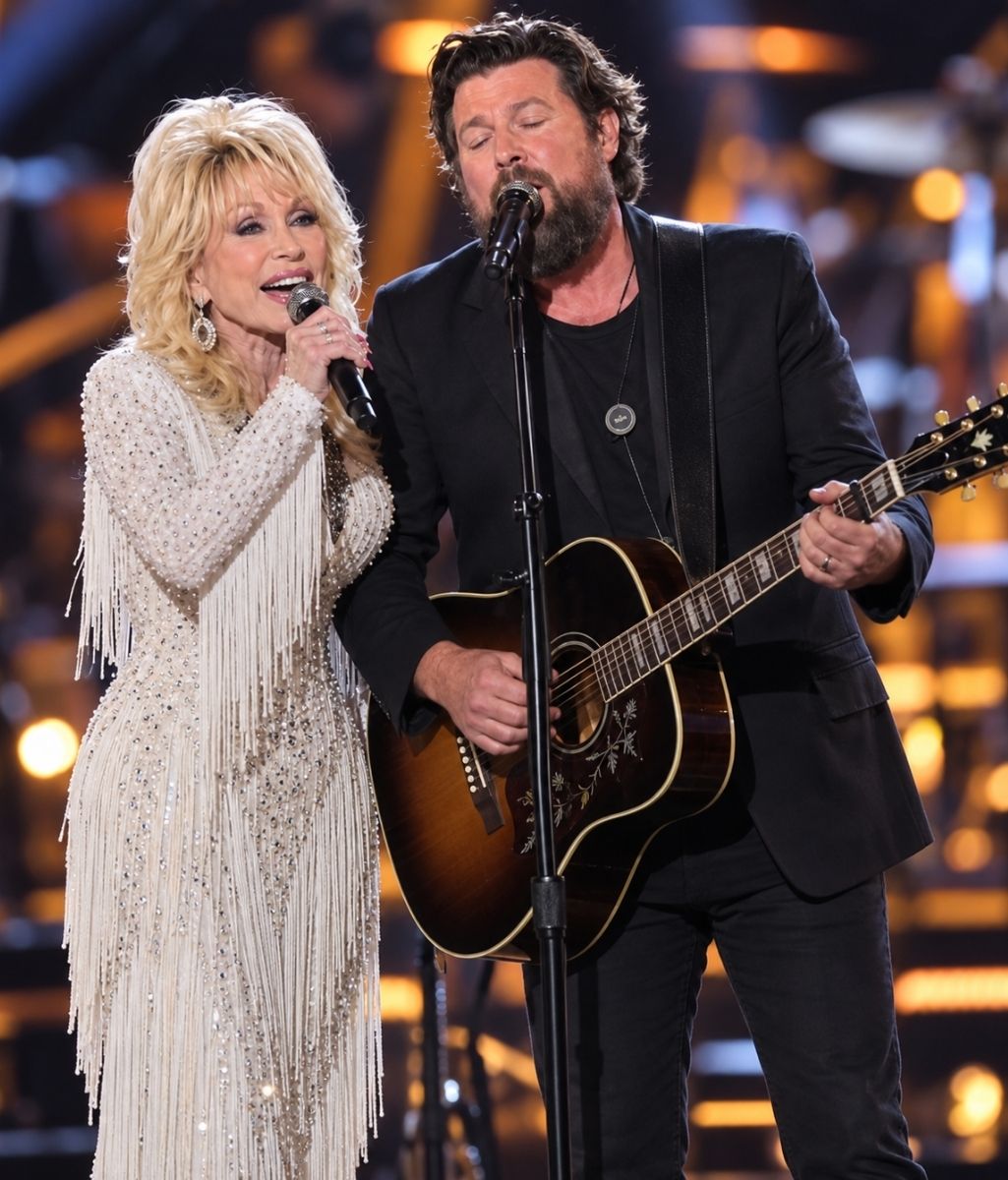
When Zach Williams first imagined Dolly Parton singing on “There Was Jesus,” even he thought the idea sounded almost impossible.
The song had already been written with Jonathan Smith and Casey Beathard, and Zach had taken a demo home to play for his wife, Crystal. After hearing it, she made a suggestion that sounded far too ambitious to be realistic: they should ask Dolly Parton to sing the female part. Zach laughed at the idea because, as he later remembered, you do not simply pick up the phone and call Dolly Parton.
Even people around him initially treated the suggestion like a joke.
But the song eventually reached Dolly.
And she did not need long to make up her mind.
Zach later recalled that Dolly told him she had not even made it through the entire chorus before realizing she wanted to be involved. She believed the song was special almost immediately and agreed to record it with him, setting in motion a collaboration neither artist could have known would become one of the most important Christian music moments of Dolly’s later career.
Then came the moment Zach never forgot.
When Dolly walked into the Nashville studio to record “There Was Jesus,” she looked at him and made a prediction with the confidence of someone who had spent more than half a century recognizing songs that mattered.
She told him they were going to win a Grammy for it.
Zach’s reaction was much less certain.
He later remembered essentially thinking, maybe.
But Dolly was right.
At the 63rd Annual Grammy Awards in 2021, “There Was Jesus” won Best Contemporary Christian Music Performance/Song, giving Zach Williams another Grammy and Dolly her tenth career win. The Recording Academy credited Williams, Dolly, Casey Beathard, and Jonathan Smith with the winning song.
For Dolly, the achievement carried an unusual kind of significance.
She had already conquered country music, crossed successfully into pop, built a film career, written standards, opened Dollywood, and recorded with artists from almost every corner of the music industry. Yet “There Was Jesus” pushed her into territory where she had never previously reached No. 1.
The song topped Billboard’s Christian Airplay chart, marking Dolly’s first No. 1 on a Billboard Christian chart. It also reached No. 1 on Christian AC while peaking at No. 2 on the broader Hot Christian Songs chart.
That happened when Dolly was already in her seventies.
More than sixty years into a career most artists would have considered complete decades earlier, she was still finding new audiences.
That fact makes the success of “There Was Jesus” especially remarkable.
Dolly was not chasing a trend or attempting to manufacture a late-career reinvention. Faith had always been woven deeply into her life and music. She grew up singing in church in East Tennessee, recorded gospel material throughout her career, and frequently spoke openly about prayer and her Christian beliefs.
What changed with Zach Williams was not Dolly’s faith.
It was the audience and format through which that faith suddenly reached the top of the charts.
The song itself also fit Dolly naturally.
Williams has said “There Was Jesus” was rooted in looking back over difficult periods of his own life and realizing that God had been present even when he did not recognize it at the time. The message was not about pretending hardship never happened. It was about seeing meaning in retrospect.
That idea had appeared throughout Dolly’s own work for decades.
She repeatedly turned poverty, heartbreak, rejection, grief, and family struggles into songs about endurance. Joining Zach on a track about finding faith in the middle of difficult moments therefore felt less like Dolly entering a completely foreign genre and more like another chapter of something she had been saying all along.
What made the collaboration even more meaningful was how little Dolly demanded from it.
Zach later said she did not seek songwriting credit on a song she had not written, nor did she ask for the kinds of financial benefits someone of her stature might easily have requested. She simply believed in the song and wanted to be part of it. He described her as a champion of the track from the beginning.
That support did not stop after the recording session.
Dolly brought Zach into other opportunities, including CMA-related appearances and later her television projects. Their musical connection eventually continued beyond “There Was Jesus,” proving the first collaboration had grown into genuine mutual respect rather than a one-time celebrity feature.
Years later, Zach would remember Dolly not only as a legendary singer who agreed to appear on his record but as someone who genuinely encouraged him.
And the strangest part remained that prediction.
Before the nominations.
Before the chart success.
Before the Grammy.
Dolly had walked into the studio and told him exactly what was going to happen.
Then it happened.
After Dolly’s death, that memory took on even greater emotional weight. Zach said he still returned to “There Was Jesus,” but the song now sounded different to him because the person singing beside him was gone.
The Grammy also gained another significance.
It would become Dolly Parton’s final Grammy win.
For an artist whose awards stretched across generations, her last Grammy did not come from another country blockbuster or a nostalgic celebration of her earlier work. It came from a Christian duet recorded with an artist who once thought asking Dolly Parton to participate was almost ridiculous.
That may be the most fitting part of the story.
Dolly spent her entire career proving that age did not have to limit curiosity and that success did not have to stop an artist from trying something unexpected.
In her seventies, more than six decades after beginning her journey, she walked into another studio, heard something she believed in, and trusted her instincts one more time.
She told Zach Williams they would win a Grammy.
She was right.