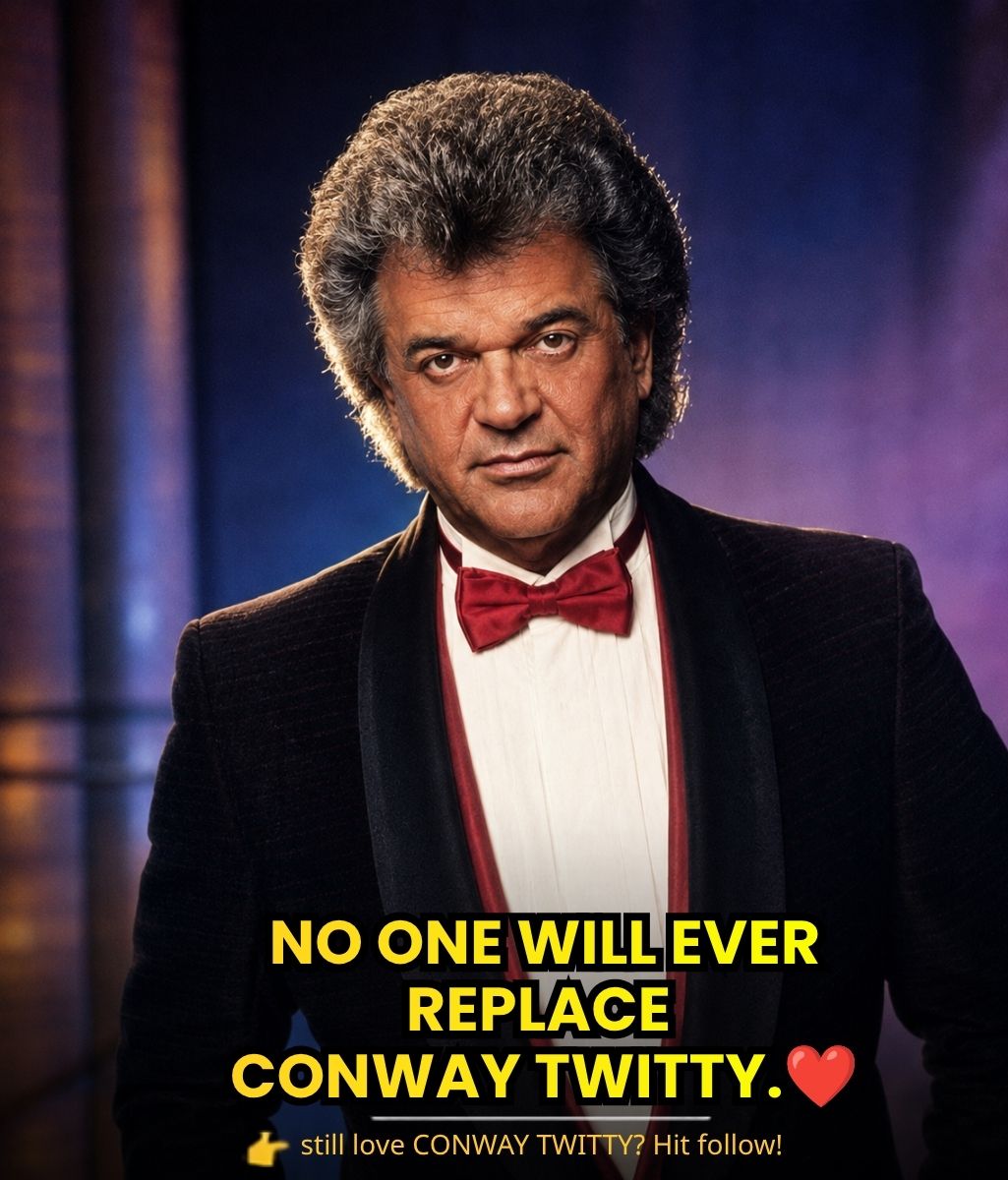
Before Conway Twitty became one of the most recognizable voices in country music, his future seemed to be heading somewhere completely different. In the late 1950s and early 1960s, he was not being introduced as a country singer at all. He was a rock-and-roll star, a young performer with a dramatic voice, hit records, and enough momentum that many people compared him to Elvis Presley. From the outside, the path looked obvious: keep going, keep making rock records, and build an even bigger career.
But Conway Twitty did something few artists would have dared to do.
He walked away from the direction that was already working.
At a time when most singers would have protected every bit of success they had earned, Conway chose to move toward a genre that felt more natural to him. He turned away from the image that had made him famous and began pursuing country music, even though there was no guarantee the audience would follow him. It was a risky move because he was not trying to rescue a failing career. He was stepping away from a successful one.
That is what makes the decision so striking.
He did not leave rock and roll because he had no other choice. He left because country music was where he felt he truly belonged.
Conway had grown up surrounded by Southern music, and country had always been part of his musical identity. Rock and roll gave him his first major breakthrough, but over time he became increasingly determined to record the kind of songs he felt more deeply connected to. Rather than continue chasing the image people had already accepted, he chose to rebuild himself around the music he loved most.
For a performer with hit records behind him, that meant starting over in many ways.
Rock audiences knew the name Conway Twitty, but country radio did not automatically owe him anything. Nashville was filled with established singers, respected songwriters, and artists who had spent years proving themselves within the genre. Conway had to show that he was more than a rock singer trying on a cowboy hat. He had to convince country listeners that this was not a temporary experiment.
The transition was not instant.
There were records that did not become major hits, periods when his new direction seemed uncertain, and plenty of reason to wonder whether he had given up something valuable for a dream that might never fully work. Yet Conway stayed with it. Instead of retreating to the safer identity that had already made him successful, he kept shaping a country sound around the voice audiences already knew.
Then the gamble began to pay off.
By the late 1960s, Conway Twitty had established himself as a serious country artist, and songs such as “Next in Line” and “Hello Darlin’” transformed his place in Nashville. “Hello Darlin’,” in particular, became one of those recordings that seemed to define an artist almost instantly. Conway’s spoken opening, his controlled delivery, and the song’s emotional directness created a style that would become inseparable from his name.
From there, the career that once looked like a risky reinvention became something much bigger.
Conway went on to score an extraordinary run of country hits, becoming one of the genre’s most successful artists and eventually building a catalog filled with songs about love, heartbreak, desire, regret, and devotion. Records such as “It’s Only Make Believe” had introduced him to the world as a rock-and-roll singer, but songs like “Hello Darlin’,” “You’ve Never Been This Far Before,” “Linda on My Mind,” and many others made him a country legend.
His partnership with Loretta Lynn added another major chapter. Together, they became one of country music’s most beloved duet teams, recording songs that fans still return to decades later. The chemistry, timing, and emotional tension between them helped create a body of work that would have been impossible if Conway had stayed permanently locked inside his earlier rock-and-roll identity.
Looking back, the decision seems almost inevitable because everyone now knows how successful it became.
But it did not feel inevitable at the time.
That is the part of the story easy to forget. Conway Twitty was not choosing between failure and opportunity. He was choosing between the success he already had and the music he truly wanted to make. One path was familiar. The other required him to risk his reputation and start proving himself again.
Many artists spend their entire careers trying to reach the position Conway already occupied. He had recognition, a strong audience, and a proven formula. Yet he was willing to jeopardize all of it because continuing down the wrong musical road seemed less satisfying than beginning again on the right one.
That may be one reason his story continues to resonate with fans.
The decision was not dramatic because someone forced him to make it. There was no single public collapse that pushed him out of rock and roll. The deeper reason was much simpler: Conway loved country music enough to gamble on it.
And that gamble changed everything.
If he had remained focused on rock and roll, Conway Twitty might still be remembered today as an important performer from the early era of the genre. He had the voice, charisma, and early success to leave a mark there.
But country music would have lost something far greater.
It would have lost the man who could say “Hello Darlin’” and make an entire audience react before another note was sung. It would have lost one half of the legendary Conway-and-Loretta partnership. It would have lost decades of recordings that helped define the emotional sound of mainstream country music.
Sometimes the most important decisions in a career do not look sensible when they are made.
Conway Twitty left behind a future that already seemed secure because another kind of music felt more honest to him. He chose uncertainty over comfort, passion over predictability, and the sound that spoke to his heart over the image that had already made him famous.
That single choice did not merely change Conway Twitty’s career. It helped create the country music legend the world remembers today.