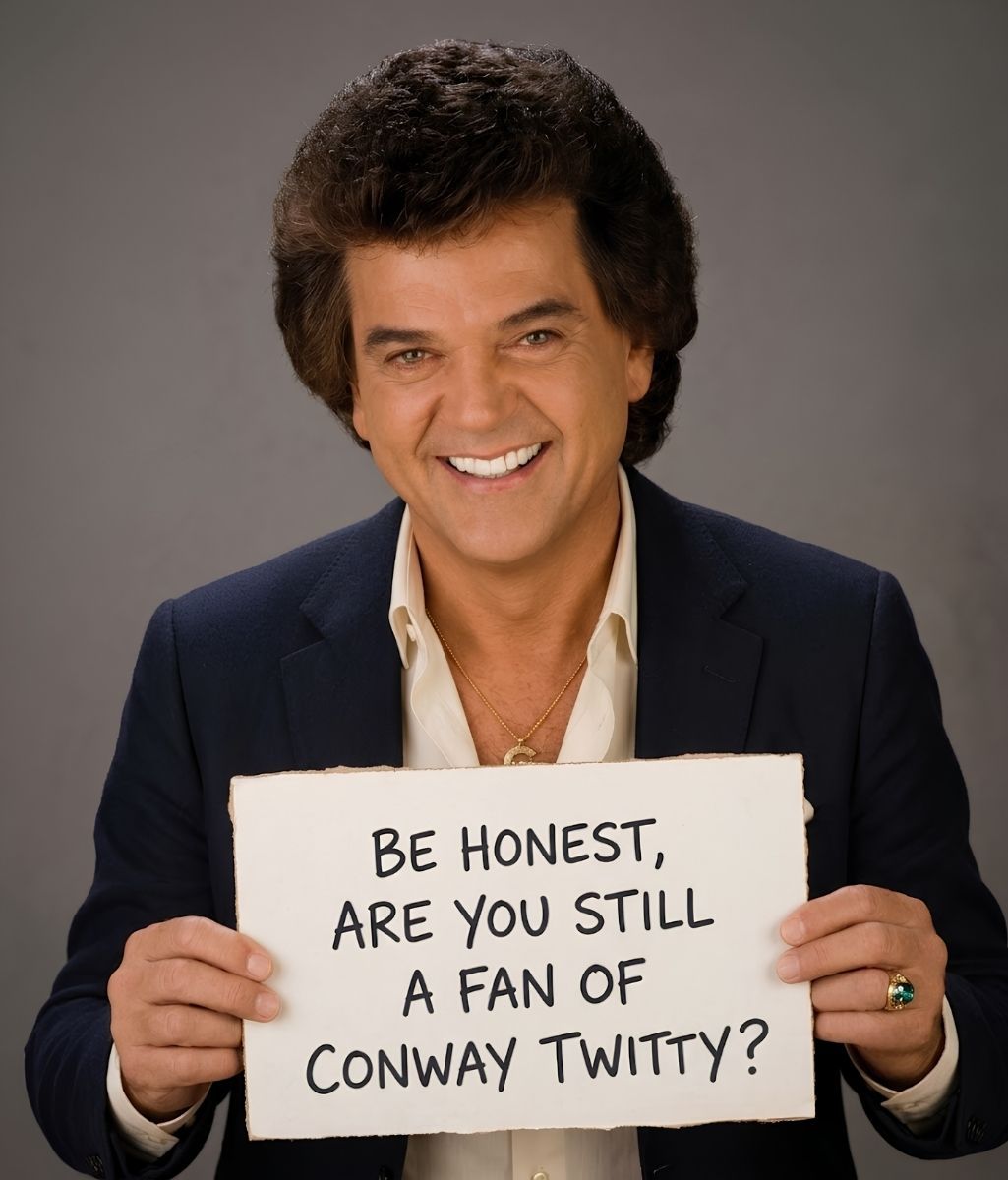
Written in a burst of inspiration and released when Conway Twitty was still searching for his place in rock & roll, “It’s Only Make Believe” became the song that opened the door to a career few could have imagined.
Before millions of people knew the name Conway Twitty, he was still Harold Lloyd Jenkins, a young singer trying to find his place in the rapidly changing world of American popular music. He had talent, ambition, and the determination to keep going, but none of those things guaranteed success. Like countless young performers of the 1950s, he was chasing the possibility that one song, one recording, or one unexpected moment might finally separate him from everyone else trying to be heard. Then, in 1958, that moment arrived. The song was “It’s Only Make Believe,” and almost everything about Conway Twitty’s future would look different after the world heard it.
The story behind the song has become almost as remarkable as the record itself. Conway and drummer Jack Nance wrote “It’s Only Make Believe” while touring in Canada, reportedly during a short break at the Flamingo Lounge in Hamilton, Ontario. The writing did not take months of careful planning. According to the story long associated with the song, the two men completed it in roughly 20 minutes before returning to their performance. At that moment, there was no way for Conway to know that those few hurried minutes would create the recording that changed his life. Some careers are built gradually. Conway Twitty’s suddenly had a door thrown wide open.
When the song was released, however, success was not immediate. “It’s Only Make Believe” initially attracted relatively little attention, and for a time it seemed possible that it might simply disappear among the thousands of records competing for radio airplay. Then something changed. More stations began playing it. Listeners started asking for it. The emotional intensity of Conway’s performance caught on, and the record began climbing. By late 1958, “It’s Only Make Believe” reached No. 1 on the Billboard pop chart, turning a struggling young singer into a nationally recognized star.
The recording had everything needed to stop a listener. Conway began softly, almost cautiously, allowing the story to unfold before gradually building toward the explosive emotional peak of the chorus. The song describes a man who desperately wants a love that exists largely in his imagination. He knows the truth, but knowing does not make the longing disappear. That tension between hope and reality gave the song its power. Conway’s voice made the heartbreak feel immediate, even to listeners who knew nothing about the young man singing it.
Comparisons with Elvis Presley naturally followed. Conway’s early rock-and-roll style, dark looks, and dramatic vocal delivery placed him in a musical world Elvis had helped transform. For a young performer trying to build a career during that era, the comparison could be both flattering and limiting. “It’s Only Make Believe” proved that Conway possessed something unmistakably his own. He could begin a song almost conversationally and then unleash a voice capable of filling the final moments with extraordinary urgency. The record did not simply show that Conway Twitty could sing. It showed listeners exactly why they should remember his name.
The success spread far beyond the United States. The song became an international hit, introducing Conway’s voice to audiences who had never seen him perform and knew little about his background. Suddenly, the uncertainty that had defined his early career was replaced by television appearances, larger audiences, and the expectations that come with a No. 1 record. In only a short period, Conway Twitty had gone from searching for a breakthrough to living inside one.
Yet what makes the story even more fascinating is that “It’s Only Make Believe” did not ultimately define the entire direction of his career. For many artists, a worldwide rock-and-roll hit might have become a formula they spent decades trying to repeat. Conway eventually chose a more difficult road. During the 1960s, as his pop success faded, he began moving toward the music that increasingly felt like home to him: country music. Critics and industry figures could easily have dismissed him as a former rock singer attempting to reinvent himself after his biggest days were behind him. Conway refused to accept that judgment.
The transition required patience. Country audiences did not immediately embrace him simply because he had once possessed a No. 1 pop record. He had to prove himself again, almost as though the success of 1958 belonged to another man. Eventually, songs such as “Next in Line,” “Hello Darlin’,” “I See the Want To in Your Eyes,” and many others established Conway as one of country music’s most important voices. He would go on to create an enormous catalog of hits and one of the genre’s most celebrated duet partnerships with Loretta Lynn.
That later success makes “It’s Only Make Believe” even more significant. The song was not merely Conway Twitty’s biggest early hit. It was the first great turning point in a life filled with reinvention. Without it, the young singer struggling to establish himself in rock & roll might never have received the opportunities that followed. Yet Conway also refused to let the song trap him inside 1958. He took the fame it gave him, survived the years when that fame began to fade, and built an entirely new career in another musical world.
More than six decades later, “It’s Only Make Believe” still carries the same dramatic pull. The production belongs unmistakably to another era, but the emotion does not. People still understand what it means to want something they know may never become real. They still recognize the ache of loving an idea as much as a person. And when Conway’s voice rises toward the song’s unforgettable climax, it remains possible to hear the moment when a young performer finally found the record that would change everything.
In 1958, Conway Twitty did not know he was writing the opening chapter of a legendary career. He was simply trying to create a good song. Twenty minutes of inspiration became a No. 1 hit, a worldwide breakthrough, and the first great proof that the voice behind “It’s Only Make Believe” was destined to be heard for decades.