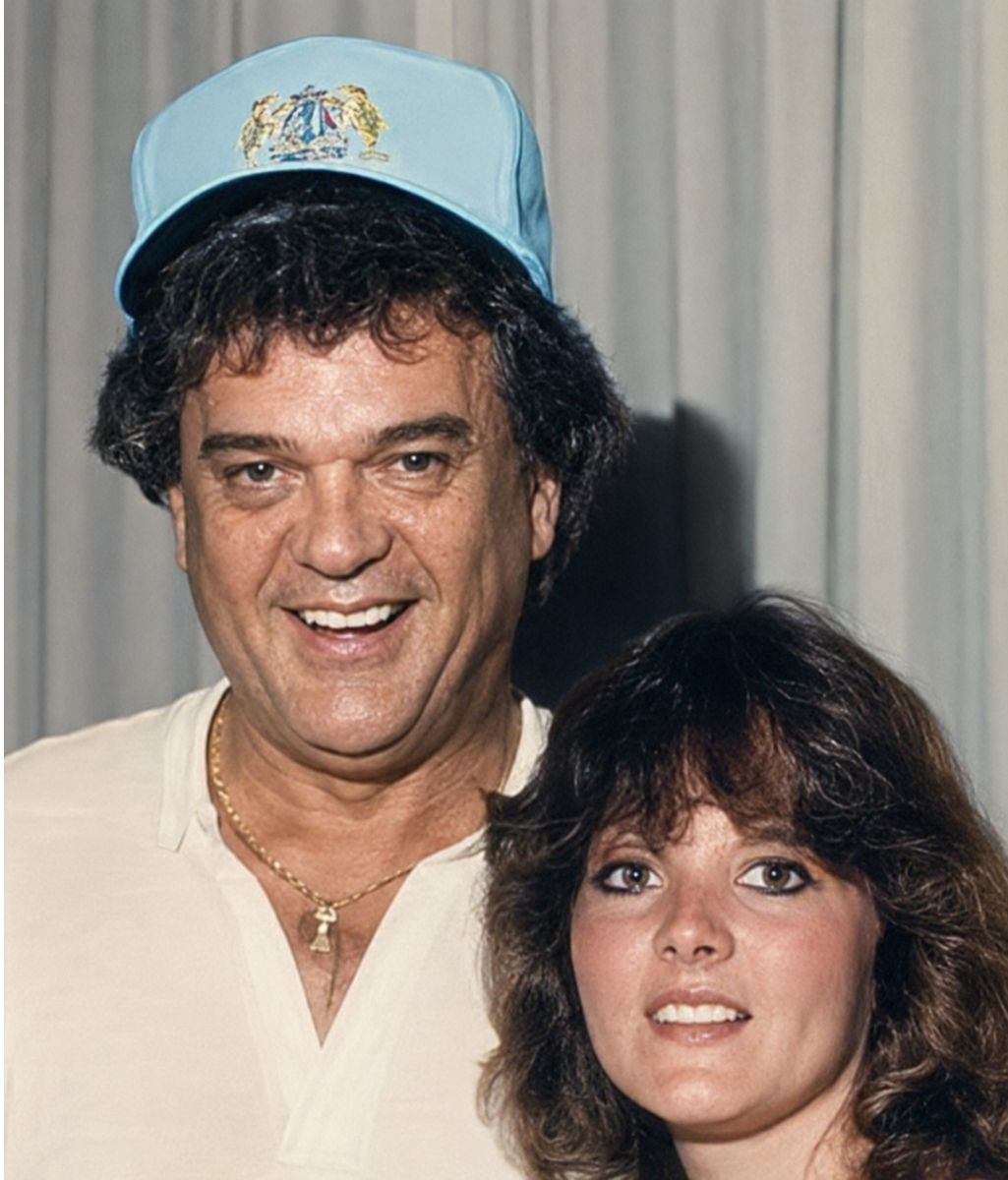
What began as an old song written before fame eventually became a deeply personal father-and-daughter recording—one that listeners embraced far more strongly than anyone expected.
Long before Conway Twitty became one of country music’s most recognizable voices, he was still a young man carrying ambitions far larger than the small Southern towns around him. Before the awards, the packed concerts, and the long list of chart-topping records, he was already writing songs and imagining a future in music. One of those early creations was “Don’t Cry Joni,” a tender story about youthful love, separation, and regret. Conway wrote the song while he was still a teenager, years before he could have known how closely it would one day become connected to his own family. Like many songs written early in an artist’s life, it was eventually set aside while time, responsibility, and an expanding career carried him in other directions. It might easily have remained forgotten among the memories of his youth. Instead, when Conway returned to it years later, the song unexpectedly opened a door for his daughter and created one of the most personal moments of his recording career.
By that time, Conway was no longer a hopeful teenager wondering whether anyone would ever hear his music. He had already survived the difficult transition from rock-and-roll success to country stardom and had established himself as a performer capable of making even the simplest lyric sound intimate and unforgettable. His daughter, Joni Lee Jenkins, was growing up in the shadow of that enormous career. She had inherited musical ability, but talent did not automatically give her the confidence to stand before a microphone. At sixteen, she was reportedly shy, hesitant, and uncertain about whether she wanted to follow the path that had defined her father’s life. Conway understood that pressure could easily make the experience frightening rather than meaningful. Instead of forcing her toward a professional career or demanding that she prove herself, he invited her to join him on an old song that already carried part of his own youth inside it. The purpose was not necessarily to manufacture a hit. It was to give his daughter a safe place to discover what her voice could do.
That decision gave “Don’t Cry Joni” an emotional quality no studio arrangement could have created on its own. Conway was not simply singing with another performer. He was sharing a song from his teenage years with his teenage daughter, allowing two generations of the same family to meet inside one recording. His voice carried the maturity of a man who had already lived through success, disappointment, reinvention, and responsibility. Joni’s voice brought youth, uncertainty, and a natural innocence that matched the story. The contrast made the duet feel less like a carefully planned performance and more like a private family moment that listeners had somehow been allowed to overhear. There was no need for exaggerated drama. The emotion came from the relationship between the two voices and from the knowledge that Conway was gently helping his daughter take a first step into a world he understood better than almost anyone.
Even then, few people expected the recording to become the center of attention. “Don’t Cry Joni” was originally released as the B-side of Conway’s single “Touch the Hand,” meaning it was not positioned as the main song expected to lead the record. In the music business, the A-side usually received the strongest promotional support, while the B-side often existed as a secondary selection. But listeners do not always follow marketing plans. Radio programmers and country fans began responding to the sincerity of the duet, and the supposedly secondary song gradually became the one people remembered. There was something about the gentle exchange between father and daughter that felt different from an ordinary commercial release. It sounded honest. It sounded unguarded. Most importantly, it sounded real, and that authenticity gave the song a power no promotional campaign could have guaranteed.
The unexpected response carried “Don’t Cry Joni” to No. 4 on Billboard’s Hot Country Singles chart, while the song also crossed into the broader pop market through the Billboard Hot 100. Its success demonstrated an important truth about country music: listeners often respond most deeply to recordings that feel connected to real life. Conway had spent years mastering the art of emotional storytelling, but this performance required very little theatrical effort. The father-and-daughter relationship was already present before the first note was recorded. The song’s story may have been written years earlier, but the voices gave it a new meaning. What had once been a teenager’s composition became a mature artist’s gift to his child, and what was intended partly as an experience to strengthen her confidence became a recording heard far beyond their family.
For Joni Lee, the duet became more than a brief visit to her father’s world. It represented an introduction to country music under unusually personal circumstances. She did not enter the spotlight through an elaborate campaign designed around the daughter of a superstar. She entered beside her father, singing a song he had written before either of them could have imagined that moment. That connection gave the recording a depth that remains difficult to reproduce. Conway was offering more than access to a studio. He was sharing a piece of his own beginning with her, allowing an old dream from his youth to become part of her first public musical chapter.
The song also revealed a gentler side of Conway Twitty, a performer often remembered for his commanding stage presence, deep voice, and emotionally intense love songs. Behind the famous image was a father who understood that encouragement could be more valuable than pressure. He did not need the duet to prove anything about his own career. By then, his place in country music was secure. What mattered was giving his daughter a chance to hear herself, trust herself, and discover whether music might belong to her too. That quiet act of support became the true heart of the recording.
Decades later, “Don’t Cry Joni” continues to endure not simply because it became a chart success, but because it preserves something listeners recognize immediately: the fragile moment when a parent helps a child step toward an uncertain future. Conway could not have known, when he wrote the song as a teenager, that it would one day return as a bridge between his past and his daughter’s beginning. He could not have predicted that a B-side would become the recording audiences embraced or that a simple duet meant to build confidence would outlive the circumstances that created it. What began as an old song Conway Twitty had quietly carried for years became a father’s gift, a daughter’s first step, and one of country music’s most genuine family memories.