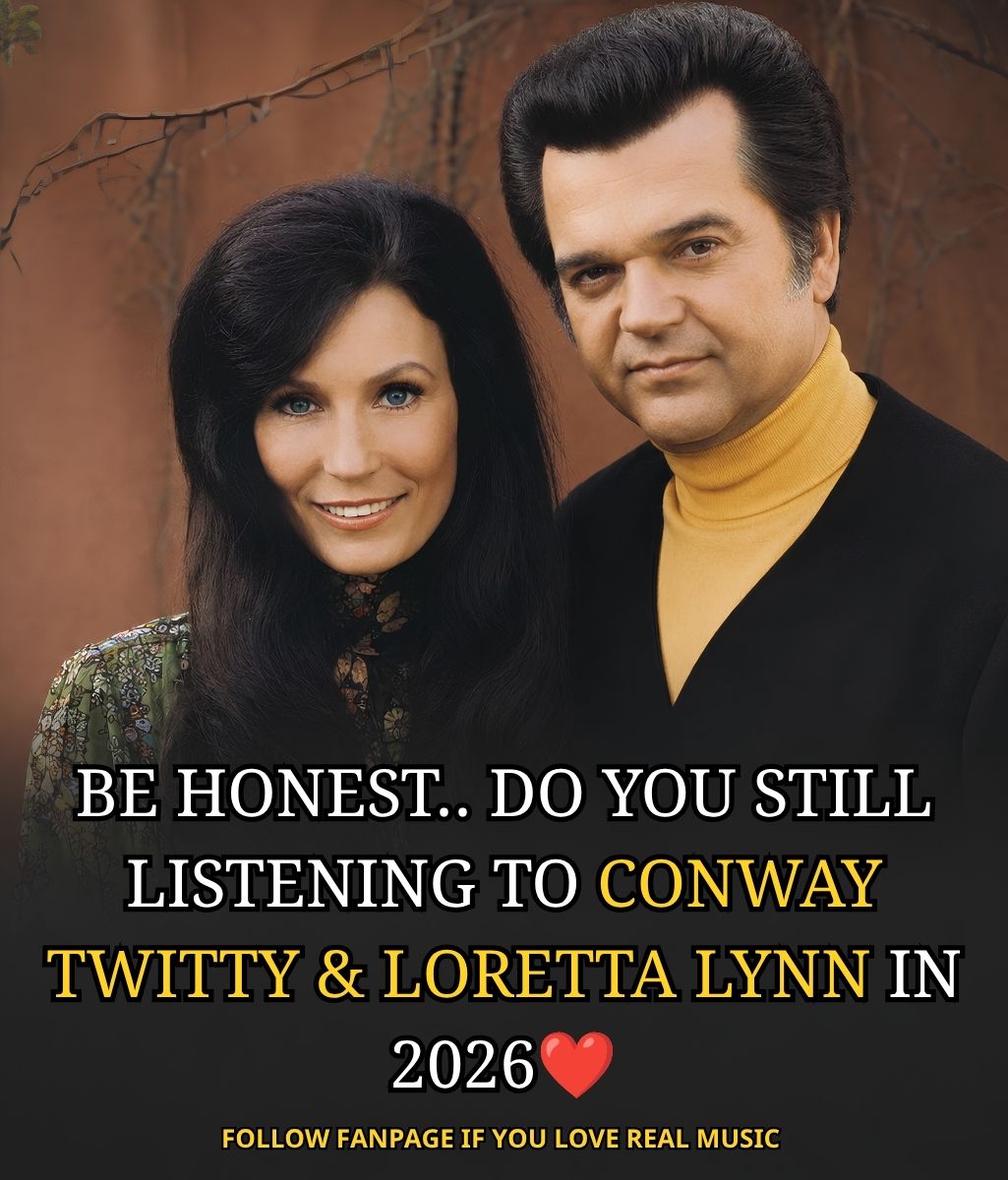
Their most unforgettable recordings were filled with betrayal, regret, arguments, and broken promises—and they performed them so convincingly that many listeners began confusing the characters in the songs with Conway and Loretta themselves.
When Conway Twitty and Loretta Lynn stepped to the microphone together, they did more than blend two famous country voices. They created conversations. Sometimes those conversations were tender. Sometimes they were playful. But some of their most powerful duets sounded like two people standing in the middle of a relationship already damaged beyond repair. “After the Fire Is Gone” is one of the clearest examples. The song is built around emotional dissatisfaction, temptation, and the painful recognition that something important has faded. Conway and Loretta delivered the lyrics with such restraint and realism that the performance never felt theatrical. Instead, it sounded uncomfortably close to a private argument that listeners were never supposed to hear. That realism became one of their greatest strengths, but it also helped create a misunderstanding that followed them for years.
The same quality appeared in songs such as “Feelin’s,” where complicated emotions were allowed to remain complicated. Conway’s deep, controlled delivery could sound wounded without becoming exaggerated, while Loretta’s voice carried directness and emotional clarity. They did not perform these songs as distant narrators. They stepped inside the characters and made every hesitation, accusation, disappointment, and unanswered feeling seem personal. For an audience already fascinated by their chemistry, it was easy to begin asking whether some of those emotions came from real tension between the singers themselves.
That question became especially powerful because Conway and Loretta were so convincing together off the record as well. Their stage presence was comfortable, familiar, and often playful. They knew how to look at one another at exactly the right moment, how to leave space after a difficult lyric, and how to make a simple exchange feel spontaneous. To longtime country fans, that kind of chemistry could feel impossible to fake. The songs sounded like arguments between two people who knew each other too well, and the performances made those fictional conflicts feel almost autobiographical.
But that is where the power of great country storytelling can become misleading. Songs about damaged relationships do not automatically describe the lives of the people singing them. Country music has always depended on performers becoming believable characters, and Conway and Loretta were exceptionally skilled at doing exactly that. Their job was not to stand outside the story and explain it. Their job was to make listeners believe the story while the record was playing. The stronger the performance, the easier it became for audiences to forget where the characters ended and the real people began.
This was particularly effective because both singers had very different emotional strengths. Conway could make a line sound like something a man had struggled to say for years. His voice was smooth, but there was often an underlying sense of restraint, as though the emotion was being held just beneath the surface. Loretta approached songs differently. She could sound wounded, defiant, practical, angry, or vulnerable without losing the plainspoken honesty that defined so much of her career. When those two approaches met in a song about conflict, the result felt remarkably human. One voice would push, the other would answer, and suddenly the duet sounded less like a performance than a marriage being argued out in real time.
That dramatic quality helped distinguish their partnership from many other country duos. Their recordings were not always built around perfect harmony or uncomplicated devotion. They were often built around friction. The characters disagreed. They doubted one another. They carried regrets. They wanted things they could not easily say aloud. Those emotional contradictions gave the songs weight because real relationships are rarely simple. Conway and Loretta understood that a believable duet did not require two voices saying the same thing—it often became more powerful when the voices were pulling in opposite directions.
Listeners responded because they recognized those emotions. Older country audiences especially understood that many of the strongest songs were not fantasies about perfect lives. They were stories about disappointment, mistakes, pride, endurance, and the difficult conversations people sometimes avoid until it is too late. Conway and Loretta could bring those stories to life without making them feel polished beyond recognition. That made their duets intimate, but it also made them dangerous territory for rumor. When performers sound that believable, some listeners naturally assume the emotion must be coming from somewhere personal.
Over time, the distinction between musical drama and real-life drama became blurred in the public imagination. Fans heard songs filled with tension and watched two performers whose chemistry seemed effortless, and the speculation practically wrote itself. Yet the fascination says more about the quality of the performances than it does about any hidden conflict. Conway and Loretta succeeded because they could make fictional emotional battles sound truthful. They understood timing, phrasing, tone, and silence. They knew when to sound hurt and when to sound guarded. Most importantly, they knew how to listen to each other inside the song.
That is why recordings such as “After the Fire Is Gone” and “Feelin’s” remain so compelling decades later. The stories may belong to fictional couples, but the emotions never feel artificial. Anger still sounds like anger. Regret still sounds like regret. Distance still feels like distance. The songs survive because Conway Twitty and Loretta Lynn never treated them like simple duets. They treated them like emotional scenes with two people fighting to be understood.
And perhaps that was their greatest gift as a pair. They could sing about conflict without losing tenderness, about disappointment without losing humanity, and about damaged relationships without turning the story into caricature. Listeners sometimes mistook the characters for the singers because Conway and Loretta made those characters feel completely real. That was not evidence that every painful lyric belonged to their private lives. It was evidence that two extraordinary country artists understood the hardest part of storytelling: making an audience forget, for three minutes, that it was only a song.