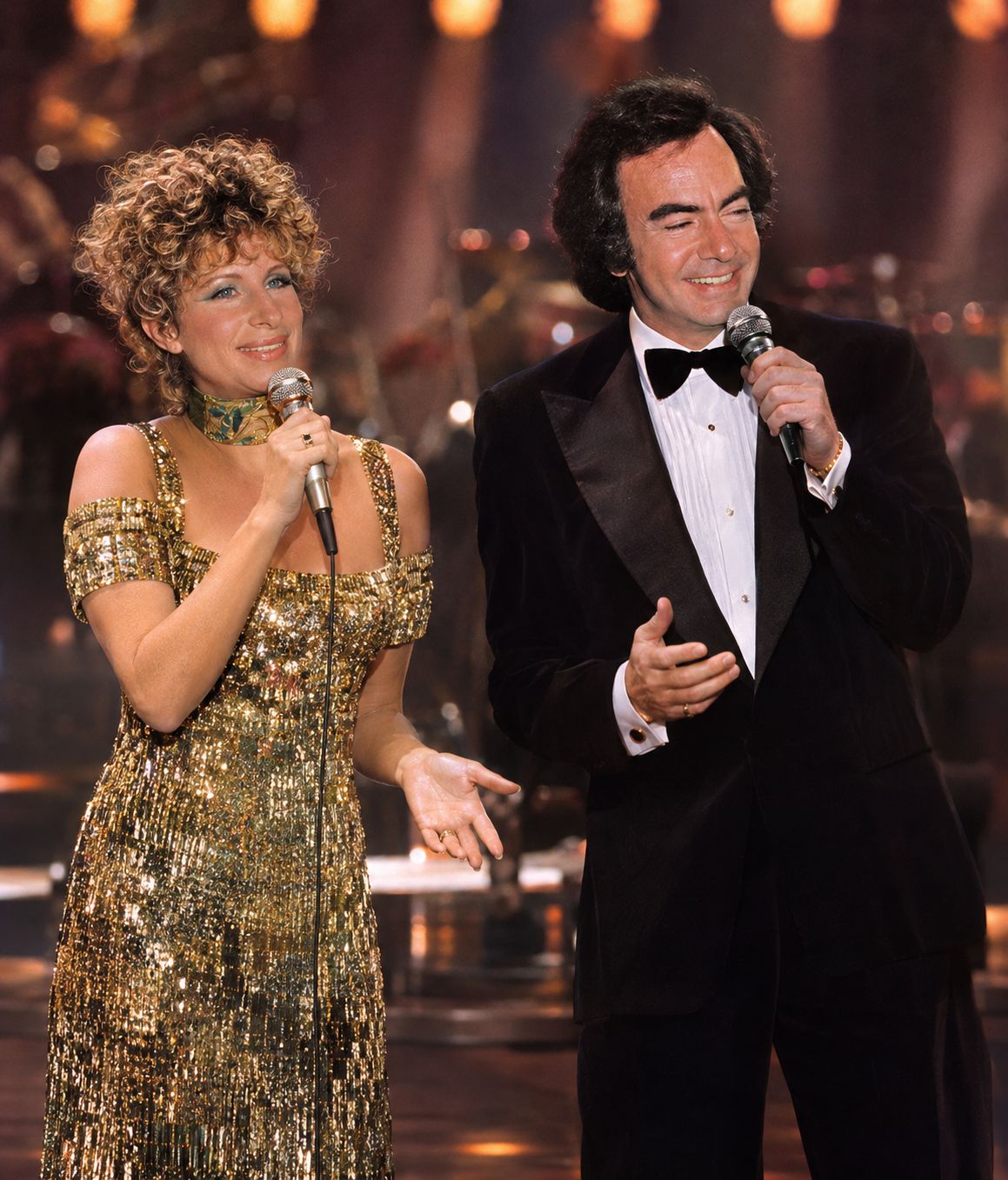
In 1978, Neil Diamond and Barbra Streisand created one of the most memorable duets of their generation, but the remarkable part of the story is that neither artist originally planned to sing the song together. The song was “You Don’t Bring Me Flowers,” which Diamond had co-written with Alan and Marilyn Bergman after the idea was first developed in connection with a television project. Diamond recorded his own version for the 1977 album I’m Glad You’re Here with Me Tonight, while Streisand recorded a completely separate version the following year for her album Songbird. At that stage, the two recordings existed independently, and there was no plan for an official duet.
Everything changed when Gary Guthrie, program director at WAKY in Louisville, Kentucky, noticed that Diamond and Streisand had recorded the song in compatible keys. Guthrie was going through an amicable divorce at the time, and the song had personal emotional meaning for him and his wife, so he decided to edit the two separate recordings together. By alternating their voices, he created the illusion that Neil and Barbra were singing directly to each other, turning two unrelated solo performances into what sounded like an intimate conversation between a couple watching their relationship quietly fall apart.
When the homemade duet went on the air, listeners responded almost immediately. The station received repeated requests to play it again, while local record stores began hearing from people who wanted to buy a duet that technically did not exist. As word spread, other radio stations began creating similar edits, and what had started as one programmer’s experiment grew into a phenomenon that Columbia Records could no longer ignore.
Instead of commercially releasing Guthrie’s edited version, the label brought Diamond and Streisand together to record a completely new duet in the studio. Their official recording session took place on October 17, 1978, transforming an accidental radio idea into a genuine collaboration between two of the biggest voices in American popular music. The chemistry sounded as though it had been planned from the beginning, with Diamond’s restrained delivery and Streisand’s emotional precision giving the lyrics the feeling of a real conversation between two people who have slowly realized that the small gestures of love have disappeared from their relationship.
Listeners reacted just as strongly to the official version. “You Don’t Bring Me Flowers” reached No. 1 on the Billboard Hot 100 in December 1978 and remained there for two weeks, while the single went on to sell more than a million copies and became one of the defining recordings associated with both singers during the late 1970s. The success was especially remarkable because the duet had not been created through an elaborate record-company strategy, but through the imagination of a radio programmer who heard a connection between two performances that had never been intended to meet.
The story became even more memorable because Diamond and Streisand had known of each other long before fame. Both grew up in Brooklyn and attended the same high school, although their careers developed separately and eventually carried them into different corners of American entertainment. Years later, an accidental radio edit finally brought their voices together on a record that millions of people would remember, and they later performed the song together at the 1980 Grammy Awards, turning an unexpected studio pairing into one of the era’s memorable live television moments.
What makes “You Don’t Bring Me Flowers” so extraordinary is that nearly every important part of its journey happened by accident. There were two separate recordings, one observant radio programmer and an audience that heard something special before the artists themselves had ever recorded it together. The song became a No. 1 hit because listeners imagined Neil Diamond and Barbra Streisand as a duet before the music industry did, proving that sometimes one of music’s most natural pairings begins with no plan at all.