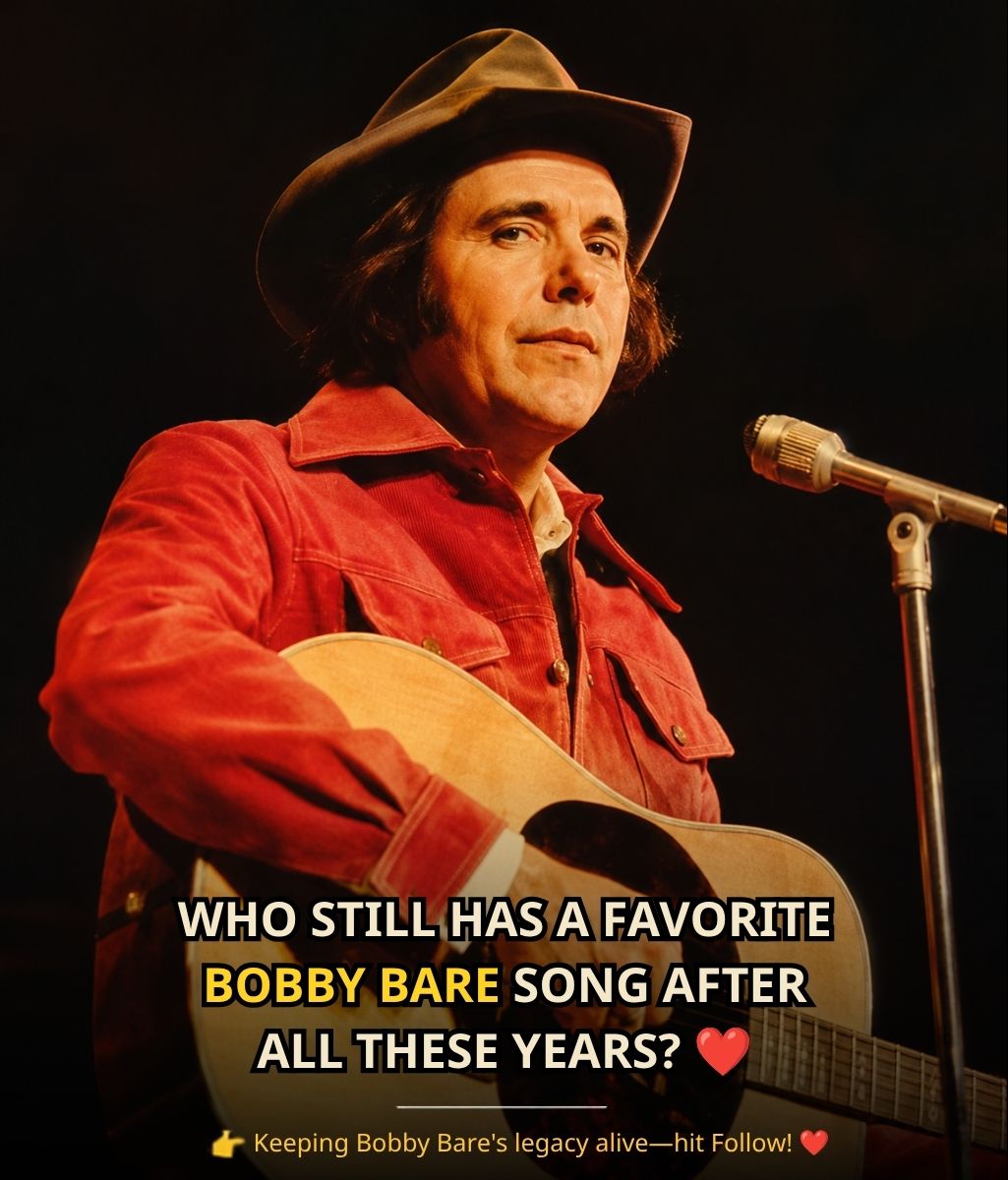
Bobby Bare had already spent years building the kind of country music career most singers could only dream about. He had memorable records, devoted fans, and a storytelling voice that could make even the simplest lyric feel like something that had really happened. Yet there was one surprising achievement still missing from his résumé: he had never reached No. 1 on Billboard’s country singles chart. Then, in 1974, “Marie Laveau” changed everything.
What makes the story remarkable is the kind of song that finally took him there. “Marie Laveau” wasn’t a conventional country ballad or an obvious attempt at creating a radio blockbuster. It was a strange, darkly humorous story involving Louisiana folklore, a mysterious woman, an outrageous bargain, and a man who believed he could make a promise and simply walk away from it. Somehow, that unlikely combination produced the biggest chart milestone of Bobby Bare’s career.
By the time “Marie Laveau” appeared, Bare hardly needed an introduction to country audiences. Songs such as “Detroit City” and “500 Miles Away from Home” had already helped establish him during the 1960s, and he had accumulated an impressive run of country hits. But numbers alone don’t explain why Bobby Bare mattered. His real strength was his ability to tell a story without sounding as though he was trying too hard to tell one.
Bare could sound like a man sitting across the room sharing something he had witnessed himself. He understood when to lean into a line, when to let the humor breathe, and when to allow the listener to figure out that something important was about to happen. That conversational quality made him almost perfectly suited for “Marie Laveau.”
The song was written by Shel Silverstein and Baxter Taylor, and its central character borrowed the name of the famous Marie Laveau associated with nineteenth-century New Orleans history and legend. But the character presented in the song belongs much more to folklore and imagination than to historical biography. Silverstein and Taylor turned the name into the center of a colorful country story filled with mystery, humor, danger, and a wonderfully strange sense that anything could happen next.
That distinction matters because “Marie Laveau” isn’t really asking listeners to study history. It wants them to enter a story. From the beginning, the song creates a mysterious Louisiana world and introduces a character who is clearly not someone to underestimate. Then another character arrives — Handsome Jack — and suddenly the song has exactly what every great story needs: someone about to make a very bad decision.
Jack approaches Marie because he wants something from her. He proposes an extraordinary bargain: if she can produce one million dollars, he will marry her. Marie agrees and gives him exactly what he asked for. At that moment, Jack appears to have won beyond his wildest imagination — but there is something Marie doesn’t yet know about the promise he has made.
Jack never intends to keep it.
Once the money is his, Jack reveals his true intentions. He insults Marie and attempts to back away from their agreement, apparently convinced that he can take what she has given him and leave without consequences. It is here that “Marie Laveau” shifts from an amusing tale into something darker, because anyone paying attention can sense that Jack has badly underestimated the person he has just betrayed.
Bobby Bare doesn’t rush what happens next. His delivery allows the tension and humor to work together, making the listener wait for the inevitable payoff. Jack believes he has outsmarted Marie — but the audience is beginning to suspect something very different.
Then Marie responds.
Her famous scream arrives, and Handsome Jack disappears. The man who thought he had found an easy path to a fortune discovers that breaking his promise carried a consequence he never imagined. It is strange, funny, slightly unsettling, and memorable enough that once you’ve heard the story, it is difficult to forget how it ends.
That unforgettable payoff is one reason “Marie Laveau” works so well, but the story itself is only half of the equation. A song this unusual could easily have become nothing more than a novelty recording. Bobby Bare’s performance is what gives the tale its personality.
He doesn’t overplay the strange details. Instead, he tells the story with the relaxed confidence of someone who already knows exactly where it is going. You can almost imagine him watching the listener’s reaction while patiently waiting to reveal the next twist. That quality was central to the creative partnership Bare developed with Shel Silverstein, whose writing gave him an extraordinary collection of characters and stories to bring to life.
Their collaboration had become especially important with the album Bobby Bare Sings Lullabys, Legends and Lies, a project filled with Silverstein material. The album also produced “Daddy What If,” Bare’s memorable duet with his young son Bobby Bare Jr., which reached No. 2 on the country chart. But it was “Marie Laveau” that ultimately accomplished something none of Bare’s previous country singles had managed.
In the summer of 1974, “Marie Laveau” reached No. 1 on Billboard’s Hot Country Singles chart. After all the records, all the years on country radio, and all the songs that had already made Bobby Bare famous, this bizarre Louisiana story finally carried him to the very top. Even more remarkably, it became the only No. 1 country single of his long career.
Think about that for a moment. Bobby Bare scored dozens of country hits and built a career substantial enough to eventually earn induction into the Country Music Hall of Fame. Yet the one song that reached the summit wasn’t “Detroit City,” “500 Miles Away from Home,” or one of the other recordings now immediately associated with his name. It was “Marie Laveau.”
And perhaps that tells us something about why the song connected so strongly with listeners. “Marie Laveau” gave country radio something difficult to ignore. You didn’t simply listen for a melody or wait for a chorus — you followed the characters because you wanted to know how the story would end. The song created the same basic curiosity that has kept people listening to good storytellers for generations.
Country music has always understood the power of a great story. Some songs make listeners remember home, some capture heartbreak and regret, and others preserve little pieces of everyday life. But occasionally a country song succeeds because it asks one irresistible question from the beginning: What happens next?
“Marie Laveau” does exactly that. First there is the mysterious central character. Then comes Handsome Jack. Then the bargain. Then the betrayal. By the time Jack realizes the mistake he has made, the listener has already followed Bobby Bare through an entire miniature world.
More than five decades later, that storytelling quality remains one of the most charming things about the recording. You don’t need to know where “Marie Laveau” appeared on the charts in 1974 to enjoy it today. You only need to hear Bobby Bare begin telling the story, because once the pieces start falling into place, there is a natural temptation to stay until the end.
That may also explain something larger about Bobby Bare’s legacy. His importance to country music was never dependent on having a long list of No. 1 singles. Bare’s real gift was making stories sound alive, whether they were funny, lonely, reflective, unusual, or somewhere in between. His career ultimately produced nearly five dozen Top 40 hits, and in 2013 he was inducted into the Country Music Hall of Fame.
Yet history has a wonderful sense of irony. After years of major songs and an already successful career, Bobby Bare’s only No. 1 arrived with one of the strangest stories he ever recorded. Not with a predictable ballad designed to sound like a chart-topper, but with Marie Laveau, Handsome Jack, a million-dollar bargain, and one spectacularly foolish broken promise.
Maybe that is why “Marie Laveau” remains such a perfect Bobby Bare record. It is unusual, funny, unpredictable, and completely dependent on the singer’s ability to make you believe that the next part of the story is worth hearing. And in 1974, country listeners followed that story all the way to No. 1.
More than 50 years later, they are still following it to the end.