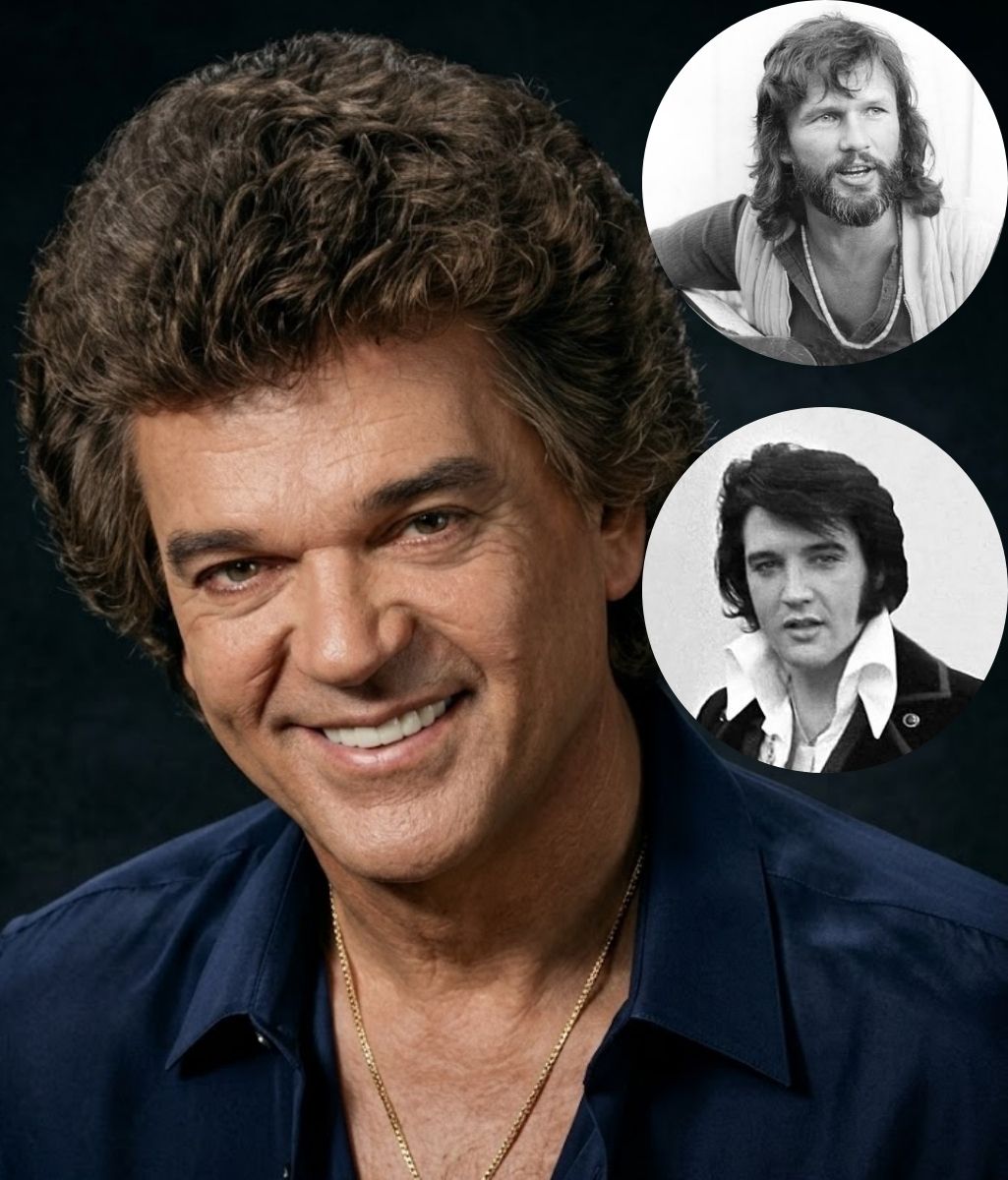
For listeners who first discovered Kris Kristofferson’s “Why Me” through its deeply personal original recording—or later heard Elvis Presley bring his own gospel power to the song—Conway Twitty’s interpretation offers something strikingly different. Recorded for his 1975 album Linda on My Mind, Conway’s version does not try to overwhelm the listener. There is no need for dramatic excess. Instead, he approaches the song almost like a private prayer, allowing humility, regret, gratitude, and spiritual reflection to carry the performance. It is the kind of recording that can sound simple on first listen, yet become more affecting with age, especially for anyone who understands what it means to look back on life and wonder why they were given more grace than they believe they deserved.
By 1975, Conway Twitty was already firmly established as one of country music’s defining voices. His journey had taken him from the rock-and-roll breakthrough of “It’s Only Make Believe” to a remarkable second career in country music, where his warm baritone and intimate delivery became instantly recognizable. He was especially gifted at making a song sound less like a performance for thousands of people and more like a conversation intended for one listener. That quality proved perfectly suited to “Why Me.” Written by Kristofferson and released by him in 1972, the song is built around a profoundly vulnerable question: why should someone who recognizes his own failures receive mercy, love, and blessings he feels he has not earned? It does not require vocal fireworks because its power comes from surrender.
That is where Conway’s interpretation becomes so compelling. His deep, smooth baritone, carrying the weathered character listeners had come to recognize, gives the lyric the weight of experience. Rather than treating the song as an opportunity to demonstrate vocal power, he keeps the emotion controlled. His phrasing is measured, and there is a reflective quality in the performance that makes the words feel deeply personal. When the song reaches its plea for help and mercy, Conway does not need to force the emotion. The restraint is the emotion. He sounds like a man examining his own life rather than an entertainer trying to convince an audience that he is moved.
The arrangement reinforces that feeling. Instead of surrounding Conway with an enormous wall of sound, the recording leaves space around his voice. Country instrumentation, including the mournful character associated with steel guitar and restrained accompaniment, helps create an atmosphere of reflection rather than spectacle. The music supports the lyric instead of competing with it. Each pause seems to matter. The quieter moments give the listener time to absorb the questions at the center of the song, and Conway’s voice remains the emotional anchor throughout. It is an approach particularly suited to a composition like “Why Me,” because the song’s central struggle is internal. The drama is not happening in a crowded room. It is happening inside the person asking the question.
That simplicity also separates Conway’s interpretation from other memorable performances of the song. Kris Kristofferson brought the authority of the songwriter himself, giving the original a vulnerability rooted in the circumstances that inspired it. Elvis Presley, whose gospel influences remained an important part of his musical identity throughout his life, could bring a broader, more powerful spiritual intensity to material of this kind. Conway occupied another emotional space. His version feels rooted in the storytelling traditions of country music, where a complicated truth can sometimes be communicated more effectively through a quiet voice than through a dramatic declaration. None of these approaches needs to diminish the others. In fact, their differences reveal how strong Kristofferson’s composition truly was: the same words could pass through three unmistakable voices and emerge with a different emotional character each time.
There is another reason Conway was such a natural interpreter of the song. His greatest recordings often depended on his ability to create intimacy. Whether singing about longing, regret, devotion, loneliness, or memory, he had an unusual way of narrowing the distance between performer and listener. “Why Me” requires exactly that kind of closeness. Its narrator is not claiming moral certainty or presenting himself as someone with all the answers. He is acknowledging weakness and asking why grace has reached him anyway. Conway’s understated delivery allows that vulnerability to remain intact. The listener is not being preached to; the listener is being invited to overhear a confession.
That distinction becomes even more meaningful when considering the audience that had followed Conway through different chapters of life. Many of his listeners had experienced disappointment, family responsibilities, difficult decisions, loss, second chances, and the passage of years. A song centered on gratitude and humility could therefore reach far beyond its immediate religious language. Even for listeners drawn primarily to its human message, the question underneath the song is universal: What have I been given that I did not earn, and have I been grateful enough for it? Conway does not attempt to answer that question for the listener. He simply gives it a voice.
More than half a century after Kristofferson wrote the song, “Why Me” remains one of those compositions that can reveal something different depending on who sings it and when someone hears it. Conway Twitty’s 1975 recording deserves attention precisely because it does not try to become bigger than the song. He makes it smaller, quieter, and more personal. The arrangement creates room for reflection, while his voice carries the weariness and gratitude of someone who seems to understand every difficult word.
Perhaps that is the lasting beauty of Conway Twitty’s “Why Me.” It is not merely another famous singer covering a celebrated Kris Kristofferson composition. It is Conway doing what Conway did best: taking someone else’s words and making them sound, for a few unforgettable minutes, as though they had been waiting for his voice all along. For listeners who have lived long enough to know that life rarely unfolds exactly as expected, that quiet question—why me?—can become far more powerful than any grand performance. And when Conway sings it, the answer seems almost beside the point. What matters is the humility of asking.