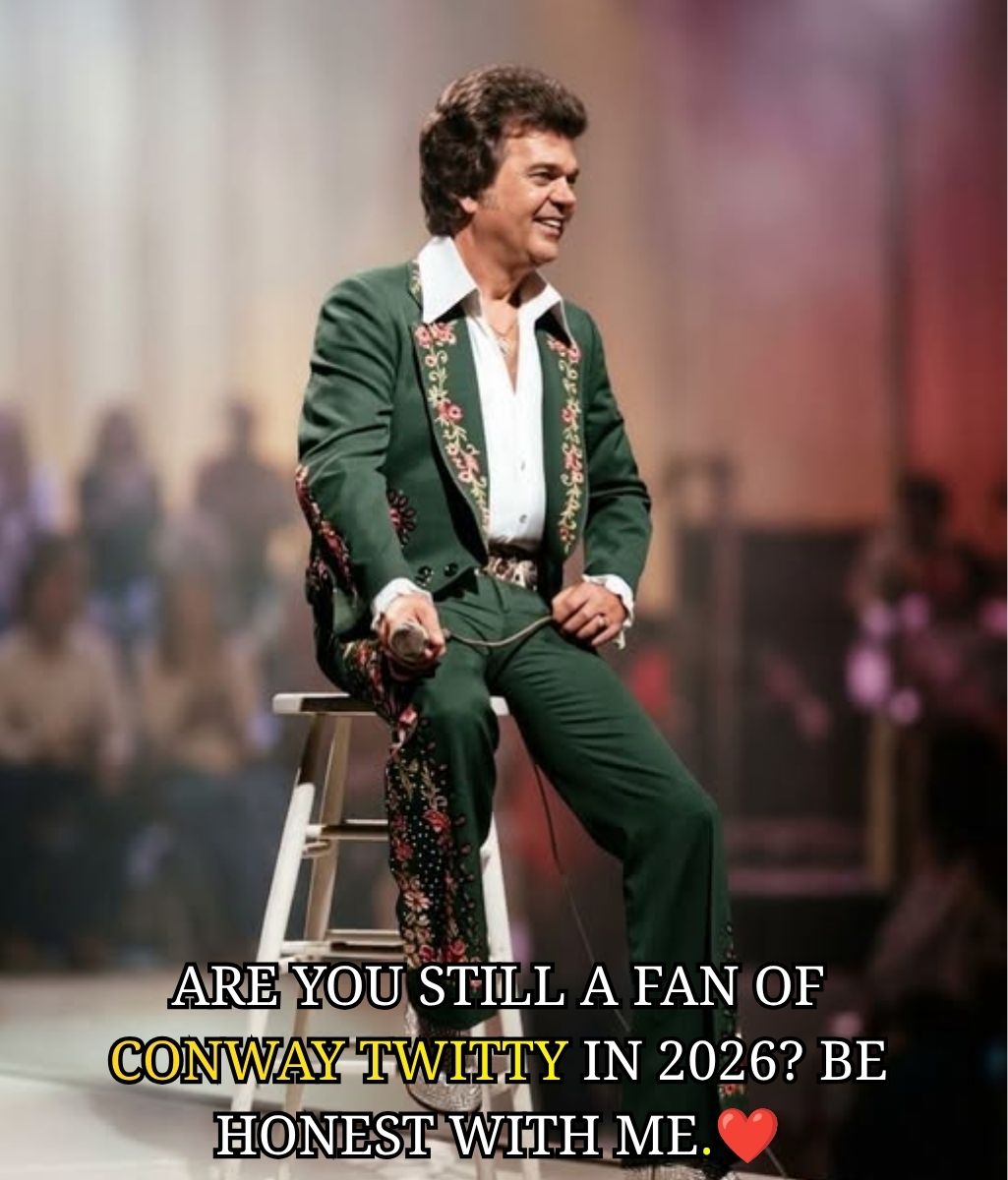
For decades, Conway Twitty lived in a world of stage lights, crowded theaters, radio hits, and audiences who seemed to recognize his voice from the first few words of a song. By 1993, he had traveled an extraordinary distance from the young Harold Lloyd Jenkins who first found international fame with “It’s Only Make Believe.” He had survived changing musical fashions, crossed from rock and roll into country music, and built a catalog that made him one of the most successful recording artists of his generation. By the commonly cited count, Conway accumulated 55 No. 1 singles across the charts used to measure his career, an achievement that reflected decades of remarkable consistency. “Hello Darlin’,” “Linda on My Mind,” “I See the Want To in Your Eyes,” and so many others became more than successful records. For listeners who had grown older alongside him, those songs became markers of marriages, separations, long drives, quiet evenings, and memories of people who were no longer there.
That is what makes the final chapter of Conway’s life so difficult to separate from the music that came before it. He did not spend years slowly disappearing from public view. He was still working, still traveling, and still stepping onto stages. On June 4, 1993, Conway performed at the Jim Stafford Theatre in Branson, Missouri. To the audience, it was another opportunity to see a country legend doing what he had done for decades. There was no reason for the people watching him to imagine that they were witnessing his final performance. They had come to hear the familiar voice and the songs that had followed them through much of their lives. When the show ended, Conway walked away from the stage without the elaborate farewell that often accompanies a planned retirement. There was no final announcement, no carefully prepared goodbye, and no way for the audience to know that the curtain had fallen on his performing career for the last time.
After the show, however, the evening changed dramatically. Conway became seriously ill while traveling away from Branson and was taken to a hospital in Springfield, Missouri. Doctors discovered that he was suffering from an abdominal aortic aneurysm, a dangerous medical emergency requiring immediate attention. Surgery followed, but the condition proved overwhelming. On June 5, 1993, Conway Twitty died at the age of 59. The speed of what happened was devastating. Only the previous evening, audiences had been watching a performer whose career had endured for decades. Suddenly, country music was confronting the loss of one of its most recognizable voices.
The contrast was especially powerful because Conway had built his reputation around a remarkable sense of control. Onstage, he rarely needed spectacle to command attention. The voice did the work. He could begin with the familiar “Hello darlin’” and immediately create the impression that he was speaking directly to one person rather than an entire room. His greatest performances often depended on restraint rather than excess. He understood pauses, phrasing, and the emotional weight of a simple lyric. That approach helped him become particularly associated with songs about love, longing, regret, and relationships, but underneath those themes was something broader: Conway understood how to make private emotions feel universal. Millions of people heard pieces of their own lives in the stories he sang.
His path to that position had been anything but guaranteed. Conway first became famous during the rock-and-roll era, when “It’s Only Make Believe” reached No. 1 in 1958 and introduced him to audiences far beyond the South. He could easily have spent his career trying to repeat that success. Instead, he eventually turned toward country music, risking an established identity to pursue the music he believed suited him more deeply. The transition required patience. A former rock-and-roll star was not automatically accepted as an authentic country performer, but Conway persisted until the doubts became increasingly difficult to sustain. Hit followed hit, and the singer once associated with youthful rock stardom gradually became one of Nashville’s defining voices. He did not simply change genres; he successfully built a second musical life.
Another important chapter came through his celebrated partnership with Loretta Lynn. Together they recorded enduring duets including “After the Fire Is Gone,” “Lead Me On,” and “Louisiana Woman, Mississippi Man.” Their contrasting voices created an extraordinary conversational quality, as though listeners were overhearing two people working through complicated emotions rather than hearing two stars simply trading verses. Their chemistry became part of country music history and added another dimension to Conway’s enormous catalog. Yet even within those duets, his greatest strength remained unchanged: he knew how to serve the story of a song without overwhelming it.
That is why his sudden death resonated so deeply. Fans had not been given time to prepare themselves for a farewell. There had been no final tour marketed as the end of an era, no retirement concert designed to summarize everything that had come before. One night Conway Twitty was performing. The next chapter arrived before anyone was ready for it. In retrospect, that June 4 performance carries a meaning nobody in the theater could have understood at the time. Every lyric became one of the last he would sing before an audience. Every moment of applause became part of a goodbye that neither the performer nor his fans knew they were making.
But Conway Twitty’s story did not end on a Missouri road or in a Springfield hospital. His recordings remained, and the emotional connection behind them survived the man who created them. Decades later, “Hello Darlin’” still needs only a few seconds to bring his presence back into a room. “It’s Only Make Believe” still carries the sound of the young singer who first conquered the charts, while his country recordings preserve the artist he fought to become. The numbers tell us how successful Conway Twitty was, but they cannot explain why listeners still miss him. Fifty-five chart-toppers can measure an extraordinary career; they cannot measure the memories attached to those songs.
Perhaps that is what makes his final performance so haunting. Conway spent a lifetime singing about the moments people wish they could hold onto—the love that slipped away, the words left unsaid, the memory that returns when a familiar song begins. Then his own life ended with the same painful absence of warning found in so many country songs. There was no long goodbye. There was simply one more stage, one final audience, and a man walking away from the lights without knowing he would never return to them. The applause eventually stopped, but more than three decades later, Conway Twitty’s voice has not.