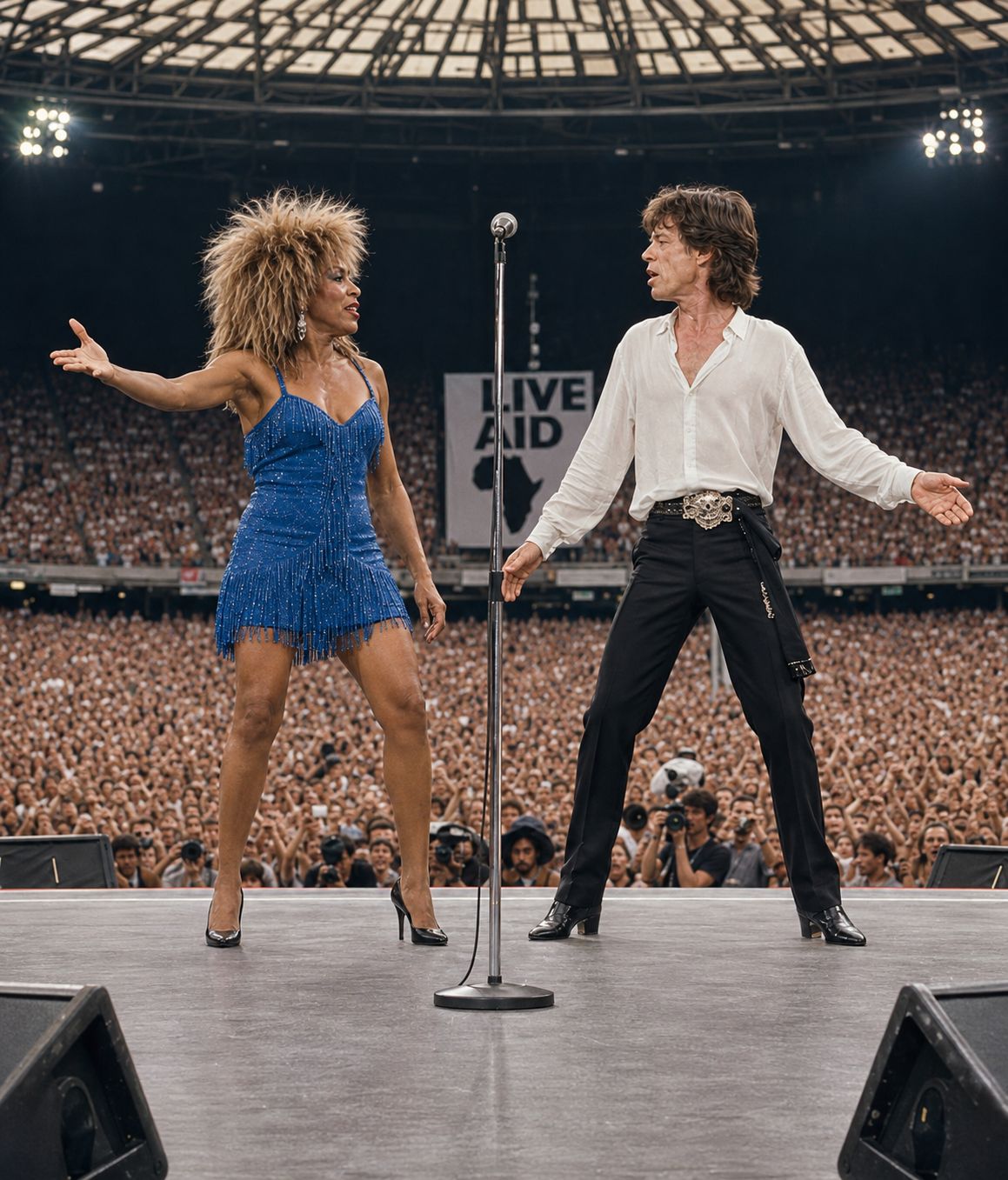
 On July 13, 1985, Tina Turner walked onto the Live Aid stage in Philadelphia at a moment when her career had reached an extraordinary new peak. The success of Private Dancer had transformed her into one of the biggest stars in the world, and when Mick Jagger called her onto the stage at JFK Stadium, two of rock music’s most physical performers suddenly stood side by side in front of an enormous global audience.
They began with “State of Shock,” but it was their performance of “It’s Only Rock ’n’ Roll (But I Like It)” that became impossible to forget.
Tina was wearing a tight black leather outfit when Mick looked at her and asked whether the skirt could come off. In her 2018 memoir My Love Story, Tina remembered being startled by the question. Mick then told her he intended to remove it during the performance, giving her little time to discuss exactly how the moment would unfold.
Once the song was underway, their usual stage chemistry took over.
Mick removed his shirt, moved wildly around the stage and eventually reached for Tina’s skirt. With one dramatic motion, he pulled it away, leaving Tina performing in the leotard underneath. For a brief instant she appeared surprised and moved behind Mick before immediately returning to the performance. The crowd erupted, and the moment became one of the images most frequently remembered from the Philadelphia half of Live Aid.
Seen without context today, the scene can look like Mick had decided to embarrass Tina in front of the world.
Tina herself remembered it differently.
Their relationship stretched back to the 1960s, when Tina and the dancers around the Ike & Tina Turner Revue had spent time with the Rolling Stones. Tina even recalled helping a young Mick improve some of his dance moves after he came backstage to watch the women dance. Their friendship developed over decades, and the wild physicality seen at Live Aid was part of a performance relationship in which neither singer was known for simply standing still behind a microphone.
That history changes the meaning of what happened onstage.
Tina was surprised by Mick’s idea, but she did not later describe the moment as a humiliating attack. In fact, shortly before her death in 2023, she still spoke warmly about Jagger, saying she had always had a crush on him and loved touring with the Rolling Stones. After Tina died, Mick remembered her as talented, warm, funny and generous, and said she had helped him greatly when he was young.
The Live Aid duet therefore survives not because Tina was defeated by an embarrassing moment, but because of what she did with it.
Another performer suddenly changed the plan in front of an enormous audience, yet Tina did not freeze or allow the surprise to take control of the performance. Within seconds she was back in command, moving across the stage with the same confidence that had carried her through one of music’s greatest comeback stories.
Live Aid itself was one of the largest television music events ever attempted, linking performances in London and Philadelphia and broadcasting them internationally to raise money for famine relief in Ethiopia. Tina and Mick’s explosive duet became one of the concert’s defining images.
Mick Jagger may have created the surprise, but Tina Turner created the memory. What could have become an awkward moment instead showed exactly why she was such a formidable performer: even when the unexpected happened in front of the world, Tina knew how to make the stage belong to her.