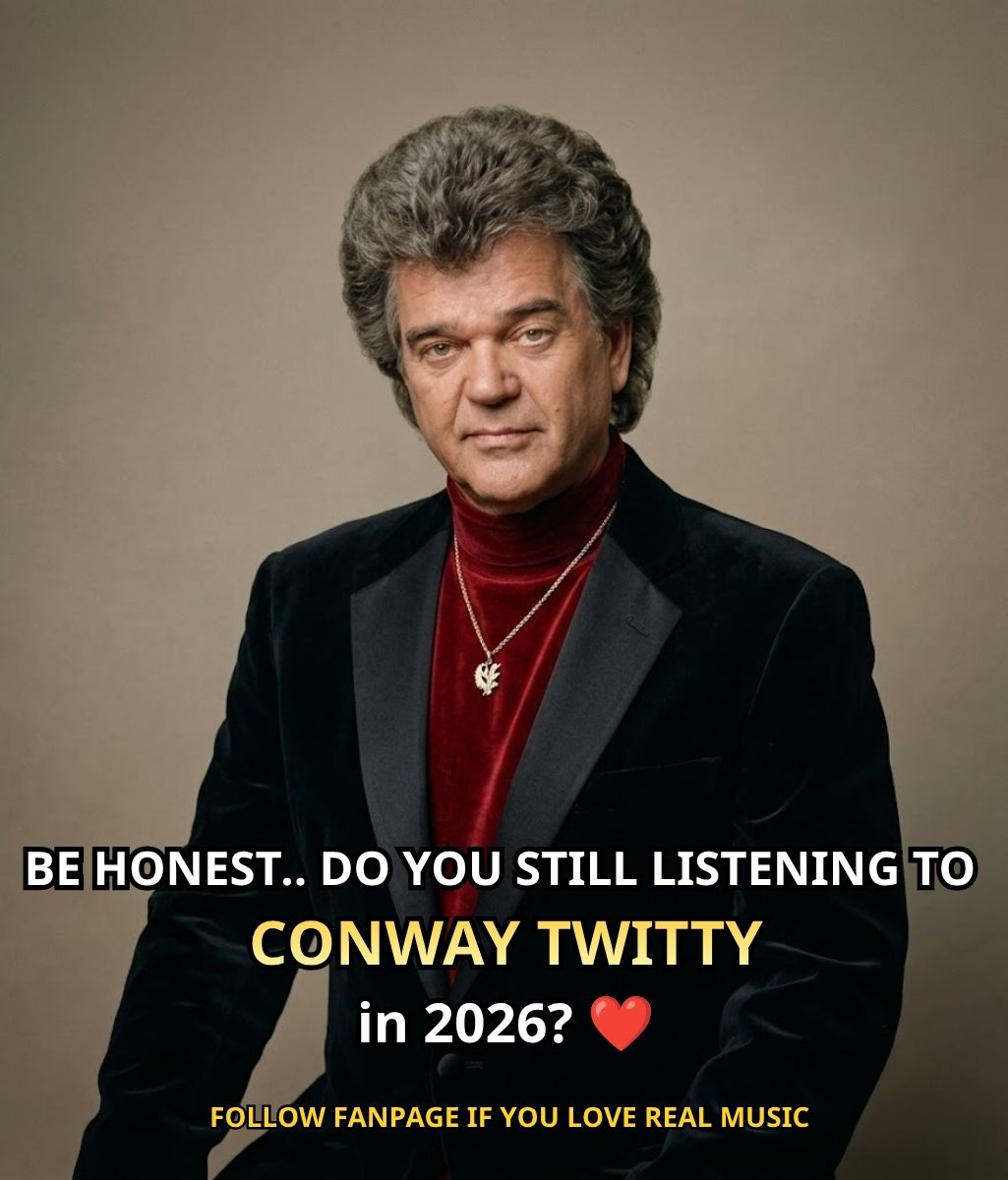
No one in the audience could have known how close they were to witnessing the end of an extraordinary chapter in country music. Conway Twitty was performing what would become his final concert, and although the familiar voice was still there, the man behind it was struggling. He was reportedly feeling seriously unwell during the performance, yet instead of walking away from the stage, Twitty continued. For an entertainer who had spent decades giving audiences everything he had, finishing the show seemed to matter deeply.
The story becomes even more poignant because “That’s My Job,” one of Twitty’s most deeply affecting songs about the bond between a father and son, has often been associated with that final night. Released in 1987, the song was written by Gary Burr and recorded by Twitty with the kind of emotional restraint that made so many of his performances unforgettable. Rather than depending on spectacle, the song tells a simple story: a child turns to his father for reassurance, and the father answers with a promise to protect, guide, and care for him. As the years pass, the meaning of those words grows heavier, until the child must eventually face a world without the man who had always been there.
For Conway Twitty, songs like this were never just words set to music. His greatest strength was making a story sound as though it belonged to the person listening. He could take an ordinary fear, memory, or moment of loss and give it a voice. That ability had helped carry him from his early Rock ‘n’ Roll success into one of the most remarkable careers country music had ever seen. By the time of his final years, he was no longer trying to prove that he belonged in country music. He had become one of the artists who helped define it.
That is what makes the circumstances surrounding his final performance so difficult for longtime fans to forget. On June 4, 1993, Twitty performed at the Jim Stafford Theatre in Branson, Missouri. After the show, while traveling away from the venue, he became seriously ill and was taken to a hospital in Springfield. His condition was grave. Conway Twitty died the following day, June 5, 1993, at the age of 59, after an abdominal aortic aneurysm.
The speed of it all was devastating. One night, audiences were watching the legendary singer perform onstage. By the next day, country music was mourning the loss of a voice that had been part of American life for decades. There had been no grand farewell tour built around his departure, no carefully prepared final speech, and no way for the people watching that evening to understand the significance the concert would soon carry. It was simply Conway Twitty doing what he had done for years—showing up for his audience and singing the songs they had come to hear.
And that may be why the story of his final concert continues to resonate. Twitty’s career had always been built around a quiet professionalism. He had survived changing musical tastes, moved successfully from Rock ‘n’ Roll into country music, and built a catalog filled with songs that generations of listeners connected to their own lives. Alongside his solo success, his celebrated recordings with Loretta Lynn became an essential part of classic country history. Through all those chapters, one quality remained consistent: when Conway Twitty stepped behind a microphone, the song came first.
“That’s My Job” carries an especially powerful meaning when heard in the shadow of his death. The song begins with the vulnerability of a child who fears losing his father and gradually becomes a reflection on growing older, family, responsibility, and the painful realization that parents cannot remain with us forever. Twitty’s delivery never needed to force the emotion. He simply allowed the story to unfold, and listeners could recognize pieces of their own fathers, their own children, and their own memories within it.
For fans who grew up hearing Conway Twitty on radios, record players, and family car rides, that emotional connection has never completely disappeared. His music became attached to particular places and moments—a kitchen radio playing in the morning, a long highway after dark, a record spinning in a quiet living room. When an artist becomes part of memories like those, losing the artist can feel like losing a small piece of the world in which those memories were made.
Conway Twitty could not have known how soon the final curtain was coming. What remains is the image of a veteran performer carrying on through his last show before an unexpected medical crisis ended his life. There was no opportunity for a conventional goodbye. Instead, his farewell exists in the songs, recordings, performances, and memories left behind.
Decades later, “That’s My Job” still reaches listeners because its message has outlived the moment in which it was recorded. It reminds us of promises made between generations, of the people who quietly spend their lives taking care of others, and of words whose meaning sometimes becomes clear only after someone is gone.
Conway Twitty spent a lifetime telling other people’s stories through music. In the end, his final days created a story his fans would never forget: a legendary country singer still performing, still giving his voice to the audience, with no one realizing how close they were to hearing him for the last time.