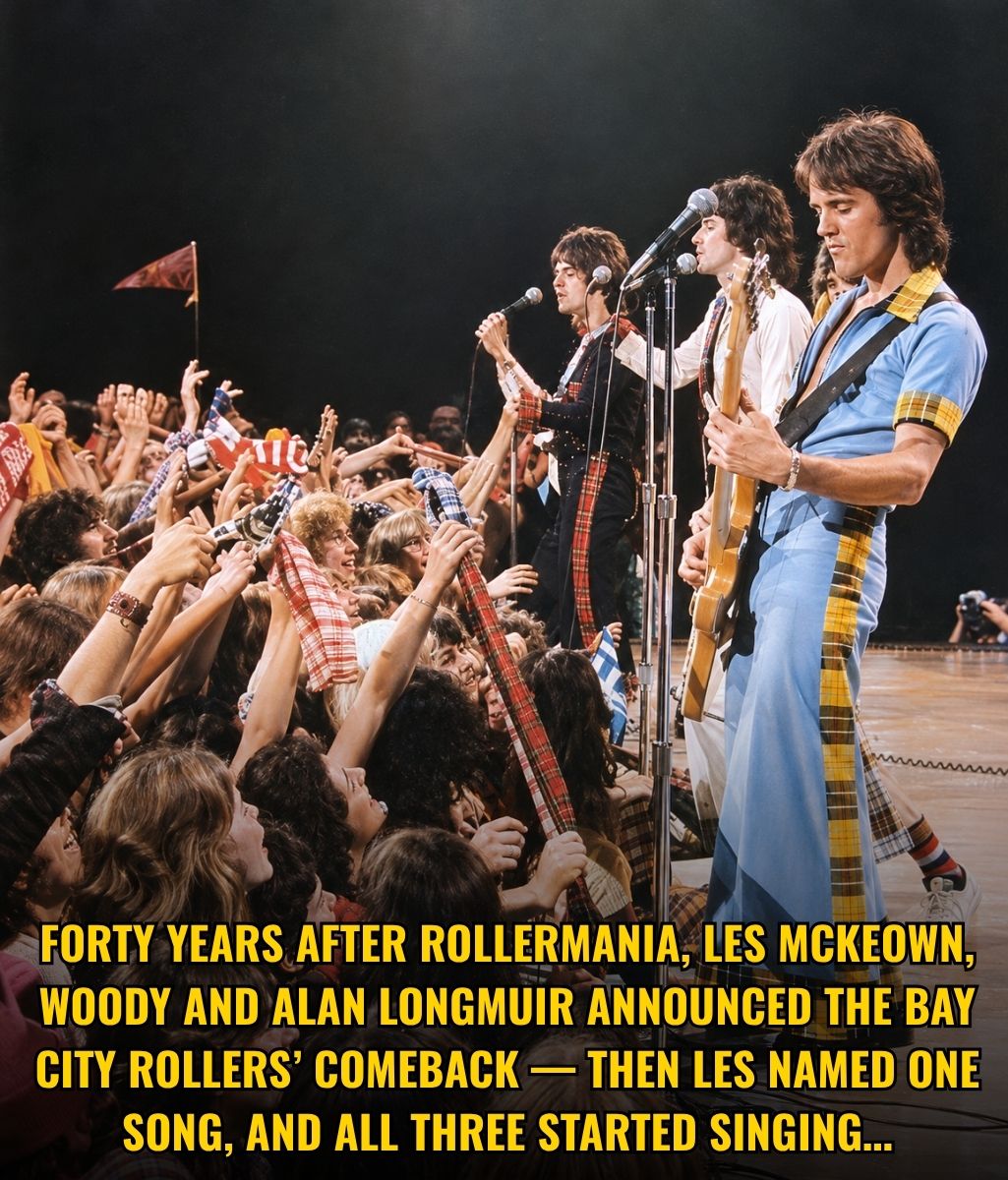
For anyone who had lived through Rollermania, the sight alone was enough to bring back memories.
On September 22, 2015, Les McKeown, Stuart “Woody” Wood and Alan Longmuir sat together at Glasgow’s Grand Central Hotel to announce something many longtime fans had stopped believing they would ever see again.
The Bay City Rollers were coming back.
Nearly four decades had passed since tartan scarves, screaming teenagers and songs such as “Bye Bye Baby,” “Give a Little Love,” “Saturday Night” and “Shang-A-Lang” had turned the Scottish group into one of the biggest pop sensations of the 1970s.
The years in between had not always been kind.
There had been arguments, separate careers, legal disputes over royalties and long periods when the possibility of a meaningful reunion seemed remote. The group had split in the late 1970s, and the relationships between former members had sometimes been strained by money, management disputes and very different ideas about how the Bay City Rollers legacy should continue.
That history made the 2015 announcement feel far more significant than an ordinary reunion tour.
Les explained that the idea had begun several years earlier when he mentioned publicly that he would like to perform with the others again. Slowly, he said, the former bandmates began moving back toward one another until the possibility of standing together again no longer seemed impossible.
Woody described the reunion in equally emotional terms.
He said they were excited to return to Glasgow’s legendary Barrowland Ballroom, where their first comeback concert was scheduled for December 20. He also described the moment as the beginning of what he called the band’s “last chapter,” suggesting that the reunion was not simply an attempt to recreate the past but a chance to give the story a more satisfying ending.
Then came the small moment that captured everything.
During the press conference, Les began talking about the songs audiences could expect to hear again. He mentioned “Shang-A-Lang,” one of the records most closely associated with the Rollers’ early breakthrough.
Almost instinctively, the three men began singing several lines together.
There was no elaborate stage production, no wall of amplifiers and no crowd of teenagers pressing against barriers as there had been during the height of Rollermania.
There were simply three older men singing a song they had first performed when they were barely out of their teens.
Yet for the fans watching, that brief moment connected two completely different eras.
“Shang-A-Lang” had been released in 1974 and became one of the songs that helped transform the Bay City Rollers from a successful Scottish pop group into a national phenomenon. It reached No. 2 in the UK and became part of the run of hits that preceded the extraordinary explosion of Rollermania.
By 2015, however, the men singing it had lived through experiences their younger selves could never have imagined.
They had experienced international fame, enormous record sales, exhausting touring schedules and the strange reality of becoming pin-ups for millions of teenagers. They had also lived through disputes that lasted decades and watched the image of the carefree young Rollers become increasingly complicated with time.
That was why their spontaneous singing carried more emotional weight than the few seconds might suggest.
They were not simply remembering an old hit.
They were remembering who they had been when that song first belonged to them.
Les told reporters that the reunion was partly a way of thanking the people who had remained loyal since the days when he was 17, Woody was 16 and Alan was 20. He wanted those original fans to return, but he also hoped younger listeners would experience a band that had once occupied a unique place in pop history.
The reunion was also intended to look forward.
The trio discussed new music and announced plans for a new single called “Boomerang.” The comeback began with the Glasgow Barrowland show and expanded into a series of performances during 2015 and 2016. Les later recalled that getting Woody and Alan back together had been something he particularly wanted to do for the fans while they still had the opportunity.
Sadly, that opportunity would prove more precious than anyone realized at the time.
Alan Longmuir died in 2018, only a few years after the reunion. Les McKeown died in 2021 at the age of 65.
That knowledge changes the way the 2015 press conference feels today.
At the time, the three men were laughing, discussing future concerts and talking about bringing the music back one more time. Looking back now, it became one of the final periods when Les, Woody and Alan were able to stand together publicly beneath the Bay City Rollers name.
The reunion itself would eventually end, and differences between the members would surface again, but that does not erase what happened in Glasgow.
For one brief moment, nearly forty years of arguments, lawsuits and separate lives seemed to disappear when Les McKeown mentioned “Shang-A-Lang.”
Woody joined him.
Alan joined too.
And suddenly, three men who had spent decades growing older sounded, for a few seconds, like the boys who had once watched an entire generation scream their names.
Rollermania could never truly return exactly as it had been in the 1970s, but when Les, Woody and Alan began singing “Shang-A-Lang” together again, the years between them seemed to collapse, and the music briefly carried them back to the place where everything had begun.