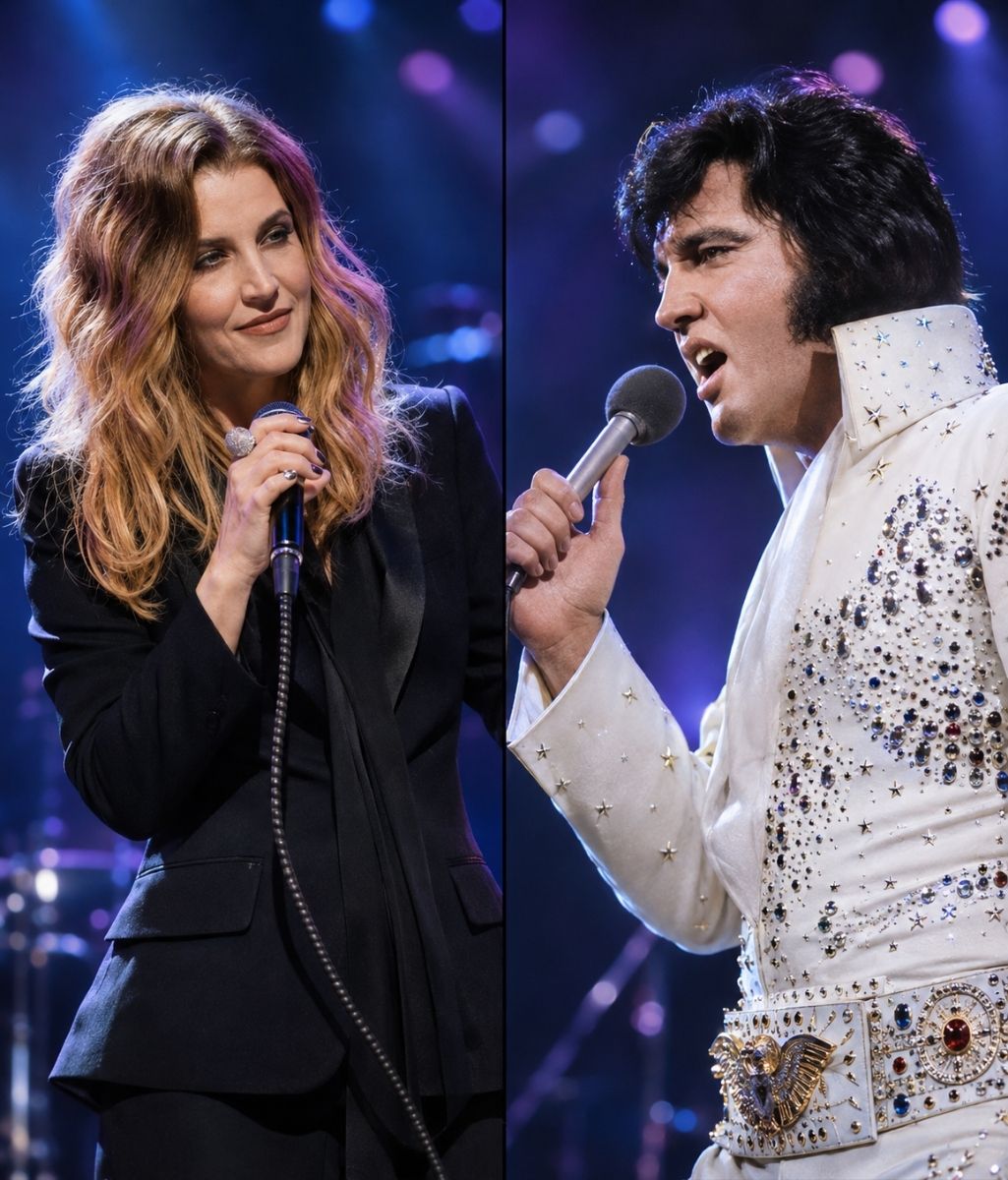
For most of her childhood, Lisa Marie Presley knew her father in a way the rest of the world never could.
To millions of fans, Elvis Presley was the King of Rock ’n’ Roll, the man whose voice filled arenas, television screens and record collections around the world. To Lisa Marie, he was simply her father, the man who lived at Graceland, teased her, spoiled her and filled the house with music.
That private relationship ended abruptly when Elvis died in August 1977.
Lisa Marie was only nine years old.
Twenty years later, she found a way to stand beside his voice again.
As the anniversary of Elvis’s death approached in 1997, Lisa Marie was expected to take part in the memorial events surrounding her father. She later admitted that she had grown tired of simply appearing at ceremonies, greeting people and smiling while everyone around her celebrated a man whose absence remained intensely personal to her. She wanted to do something that felt more meaningful.
The idea came unexpectedly.
While traveling by plane, Lisa Marie began thinking about recording her own voice alongside one of Elvis’s existing performances. She remembered the success of Natalie Cole’s posthumous duet with her father Nat King Cole and contacted producer David Foster, asking whether something similar could be created for her and Elvis.
The song she chose was “Don’t Cry Daddy.”
Elvis had originally recorded the song in 1969. Written by Mac Davis, it tells the story of a grieving father trying to comfort his children after the loss of their mother, while the children themselves are pleading with him not to cry.
For Lisa Marie, the meaning was impossible to ignore.
She had grown up as the child left behind after the death of a famous parent, and now she was adding her adult voice to a recording her father had made decades earlier.
David Foster produced the new version, combining Lisa Marie’s vocal with Elvis’s original recording so that father and daughter appeared to answer one another across time.
It was never intended to become a commercial single.
Instead, the duet was created for the memorial events held in Memphis on August 16, 1997, exactly twenty years after Elvis’s death. A specially produced video placed images of Lisa Marie alongside footage of her father while their voices played together.
The effect on the audience was immediate.
Thousands of Elvis fans who had spent years imagining what it might have sounded like if his daughter had ever sung with him suddenly heard exactly that.
The moment was especially powerful because no such duet had existed during Elvis’s lifetime.
Lisa Marie had been surrounded by music as a child and even remembered watching her father record at Graceland’s Jungle Room, but she had never developed a professional singing partnership with him before his death. Her own recording career would not begin publicly until years later.
In that sense, “Don’t Cry Daddy” became something that time itself had prevented from happening naturally.
It was a daughter singing with the father she had lost while still a child.
It was also one of the first times many fans heard Lisa Marie’s voice and realized that the Presley musical legacy had not ended with Elvis.
David Foster certainly noticed.
Lisa Marie later said that after producing the duet, Foster encouraged her to take her own musical ability more seriously. She began writing again, eventually working with producer Glen Ballard and releasing her debut album, To Whom It May Concern, in 2003. The album reached the Top 5 of the Billboard 200.
The 1997 duet also started a quiet tradition.
Ten years later, Lisa Marie recorded another posthumous duet with Elvis on “In the Ghetto.” In 2012, she returned once more with “I Love You Because.” She explained that these performances were largely gifts to her father’s fans and a way of marking significant anniversaries in Memphis.
None of those projects could recreate the years she lost with him.
They were never meant to.
What they could do was create a brief illusion that father and daughter were sharing the same musical space, even though their voices had been recorded decades apart.
That is why “Don’t Cry Daddy” remains especially emotional.
The technology made the duet possible, but the emotion came from something much simpler: a daughter finally getting to sing beside the voice she had known since childhood.
For the audience in Memphis, it was a remarkable tribute.
For Lisa Marie, it was something more personal.
Twenty years after Elvis Presley died, Lisa Marie found a way to stand beside him again, not in an old photograph or a childhood memory, but inside a song. “Don’t Cry Daddy” became the duet they never had the chance to sing together in life, and for a few minutes, music made the distance between father and daughter feel almost small enough to cross.