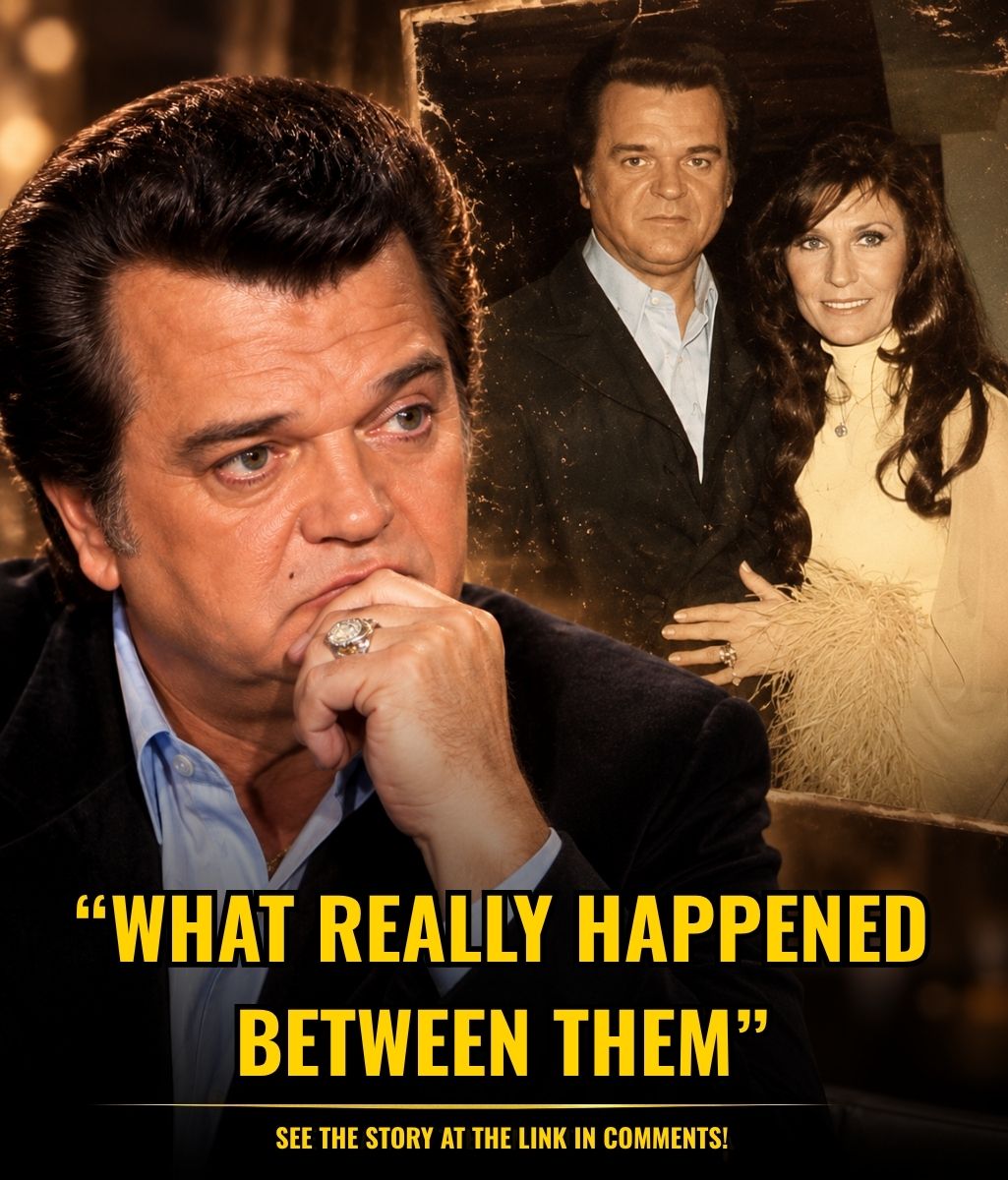
For years, country fans watched Conway Twitty and Loretta Lynn stand inches apart at microphones, trading lines about desire, heartbreak, temptation, and love with such natural chemistry that many listeners became convinced there had to be something more behind the songs. Their voices fit together almost too perfectly, and the way they looked at each other onstage only made the rumors harder to silence.
The truth, according to Conway himself, was both simpler and more meaningful.
He and Loretta were extraordinarily close friends.
Their partnership began in 1969 after producer Owen Bradley introduced them. Soon afterward, both artists found themselves on the same country music package tour in England. Conway later remembered that during the trip, he discovered Loretta had been a fan of his since 1958, while he told her that he admired her music just as much. They spent long stretches on the bus talking and singing songs together, and it quickly became obvious that their voices had an unusual chemistry.
When they returned to the United States, they decided to record together.
The reaction was immediate.
Their first major duet, “After the Fire Is Gone,” became a No. 1 country hit and established them as one of the genre’s most powerful vocal pairings. More hits followed, including “Lead Me On,” “Louisiana Woman, Mississippi Man,” “As Soon as I Hang Up the Phone,” and “Feelins’.” Their success eventually brought them four consecutive CMA Vocal Duo of the Year awards.
But the stronger their recordings became, the more people began wondering whether the emotion was real.
Fans did not simply hear two performers singing characters.
They heard intimacy.
They saw the glances.
They watched the teasing onstage.
And they began building their own story around the partnership.
Conway and Loretta were both married to other people during much of their collaboration, yet rumors persisted that the chemistry on their records reflected something happening behind the scenes. Those rumors became so intense that, after Conway’s marriage temporarily broke up in 1973, one angry fan reportedly blamed Loretta and even threatened a bomb attack at one of her concerts.
That incident showed just how seriously some fans took the speculation.
Conway eventually addressed it directly.
He described Loretta as “one of the best friends I’ve got in this business” and said they were “super-good friends.” But he also made the point fans had been waiting to hear: nothing romantic had ever happened between them.
That statement changes the way their performances look in hindsight.
The chemistry was real.
The trust was real.
The affection was real.
But according to Conway, it was not an affair.
What audiences were hearing was the result of two performers who trusted each other deeply enough to make fictional relationships sound completely believable.
Their friendship also helped explain why the duets worked so well.
Conway later said that when they first began recording together, the two worried that the duet career might become so successful that it could damage their individual careers. Because of that, they deliberately limited themselves to roughly one album together each year while continuing their own solo work.
That decision proved smart.
Loretta remained one of country music’s most important female artists, while Conway continued building one of the genre’s most remarkable solo careers. Yet whenever they came back together, audiences immediately recognized a different kind of magic.
Conway himself admitted he could not reduce their success to one simple reason.
He believed it was a combination of material, voices, timing, and the way their styles naturally blended. They were both extremely selective about the songs they recorded, sometimes going through hundreds of possibilities to find the few that felt right.
That care mattered because their duets often depended on believable tension.
Songs such as “After the Fire Is Gone” dealt with infidelity and emotional dissatisfaction, while “As Soon as I Hang Up the Phone” played out almost like a private breakup conversation overheard by the listener.
To make those songs work, Conway and Loretta had to sound as though they truly meant every word.
They did.
Perhaps too well.
Loretta later joked that many fans simply assumed the two were married. Conway received angry letters after particularly emotional recordings, and the pair became so closely linked in the public imagination that separating the performers from the characters became difficult for some listeners.
Behind the scenes, however, the bond appears to have been built on friendship and enormous professional respect.
Loretta admired Conway’s voice long before they became partners.
Conway admired her songwriting, personality, and instincts.
They could joke with each other, challenge each other musically, and step into emotionally complicated material without becoming uncomfortable.
That kind of trust is difficult to manufacture.
It also explains why their connection lasted beyond individual hit records.
Even after the peak years of their duet career passed, Conway and Loretta remained permanently linked in country music history. Their recordings became templates for later male-female duets because they showed that a partnership could feel intimate without sacrificing the identities of either singer.
Then, in 1993, the story ended suddenly.
Conway became ill while traveling and died on June 5 at the age of 59.
Loretta was deeply affected by the loss of the man who had been her friend, duet partner, and musical counterpart for more than two decades.
That grief gave their old performances another layer.
For years, fans had wondered whether Conway and Loretta were secretly in love.
Conway’s own words suggest the truth was different, but not less powerful.
He loved and respected Loretta as one of his closest friends in the business, and together they created a partnership convincing enough to make millions of people believe every song was personal.
That may be the real secret of Conway Twitty and Loretta Lynn.
There did not need to be a hidden romance.
The bond itself was already extraordinary.