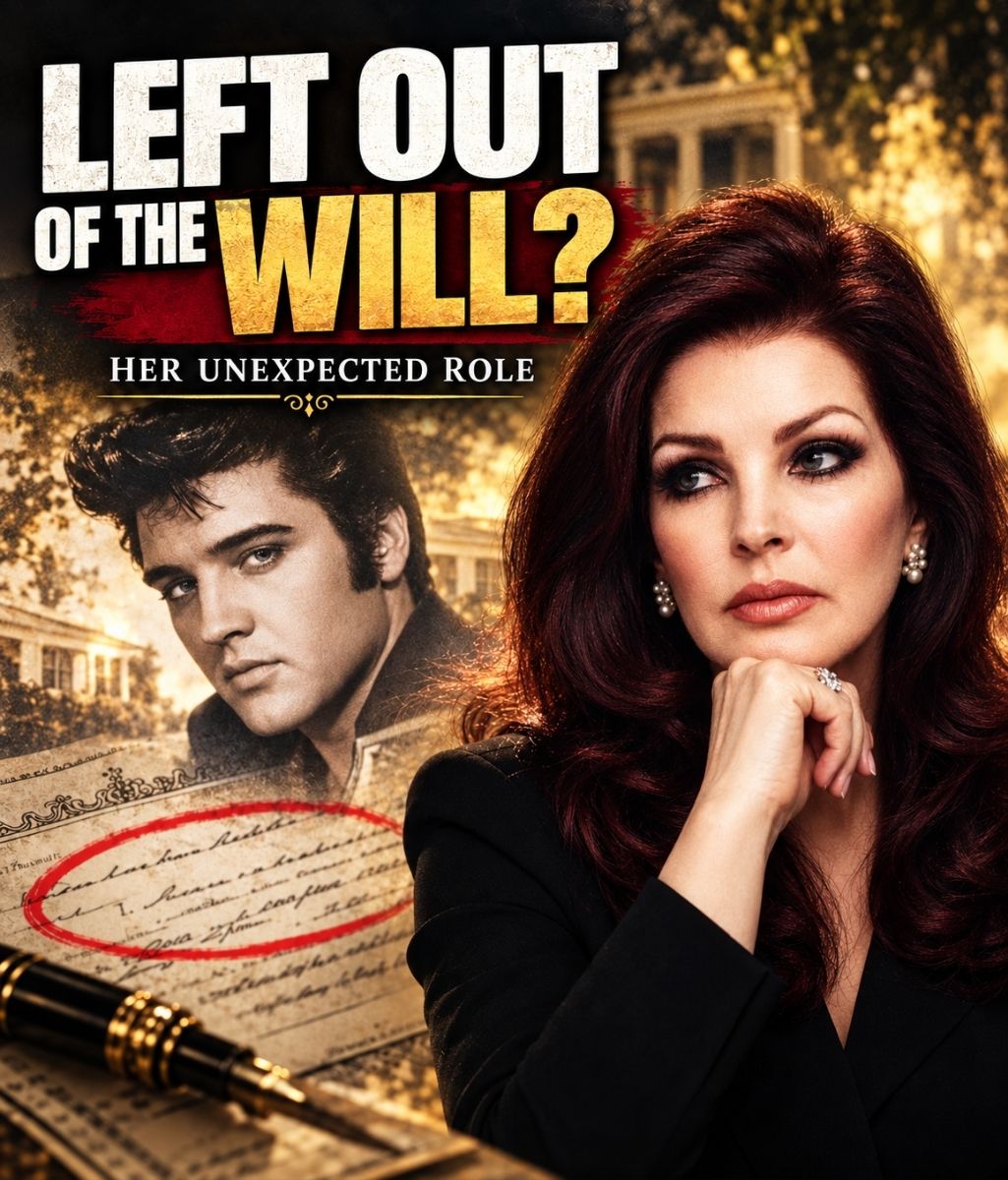
When Elvis Presley died on August 16, 1977, his will answered one question clearly: Priscilla Presley was not named as one of his beneficiaries. Their marriage had ended four years earlier, and the people Elvis chose to benefit directly from his estate were his father, Vernon Presley, his grandmother Minnie Mae Presley, and his only child, Lisa Marie Presley. At first glance, it seemed Priscilla’s legal connection to Elvis’s fortune had ended with their divorce.
History would turn out very differently.
Elvis’s will appointed Vernon as executor and trustee, placing responsibility for the estate in the hands of the father who had long helped manage many of Elvis’s personal business affairs. But Vernon died in 1979, only two years after his son. His death triggered a new arrangement involving three successor co-executors and co-trustees: the National Bank of Commerce in Memphis, accountant Joseph Hanks, and, unexpectedly, Priscilla Beaulieu Presley.
The woman Elvis had divorced in 1973 was suddenly helping oversee the future of everything he had left behind.
That did not make Priscilla an heir.
It made her something different.
She was there partly because she was Lisa Marie’s legal guardian and because Lisa was still a child. Elvis’s will required that Lisa’s inheritance remain in trust until she turned 25, meaning the adults responsible for the estate had to protect not only its immediate value but its long-term future.
The challenge was enormous.
Elvis had been one of the most successful entertainers in history, but fame did not mean his estate was generating unlimited cash after his death. Graceland’s official history explains that the estate was not broke, but it faced a serious cash-flow problem. Maintaining Graceland alone was costing more than half a million dollars each year in taxes and expenses.
Something had to change.
Selling Graceland would have solved one problem while creating another. The mansion was not simply expensive property. It was the place Elvis had bought for his family in 1957, the home most closely associated with him, and eventually the place where he was buried.
Priscilla and the other estate representatives chose another path.
They would open Graceland to the public.
In late 1981, the executors hired investment adviser Jack Soden to develop a plan for transforming the property into a public attraction. On June 7, 1982, Graceland officially opened for tours. More than 3,000 people came through the gates on the first day, each paying five dollars for the opportunity to walk through the home Elvis had once protected from the outside world.
The gamble worked.
Instead of becoming a financial burden that drained Elvis’s estate, Graceland became one of the most famous music landmarks in the world.
Over the decades, millions of visitors traveled to Memphis to see the mansion, Elvis’s costumes, awards, automobiles, airplanes, and personal belongings. The operation expanded across the surrounding property and eventually developed into a major tourism complex devoted to preserving his story.
Priscilla remained closely involved.
When Lisa Marie turned 25 in 1993, the original trust established under Elvis’s will dissolved. Lisa then created the Elvis Presley Trust, and Priscilla continued serving as co-trustee alongside the bank. By 1998, as Lisa became more involved herself, Priscilla shifted toward an advisory position while remaining connected to the preservation and management of Elvis’s legacy.
That progression makes Priscilla’s place in the Presley story unusually complicated.
She was not Elvis’s widow when he died.
She was not named as an heir.
The legal marriage had ended years earlier.
Yet when Lisa Marie was still too young to manage what her father left behind, Priscilla became one of the people responsible for protecting it.
The irony becomes even stronger when viewed against the way Elvis and Priscilla separated.
Their divorce in 1973 did not end with complete estrangement. They continued sharing responsibility for Lisa Marie, remained emotionally connected, and were famously photographed leaving the courthouse together after the marriage officially ended.
The relationship had changed.
The family connection had not disappeared.
That became especially important after Elvis was gone.
Priscilla’s role in opening Graceland was not simply an act of preserving memories from a former marriage. It was also part of protecting what Lisa Marie would eventually inherit.
Every decision had consequences for Elvis’s daughter.
That may be why the story feels different from a conventional celebrity estate narrative.
A will can specify who receives property.
It cannot predict who will eventually become responsible for protecting the meaning attached to that property.
Elvis’s document named Lisa Marie as the person who would ultimately inherit the estate.
But it was Priscilla who helped guide that estate through one of its most vulnerable periods.
Years later, she continued participating in major Graceland developments. In 2017, for example, Priscilla helped open Elvis Presley’s Memphis, a major museum and entertainment expansion connected to the Graceland campus.
By then, the outcome of that 1982 decision was impossible to ignore.
Graceland had survived.
Elvis’s possessions had remained together.
His home had become a destination for generations of fans.
And the former wife who received nothing directly under his will had played a significant role in making that possible.
There is something fitting about that contradiction.
Marriage gave Priscilla a place in Elvis Presley’s life.
Divorce legally ended that role.
But history handed her another one.
She did not inherit Elvis’s fortune.
She helped protect the legacy his daughter inherited.
And perhaps that is why their story continued long after the marriage ended.
A legal document could say who owned what.
It could not decide who would still care enough to preserve it.