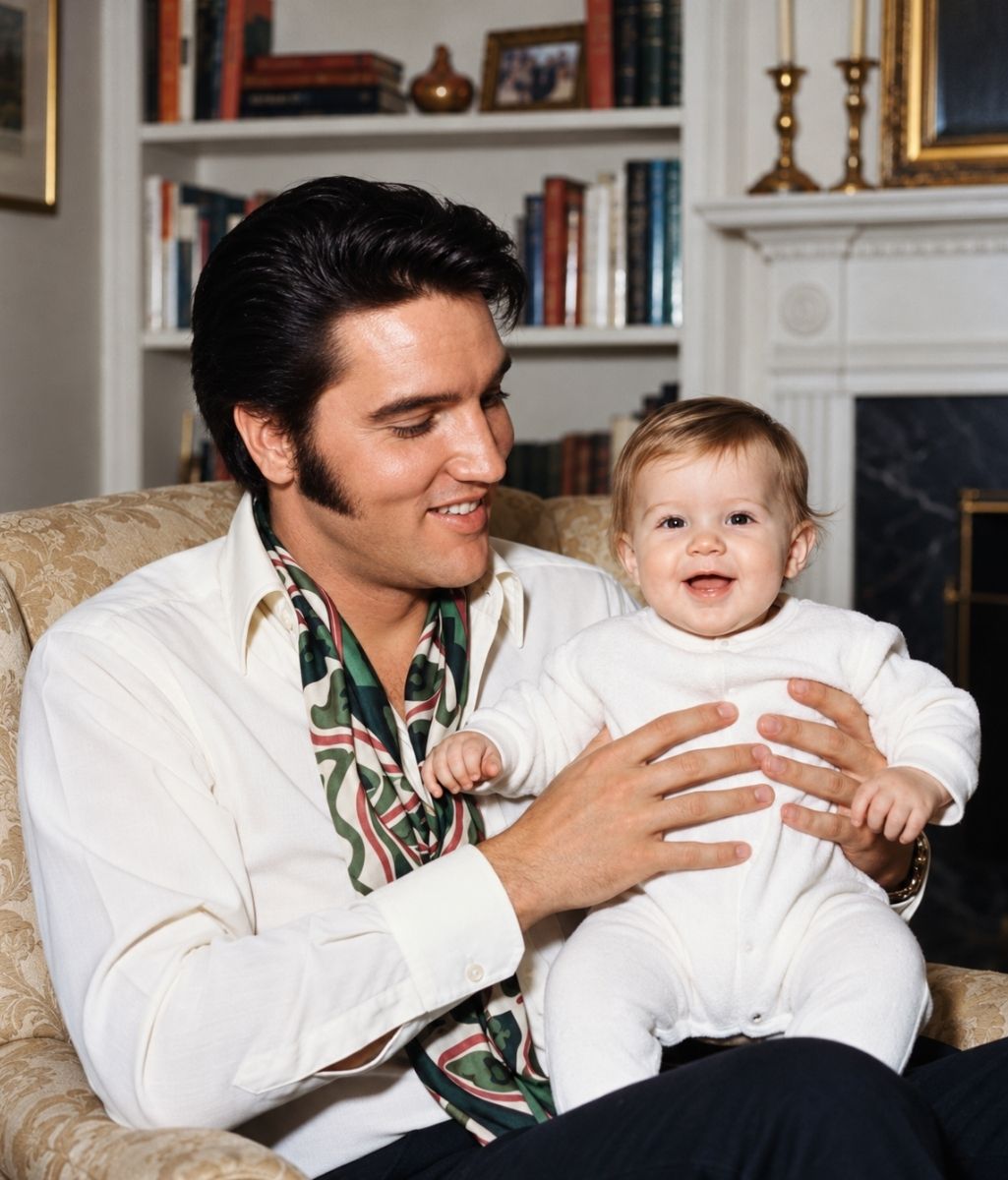
At 21, Elvis Presley was standing at the edge of everything he had ever dreamed about. “Heartbreak Hotel” was becoming a sensation, television appearances were turning him into a national obsession, Hollywood was calling, and audiences were beginning to react to him with a level of excitement that American popular music had rarely seen before. Yet photographs from that remarkable year capture something fame would soon make almost impossible for Elvis to recover: the ability to still look like an ordinary young man living an ordinary life between performances.
The year was 1956, and Elvis’s world was changing almost faster than he could understand it. Graceland’s official history describes the 21-year-old as beginning the year as an up-and-coming singer and ending it as the King of Rock ’n’ Roll and a movie star. During those twelve months, he recorded songs including “Heartbreak Hotel,” “Hound Dog,” “Don’t Be Cruel,” and “Blue Suede Shoes,” appeared repeatedly on national television, toured relentlessly, and made his first movie, Love Me Tender.
But before the gates, security teams, and permanent crowds became unavoidable, Elvis still had moments when the world around him felt surprisingly normal. Photographer Alfred Wertheimer was given unusually open access to Elvis in 1956 and captured him backstage, traveling, reading fan mail, eating, waiting for trains, and moving through everyday spaces without the carefully controlled image that would later surround him. The official Graceland store describes those photographs as spontaneous, unguarded moments taken just as Elvis’s career was exploding.
Those images are powerful today because we already know what came next.
In March 1956, Elvis used his rapidly growing earnings to purchase a house at 1034 Audubon Drive in Memphis for himself and his parents, Vernon and Gladys. It was the first home the Presleys owned in Memphis, and at first it did not even have a fence. Elvis was famous enough to buy his family the kind of home they had never been able to afford, but not yet famous enough to understand how quickly that home would stop feeling private.
As Elvis became more popular, the situation changed.
Fans discovered where he lived. Crowds gathered outside. The family eventually added a fence as Elvis’s fame made ordinary privacy increasingly difficult. Within a remarkably short period, the young man who had wanted success badly enough to work for years toward it was learning that success came with a price nobody could fully explain beforehand.
At 21, Elvis could still sometimes move through the world as Elvis Presley rather than Elvis Presley, the King.
That distinction would become increasingly difficult to preserve.
His appearance on The Milton Berle Show in June 1956 created national controversy because of his movements onstage. Critics attacked him, religious groups condemned him, and television suddenly magnified everything he did. Only a few months later, his appearance on The Ed Sullivan Show was watched by an enormous national audience, helping transform him from a successful young singer into a cultural phenomenon.
Fame gave Elvis things his family had never known.
Money gave them security.
Success allowed him to buy homes, cars, clothes, and gifts for the people he loved.
But there were things money could not replace once they disappeared.
One of them was anonymity.
Another was time.
And perhaps the most painful was the simple family life Elvis still possessed at 21.
Elvis was extremely close to his mother, Gladys Presley. His rise from poverty was deeply connected to his desire to provide for his parents, and buying the Audubon Drive house was one of the clearest early examples of that. For a brief period, Elvis could experience enormous professional success and still return to a home where he was simply Gladys and Vernon’s son.
That period did not last.
By 1957, Elvis had purchased Graceland, partly because his growing fame required considerably more privacy and security than the Audubon Drive home could provide. The boy who once lived with his parents in small apartments had become wealthy enough to buy one of America’s most famous homes, but the scale of the property also reflected how much his life had changed.
Then, in 1958, something happened that no success could repair.
While Elvis was serving in the U.S. Army, Gladys became seriously ill and died in August at only 46. Elvis was devastated by the loss of the woman who had been at the emotional center of his life from the beginning. Biography’s account of his Army years describes her death as one of the events that fundamentally changed him during his early twenties.
That makes the photographs of Elvis at 21 especially difficult to look at without hindsight.
He did not know how quickly everything was going to change.
He did not know that the crowds outside his house would soon become a permanent part of life.
He did not know that being able to walk through a train station or sit quietly in a public place would eventually become almost impossible.
And he certainly did not know that he had only a little more than two years left with his mother.
At 21, Elvis was becoming richer, more famous, and more powerful with every passing month.
But he still possessed something the older Elvis could never purchase again.
He still had a piece of ordinary life.
He still had moments when the world had not completely claimed him.
Most importantly, he could still go home and find Gladys there.
Fame would give Elvis Presley almost everything a young singer could imagine.
What it could never give him back was the life he had before the whole world knew his name.
Video
https://www.youtube.com/watch?v=0p_pSFu9KI4