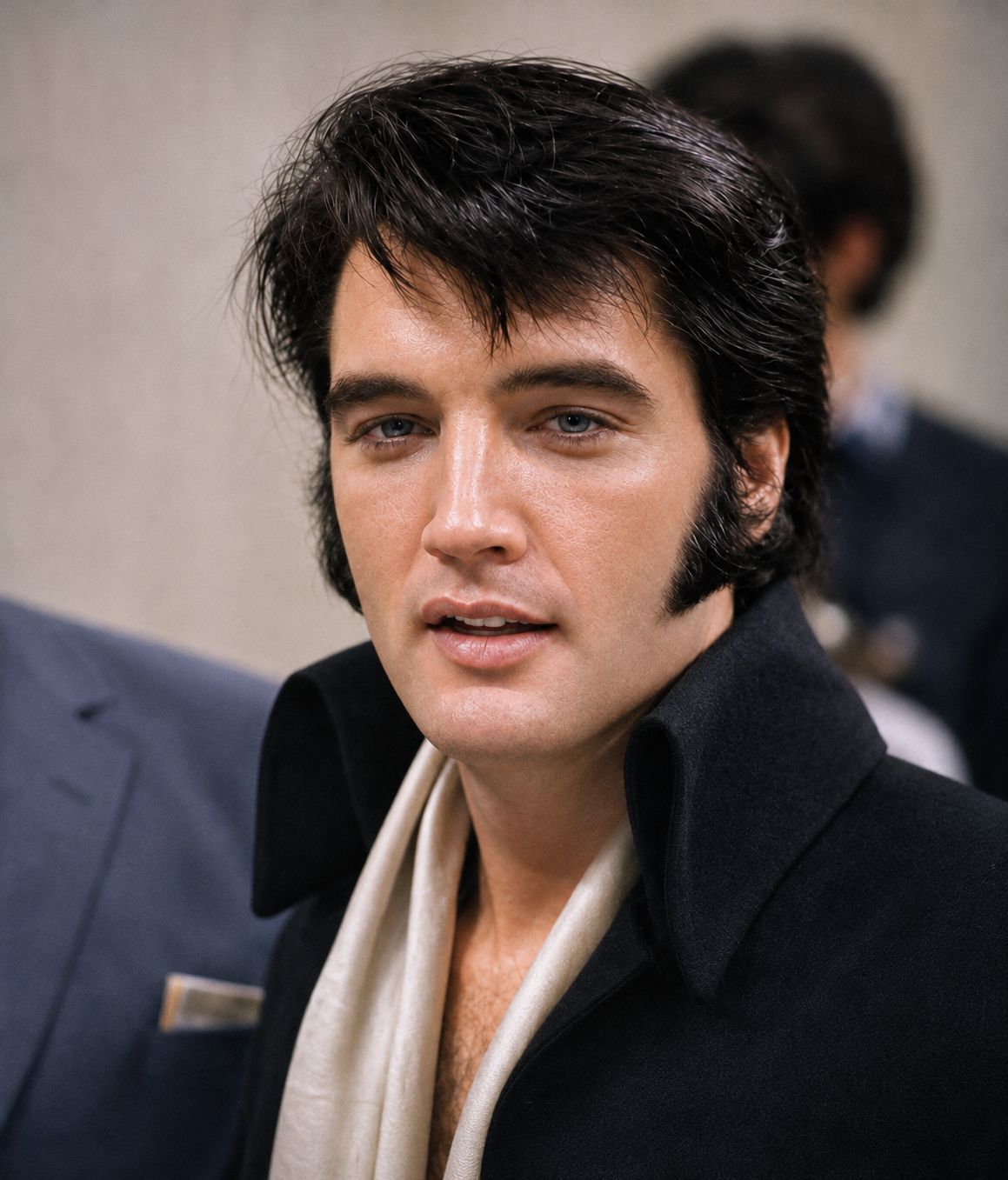
By 1969, Elvis Presley had already experienced a life that seemed almost impossible. He had gone from a poor childhood in Tupelo, Mississippi, to becoming one of the most famous entertainers in the world. Millions knew the smile, the unmistakable voice and the electrifying performances, but behind the image of the King of Rock and Roll was someone who understood what it meant to grow up without much money.
That background gave “In the Ghetto” a weight that few songs in Elvis’ catalog carried in quite the same way.
Written by Mac Davis, the song was recorded by Elvis in 1969 during his celebrated sessions at American Sound Studio in Memphis. Instead of romance, fame or youthful excitement, the story followed a child born into poverty in Chicago. From the beginning, the listener is shown a family already struggling to survive and a young boy entering a world in which hunger, desperation and limited opportunity seem to determine his future before he is old enough to choose it.
The story becomes darker as the boy grows.
Ignored by the society around him, he turns toward crime, and the cycle eventually ends in violence. Yet the song does not stop with his death. Another child is born into the same poverty, suggesting that nothing has truly changed. The tragedy is not simply what happens to one young man but the realization that another life may be beginning the same journey.
For Elvis, the subject may have carried an especially personal resonance.
Long before Graceland, gold records and sold-out shows, he had grown up in a family that knew financial hardship firsthand. Elvis was born in a small two-room house in Tupelo, and his parents, Vernon and Gladys Presley, struggled financially throughout much of his childhood. When the family eventually moved to Memphis, they lived for a period in public housing before Elvis’ music career began changing their circumstances.
He had escaped poverty, but he had not been born far removed from the people described in the song.
That connection helped reveal a different side of Elvis to listeners who primarily associated him with rock and roll spectacle. On “In the Ghetto,” there was little need for the swagger that had once shocked television audiences. His performance was restrained and compassionate, allowing the story itself to become the center of attention.
The result became one of the major recordings of his late-1960s comeback period. “In the Ghetto” reached No. 3 on the Billboard Hot 100, demonstrating that audiences were willing to hear Elvis tackle something far more serious than a conventional love song.
More than five decades later, its message has lost little of its emotional power.
The language belongs to another era, but the questions underneath it remain painfully recognizable. What happens to children who grow up without security? How much of a person’s future is shaped by circumstances they never chose? And how many lives pass unnoticed until tragedy finally forces others to pay attention?
Perhaps that is why “In the Ghetto” still feels different from many of Elvis’ biggest hits.
It reminds us that beneath the fame was a singer capable of stepping away from his own legend and giving his voice to a story about someone the world might otherwise ignore. Elvis could entertain millions, but on this recording, he did something quieter: he asked them to notice.
Great music can make us dance, remember and fall in love, but sometimes its greatest gift is making us look at another person’s struggle with more compassion. More than fifty years later, “In the Ghetto” is still asking us to do exactly that.