Some songs belong to a particular year, a particular generation, or a particular moment in someone’s life. “Can’t Help Falling in Love” somehow escaped all three. More than six decades after Elvis Presley first recorded it, the song still appears at weddings, anniversaries, family gatherings and quiet moments when people want to say something about love that ordinary words cannot quite express.
Elvis recorded the song for the 1961 film Blue Hawaii, and from the beginning it sounded different from many of the energetic records that had made him famous. There was no need for a dramatic vocal performance or a driving rock-and-roll arrangement. Instead, Elvis sang with remarkable restraint, allowing the melody and the simple confession at the center of the song to carry the emotion.
That simplicity became its greatest strength.
The song was written by Hugo Peretti, Luigi Creatore and George David Weiss, with a melody adapted from the French song “Plaisir d’amour.” The words describe something almost everyone understands: the feeling of knowing that love may be risky, complicated or impossible to control, yet being unable to stop yourself from falling anyway.
Elvis did not sing it like a man trying to impress anyone.
He sang it almost like a promise.
That difference matters because the public image of Elvis was often built around excitement. He was the young man whose movement caused controversy, whose voice shook early rock and roll, and whose concerts could turn ordinary audiences into screaming crowds. Yet on “Can’t Help Falling in Love,” there is very little of that danger or swagger.
The voice is softer.
The emotion feels closer.
For many listeners, that is exactly why the song became one of the most personal recordings of his career.
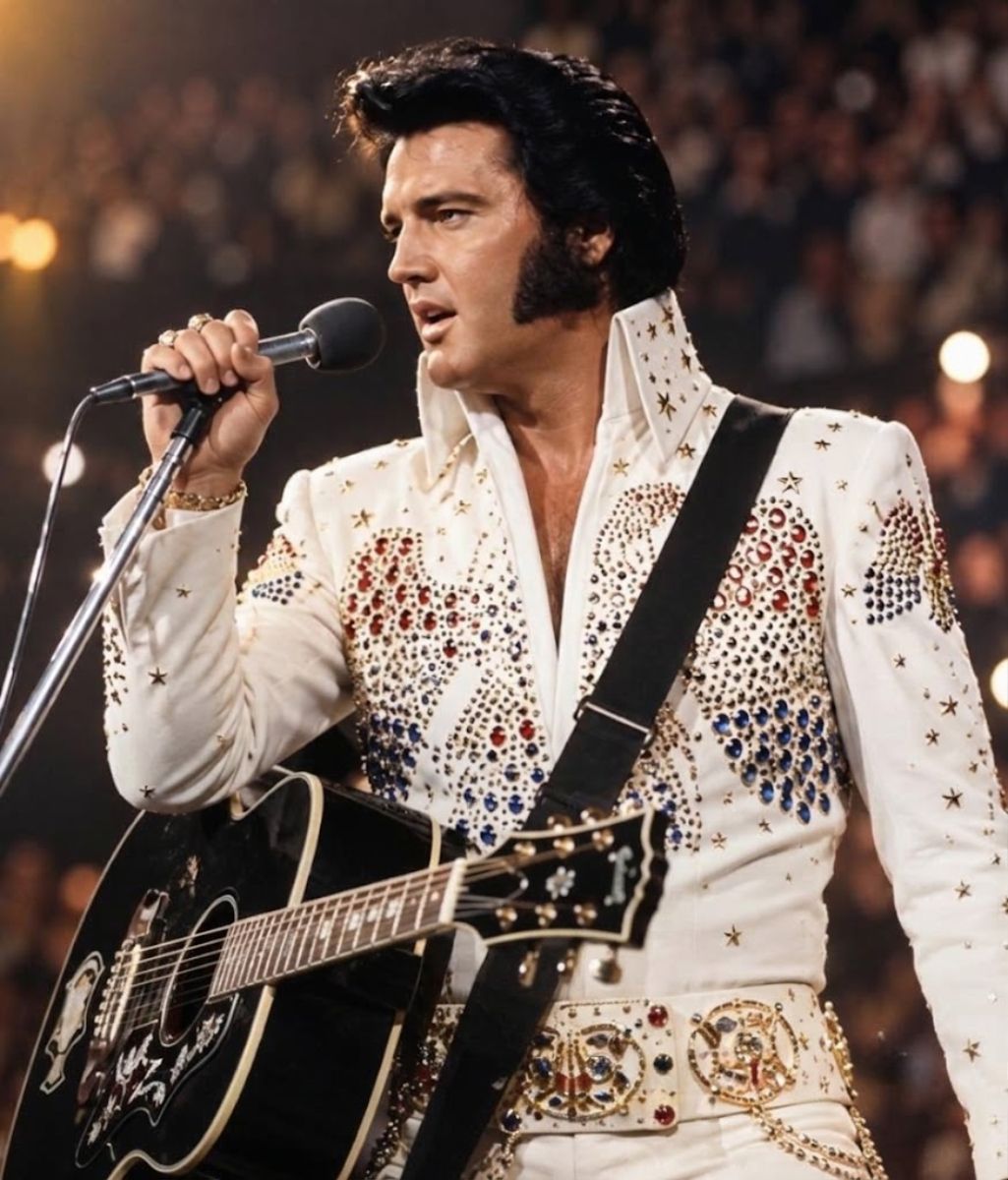
It also took on a second life through Elvis’s live performances. During the later years of his career, “Can’t Help Falling in Love” often became the closing song of his concerts. Fans knew that when the opening notes began, the evening was nearing its end. Elvis would sing the familiar lines, say goodbye, and leave the stage while the audience was still holding onto the final moments of the performance.
Over time, that association changed the emotional meaning of the song.
It was no longer only about falling in love.
It became a farewell.
For fans who saw Elvis perform in Las Vegas or on tour, those final notes could mean the lights were about to come up and the King was about to disappear behind the curtain. After his death in 1977, the same recordings began carrying another layer of sadness because audiences knew there would never be another encore.
Yet the song never became only tragic.
That may be the reason it has survived so beautifully.
People continue choosing “Can’t Help Falling in Love” for the happiest moments of their lives because Elvis gave the song an emotional openness that still feels honest. It can sound like the beginning of a romance, the memory of one, or the promise of staying with someone after many years have passed.
For some fans, hearing it brings back a first dance.
For others, it brings back a wedding, a long drive, or someone who once sat beside them while Elvis played on the radio.
And for countless listeners, it simply brings back Elvis.
More than sixty years later, “Can’t Help Falling in Love” still sounds like the kind of song that finds you exactly where you are. Elvis may have recorded it in 1961, but the feeling inside it never belonged to just one generation.