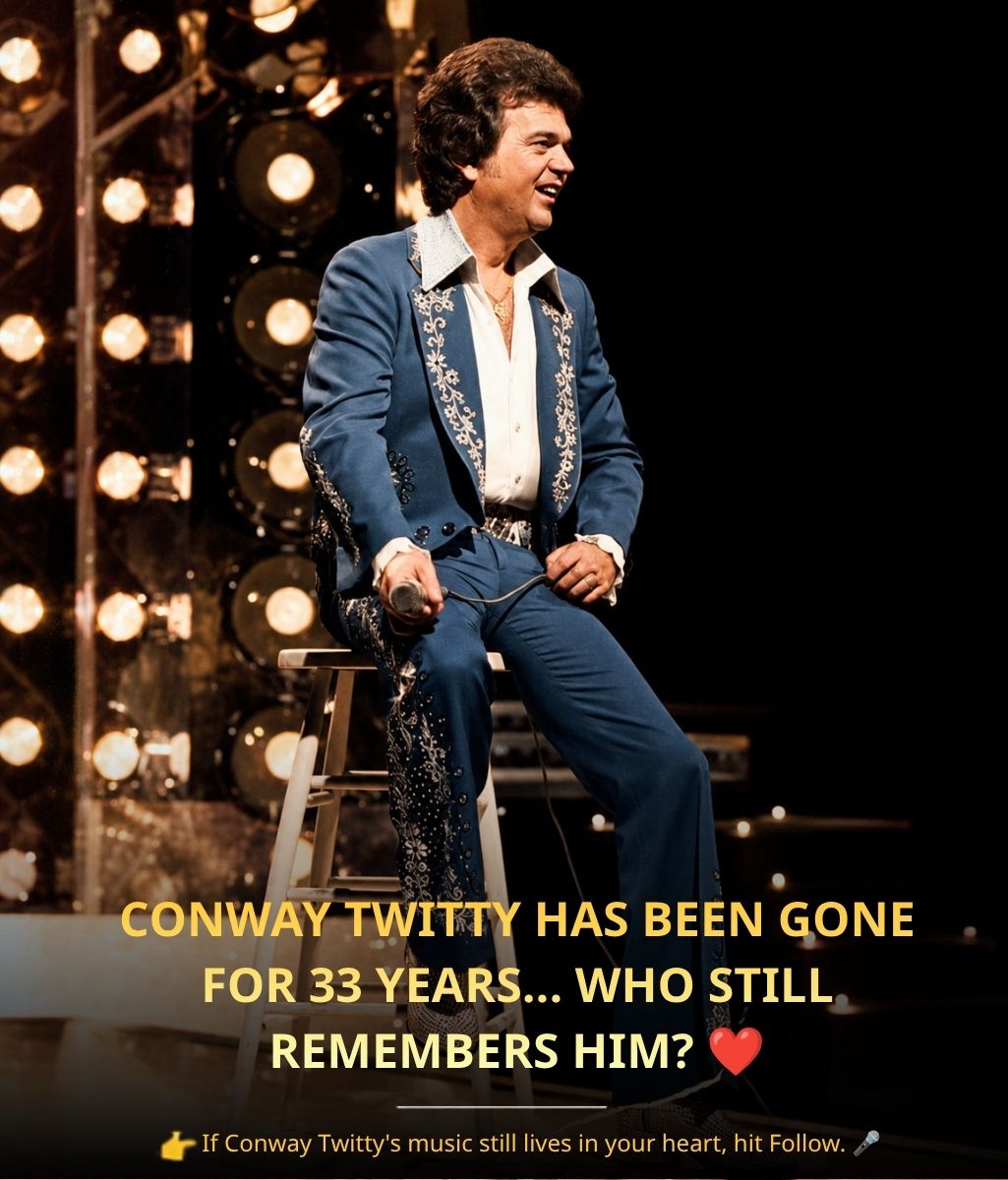
By 1969, Conway Twitty was proving that his move into country music was far more than a temporary change of direction. His unmistakable voice was finding a new home with country audiences, but “To See My Angel Cry” carried something that made it especially personal: Conway wasn’t simply interpreting a song handed to him by someone else. He helped write it, sharing songwriting credit with L. E. White, and the recording would become another important No. 1 during the period when Conway was establishing himself as one of country music’s most powerful new voices.
The song arrived at a fascinating point in Conway’s career. A decade earlier, he had been known to millions through the rock-and-roll success of “It’s Only Make Believe,” but Conway had long wanted to build a serious career in country music. By the late 1960s, that transformation was becoming impossible to ignore. Songs such as “Next in Line” had already demonstrated that country audiences were ready to accept him, and “To See My Angel Cry” gave listeners another reason to believe Conway had found exactly where he belonged.
What makes “To See My Angel Cry” so effective is that the emotion isn’t complicated or hidden behind an elaborate story. The narrator is forced to confront the pain his own actions have caused someone he deeply cares about, and seeing that hurt becomes almost unbearable. Rather than presenting himself as an innocent victim of heartbreak, he recognizes his own role in creating the situation. That sense of regret gives Conway exactly the kind of emotional territory in which his voice could do its best work.
Conway rarely needed to overwhelm a song to make listeners feel something. His strength came from sounding as though the words mattered personally to the man singing them, and “To See My Angel Cry” is an early example of the intimate approach that would eventually become one of his trademarks. He lets the emotion emerge through his phrasing rather than forcing it into every line, creating the feeling that the listener is hearing someone admit something difficult rather than simply perform a polished country recording.
The fact that Conway helped write the song adds another interesting layer. Throughout his career, he became famous for interpreting songs written by many different writers, often making those compositions sound so natural that listeners could easily assume they belonged to him. With “To See My Angel Cry,” however, Conway was directly involved in shaping the song itself. That connection makes the recording especially interesting when looking back at the period when he was still defining what the Conway Twitty country sound would eventually become.
Country audiences responded strongly. Released in 1969, “To See My Angel Cry” climbed to No. 1 on Billboard’s Hot Country Singles chart, where it spent a week at the top. More importantly, it became part of a remarkable run that demonstrated Conway’s success in country music was no accident. The former rock-and-roll star was rapidly becoming something very different: an artist capable of building a long career around emotionally direct country songs that sounded almost conversational in his hands.
That achievement becomes even more significant when viewed alongside what was about to happen next. Conway was approaching the period that would produce many of the recordings most closely associated with his name. In 1970, only a short time after “To See My Angel Cry,” he released “Hello Darlin’,” the song whose spoken opening would eventually become one of the most recognizable introductions in country music. The emotional restraint heard on the earlier record already points toward the style that would make “Hello Darlin’” so unforgettable.
There is also something revealing about the kind of narrator Conway chose to inhabit in “To See My Angel Cry.” Country music has always been filled with songs about being wronged, abandoned, or left behind, but this song asks the singer to acknowledge the damage he has helped create. Conway’s delivery never needs to turn that realization into melodrama. Instead, the regret feels quiet and personal, which may be one reason the recording still sounds convincing more than five decades after it first reached country radio.
For longtime listeners, songs from this period also capture a Conway Twitty who was still building the enormous country legacy people now tend to view as inevitable. Today, knowing how many hits, awards, famous duets, and decades of success followed, it is easy to forget there was once a time when Conway still had to prove that leaving his earlier musical identity behind was the right decision. “To See My Angel Cry” belongs to that crucial chapter, when each successful record was strengthening the argument that Conway Twitty had not merely entered country music — he was becoming one of its defining voices.
The recording also demonstrates why chart statistics tell only part of the story. Reaching No. 1 established “To See My Angel Cry” as a major commercial success, but its lasting value lies in how clearly it captures qualities that would define Conway for years afterward. There is the controlled delivery, the emotional vulnerability, the conversational phrasing, and above all the ability to make a listener believe the situation inside the song matters to the person singing it.
More than half a century later, “To See My Angel Cry” may not always be the first title casual listeners mention when Conway Twitty’s name comes up. Songs such as “Hello Darlin’,” “It’s Only Make Believe,” and his famous recordings with Loretta Lynn often receive more immediate recognition. Yet returning to this 1969 recording reveals something important: many of the qualities that would make Conway a country legend were already firmly in place before some of his most famous chapters had even begun.
Perhaps that is what makes “To See My Angel Cry” worth rediscovering today. It isn’t simply another old No. 1 from an artist who eventually accumulated many of them. It captures Conway Twitty at a pivotal moment, helping write and then delivering a song filled with regret just as his country career was moving toward an extraordinary new level. Before “Hello Darlin’” became his calling card and before his legendary partnership with Loretta Lynn reached its greatest heights, “To See My Angel Cry” was already showing country fans exactly what Conway Twitty could do when a song gave him something deeply human to say.